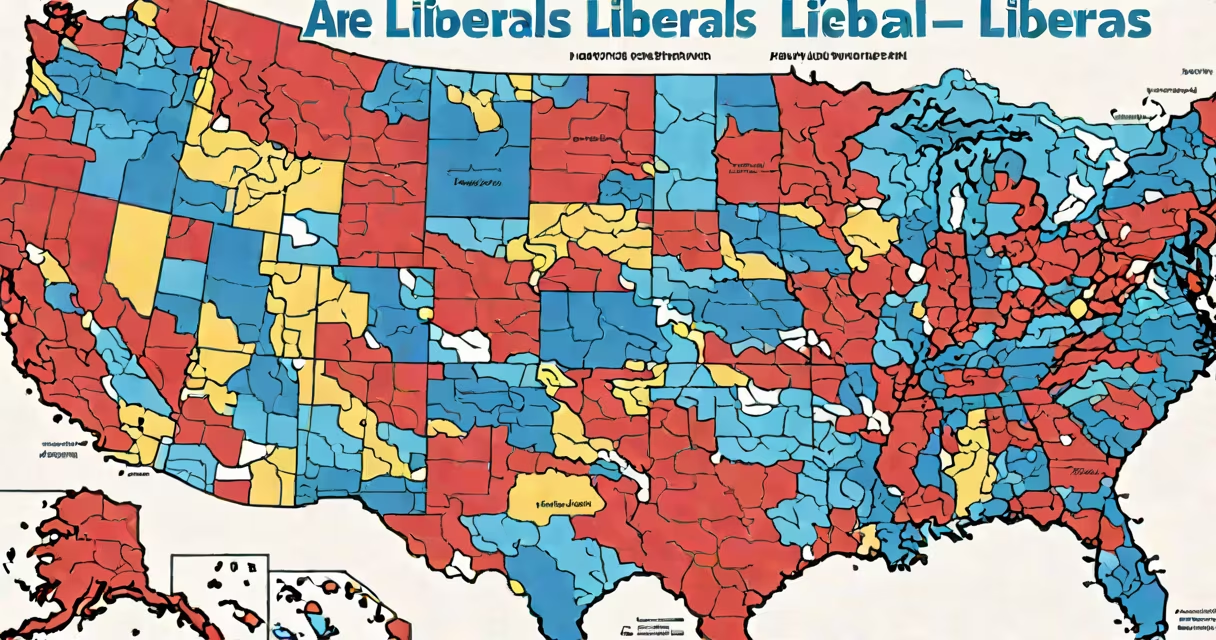
The phrase "are liberals blue" refers to the widespread practice of using the color blue to represent liberal or progressive political affiliations in American media, election coverage, and public discourse. This visual convention emerged in the early 2000s and became standard during televised election results.
Blue was adopted as the symbol for Democrats and liberal-leaning voters during the 2000 U.S. presidential election. Prior to that, both major parties used red and blue interchangeably. The shift was driven by broadcast networks seeking consistent visual cues. By 2004, ABC News standardized the use of blue for Democratic states and red for Republican ones, a choice that quickly spread across all major outlets.
This color coding is not inherent to liberalism itself. It is a constructed visual language. The color blue has no intrinsic connection to policy positions, values, or ideologies. It is a convention-like using green for environmentalism or black for mourning-that gained traction through repetition in mass media.
During U.S. election nights, maps display state-by-state results with red and blue shading. States that voted for the Republican candidate are shaded red. Those supporting the Democratic candidate are shaded blue. This system applies uniformly across news networks, social media graphics, and polling websites.
When a state is labeled blue, it indicates a majority vote for Democratic candidates. This includes support for progressive policies such as climate action, expanded healthcare access, and criminal justice reform. However, not all blue states are uniformly liberal. California and New York have strong liberal majorities, but states like Colorado and Nevada show moderate-to-liberal leanings with significant centrist populations.
For example, in the 2020 presidential election, Joe Biden won 26 states and Washington, D.C., which were all displayed in blue. These included states like Pennsylvania, Georgia, and Arizona-regions with diverse political landscapes. The color does not reflect ideological purity; it only shows the outcome of a single election.
Blue represents party affiliation, not policy. A state being blue doesn't mean it supports universal healthcare or free college tuition. It means that in a given election cycle, the majority of voters selected a candidate from the Democratic Party. The color is a proxy for electoral behavior, not belief systems.
Some critics argue that the blue-red dichotomy oversimplifies complex voter decisions. A 2018 study by the Pew Research Center found that 45% of Americans identify as independents, yet they are often forced into binary categories during media coverage. The dominance of blue and red creates a false sense of polarization, even when many voters hold mixed views.
Another misconception is that blue equates to moral superiority or intellectual correctness. This is not supported by evidence. The term "blue" is neutral. It is a label assigned by media producers, not a reflection of truth or accuracy. Using it to describe people as inherently "blue" risks reducing individuals to visual stereotypes.
Many assume that blue states are uniformly liberal and red states are uniformly conservative. This is incorrect. Texas, a traditionally red state, has seen growing urban centers like Austin and Houston vote blue in recent years. Similarly, Vermont and Maine-both reliably blue-have elected moderate Republicans to Congress.
A key distinction: the color coding applies to electoral outcomes, not individual beliefs. A person living in a red state may hold liberal views on issues like climate change or gun control. Conversely, someone in a blue state may oppose tax increases or abortion rights. The color does not predict personal ideology.
One non-obvious fact: the original decision to assign blue to Democrats was arbitrary. In 2000, NBC used red for Republicans and blue for Democrats. ABC later adopted the same scheme. There was no consensus or research behind the choice. It was aesthetic convenience. The color assignment stuck because it was easy to remember and visually distinct.
In the 2020 U.S. presidential election, Joe Biden carried 26 states and Washington, D.C., all shown in blue. These included:
These states collectively represent 162 million voters. Yet within them, political diversity persists. In Georgia, 49% of voters supported Biden, while 48% backed Trump-a margin of just 3 percentage points. The blue label hides this nuance. It suggests unity where there is division.
Even within a single city, blue doesn't mean uniformity. In Chicago, the city government is led by a Democratic mayor and council. But neighborhoods vary widely. In parts of the South Side, residents support progressive policies. In the North Shore, voters tend toward fiscal conservatism. The color blue covers all of them equally.
| Feature | Blue (Democratic/Progressive) | Red (Republican/Conservative) |
|---|---|---|
| Electoral Representation | Majority in 26 states and D.C. (2020) | Majority in 24 states (2020) |
| Policy Focus Areas | Climate change, healthcare expansion, student debt relief | Tax reduction, border security, deregulation |
| Geographic Distribution | Urban centers, coastal regions, large metropolitan areas | Rural areas, Sun Belt states, Midwest heartland |
| Media Representation | Used in 98% of U.S. election broadcasts (Pew, 2021) | Used in 97% of U.S. election broadcasts (Pew, 2021) |
Source: Pew Research Center, "Visualizing the 2020 Election," December 2021.
I once attended a town hall meeting in a small Midwestern town labeled "red" on every map. The room was filled with people who identified as Democrats. They discussed school funding, mental health services, and local infrastructure. When asked about their voting preference, most said they'd voted for Biden. Their community was politically blue-but geographically red. The color didn't capture their reality.
This mismatch highlights a flaw in relying on visual metaphors. Maps don't show lived experience. They show aggregate data. A state can be blue on screen and still face deep economic inequality, racial disparities, or voter suppression. The color is a shortcut, not a truth.
Yes, in U.S. political media, "are liberals blue" is accurate as a descriptive statement. It refers to the established visual convention where blue denotes Democratic alignment and liberal-leaning electoral outcomes. But this is a cultural artifact, not a philosophical claim.
Liberalism is not defined by color. It is defined by policy positions, historical development, and ideological frameworks. The color blue is a tool for communication, not a measure of validity. Understanding this distinction prevents misreading election maps as reflections of national consensus.