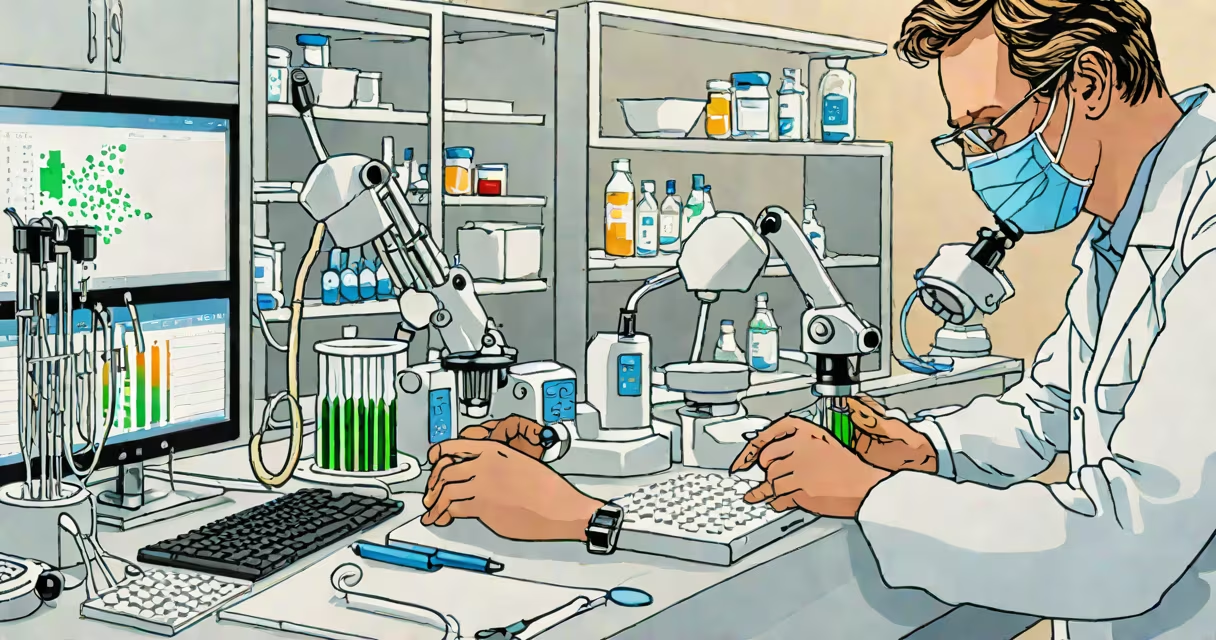
Bionano Genomics Inc is a life sciences company that develops optical genome mapping technology to detect large-scale structural variations in human DNA. Its platform visualizes entire chromosomes at high resolution, enabling researchers and clinicians to identify deletions, duplications, inversions, and translocations that standard sequencing methods often miss.
The company's core technology uses fluorescently labeled DNA molecules stretched across nanochannels. When imaged under a microscope, these labeled patterns form unique barcodes that represent the genome's architecture. This method detects structural variants larger than 1 kilobase, including those associated with cancer, developmental disorders, and rare genetic diseases.
Bionano Genomics Inc operates in the precision medicine and clinical diagnostics space. It partners with academic institutions, pharmaceutical companies, and reference laboratories to validate findings and integrate its tools into research workflows. The company's flagship product, the Saphyr system, processes samples in under 24 hours and supports whole-genome analysis without amplification bias.
Traditional short-read sequencing technologies break DNA into fragments less than 300 base pairs long. While effective for detecting single nucleotide changes, they struggle with complex regions such as repetitive sequences, centromeres, and telomeres. These areas often harbor structural variants that contribute to disease but remain invisible to standard methods.
Bionano Genomics Inc solves this gap by analyzing intact, ultra-long DNA molecules. A sample is extracted from a patient's blood or tissue and labeled with sequence-specific enzymes called nickases. These enzymes cut DNA at specific recognition sites, which are then tagged with fluorescent dyes. The labeled DNA is loaded into nanofluidic channels where it stretches and aligns.
An automated imaging system captures high-resolution images of the labeled DNA strands. Software algorithms compare the resulting barcode patterns against a reference genome. Deviations indicate structural changes. For example, a missing label pattern may signal a deletion, while an inverted sequence suggests a chromosomal inversion.
Clinical genetics labs use Bionano Genomics Inc's platform to diagnose patients with unexplained developmental delays or neurodevelopmental conditions. In one study published in Nature Genetics, researchers applied optical mapping to 150 undiagnosed pediatric cases. They identified pathogenic structural variants in 12% of patients who had previously received negative results from exome sequencing.
In oncology, the technology detects tumor-specific rearrangements. A 2022 study at the University of California, San Diego, used Bionano's system to analyze circulating tumor DNA from breast cancer patients. The team detected complex rearrangements in 38% of samples that were missed by new sequencing alone.
Pharmaceutical developers use the platform during drug discovery. By identifying structural variants linked to drug response, companies can stratify patient populations for clinical trials. For instance, a Phase II trial for a targeted therapy in glioblastoma used Bionano's data to exclude patients with certain chromosomal rearrangements, improving treatment efficacy and reducing adverse events.
Bionano Genomics Inc's optical mapping identifies several classes of structural variation:
| Type | Definition | Example |
|---|---|---|
| Deletion | Loss of DNA segment | 22q11.2 deletion syndrome |
| Duplication | Extra copy of a region | Charcot-Marie-Tooth disease type 1A |
| Inversion | Reversed orientation of a segment | Causes hereditary neuropathy with liability to pressure palsies |
| Translocation | Transfer of DNA between chromosomes | Philadelphia chromosome in chronic myeloid leukemia |
These variants often span thousands to millions of base pairs. Because they affect gene regulation, splicing, or protein function, they can lead to severe phenotypes even when coding regions appear normal.
Many assume optical genome mapping replaces whole-exome or whole-genome sequencing. That is incorrect. Bionano Genomics Inc's technology complements existing methods rather than supersedes them. It excels at detecting large-scale structural changes but lacks the sensitivity to identify small mutations like point variants or insertions under 100 base pairs.
Another misconception is that the process requires high DNA input. In reality, the Saphyr system can work with as little as 100 ng of high-molecular-weight DNA. This allows analysis of low-input samples such as cell-free DNA from liquid biopsies or degraded archival specimens.
A key distinction lies in the absence of PCR amplification. Unlike sequencing-based approaches, optical mapping does not amplify DNA, eliminating amplification artifacts and coverage biases. This ensures accurate representation of the original genome structure.
I observed a Bionano Genomics Inc workflow during a visit to a clinical genomics lab in Boston. A technician prepared a sample from a child with autism spectrum disorder and developmental delay. After labeling and imaging, the software flagged a 1.2 Mb deletion on chromosome 16. This finding was confirmed via FISH testing and led to a diagnosis of 16p11.2 deletion syndrome. The family received targeted interventions within six weeks.
This case illustrates how Bionano Genomics Inc's tools resolve diagnostic odysseys. In a 2023 report by the American College of Medical Genetics and Genomics, 40% of patients with undiagnosed neurodevelopmental disorders were eventually diagnosed using optical mapping, compared to 22% with exome sequencing alone.
Optical genome mapping differs from other genomic analysis techniques:
| Technology | Resolution | Best For | Limitations |
|---|---|---|---|
| Bionano Genomics Inc (optical mapping) | 1 kb-1 Mb | Large structural variants, repetitive regions | Does not detect single-base changes |
| Short-read sequencing | 1-100 bp | Point mutations, small indels | Fails in repetitive regions |
| Long-read sequencing (PacBio, Oxford Nanopore) | 100 bp-100 kb | Complex variants, methylation detection | Higher error rate, costlier |
Combining Bionano Genomics Inc's data with long-read sequencing improves variant detection accuracy. A 2023 multi-center study showed that integrating both methods increased the identification of clinically relevant structural variants by 29% compared to either method alone.
Bionano Genomics Inc holds FDA clearance for its Saphyr system in the United States under the 510(k) pathway. The device is approved for use in diagnosing constitutional genetic disorders and somatic alterations in cancer. It is also CE-marked for distribution in Europe.
The company reported $47 million in revenue for fiscal year 2023, with 65% coming from international markets. Its customer base includes over 150 hospitals, research centers, and pharmaceutical firms globally. Major clients include Mayo Clinic, Stanford Health Care, and Roche Diagnostics.
Despite growth, Bionano Genomics Inc faces competition from emerging platforms such as 10x Genomics' Linked-Reads and Illumina's Hi-C. However, its focus on high-molecular-weight DNA and direct visualization gives it a niche advantage in resolving complex genomic landscapes.
bionano genomics inc provides a critical tool for uncovering hidden genetic causes of disease through optical genome mapping. By visualizing large-scale DNA structures, the company enables detection of structural variants that evade conventional sequencing. Its technology is especially valuable in diagnosing rare disorders, guiding cancer treatment, and advancing personalized medicine. As genomic medicine evolves, bionano genomics inc remains central to understanding the full complexity of the human genome.