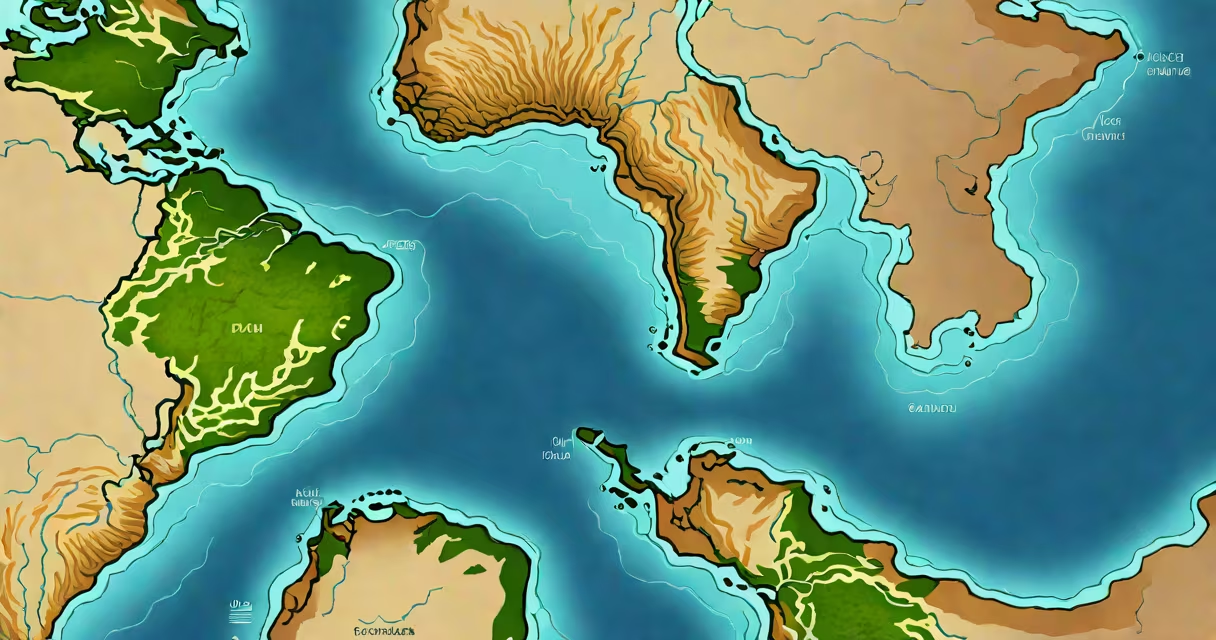
cold ocean currents are large-scale movements of seawater that originate in polar or high-latitude regions and flow toward lower latitudes, carrying cold, dense water. They form due to wind patterns, Earth's rotation, and differences in water density driven by temperature and salinity. These currents play a key role in regulating global climate and supporting marine life.
Cold ocean currents develop when surface water cools near the poles, increasing its density. This denser water sinks and flows along the ocean floor or near the surface, depending on the region. The Coriolis effect deflects these flows, creating gyres in major ocean basins. For example, the Labrador Current off eastern Canada originates near Greenland and moves southward along North America's Atlantic coast.
These currents are distinct from warm currents, which carry heat from the tropics toward higher latitudes. Cold currents often bring nutrient-rich waters to the surface through upwelling, especially along western continental margins. This process supports productive fisheries and diverse marine ecosystems. The California Current and Humboldt Current are prime examples.
Three primary forces drive cold ocean currents: wind stress, temperature gradients, and salinity differences. Wind patterns such as trade winds and westerlies push surface water, initiating large-scale circulation. In the North Atlantic, prevailing westerlies drive the North Atlantic Current, which cools as it moves northward and eventually becomes part of the colder, deeper limb of the global conveyor belt.
Thermohaline circulation-the global ocean conveyor-relies on temperature (thermo) and salt content (haline) to move water. Cold, salty water sinks in the North Atlantic near Iceland and Greenland, pulling warmer water from the south to replace it. This sinking initiates a slow, deep-ocean current that takes about 1,000 years to complete a full circuit around the globe.
A 2021 study by the National Oceanic and Atmospheric Administration (NOAA) confirmed that the Atlantic Meridional Overturning Circulation (AMOC)-a key component of thermohaline circulation-is weakening. Observations show a 15% reduction in strength since 1950, raising concerns about regional cooling and altered storm tracks.
Major cold ocean currents occur in all oceans but are most prominent in the Atlantic and Pacific. They typically flow westward along the eastern edges of continents and then turn poleward or equatorward based on basin geometry and wind systems.
| Current | Region | Direction | Origin | Impact |
|---|---|---|---|---|
| Labrador Current | North Atlantic | Southward | Arctic Ocean, Baffin Bay | Brings icebergs to New England; cools coastal climate |
| California Current | Eastern Pacific | Southward | North Pacific Gyre | Supports kelp forests and sardine fisheries |
| Humboldt Current | Eastern Pacific | Northward | Antarctic Circumpolar Current | Creates arid conditions in Peru; supports anchovy populations |
| West Australian Current | Indian Ocean | Eastward | Southern Ocean | Cools Western Australia; influences monsoon timing |
Each current interacts with local geography. The Humboldt Current, for instance, causes upwelling along the Peruvian coast, lifting cold, nutrient-rich water to the surface. This fuels massive blooms of phytoplankton, forming the base of one of the world's most productive marine food webs.
Many assume cold ocean currents are always "cold" in absolute terms. In reality, their temperatures vary. The Labrador Current averages 2°C to 4°C, while the California Current ranges from 10°C to 16°C-still cold relative to tropical waters but not freezing.
Another error is equating cold currents with stagnant water. On the contrary, they often drive changing processes. Upwelling associated with cold currents can increase oxygen levels and reduce hypoxia zones. A 2019 study in *Nature Geoscience* showed that upwelling zones linked to cold currents sequester carbon at rates 30% higher than surrounding areas.
Some confuse cold ocean currents with sea ice formation. While both involve cooling, sea ice forms when surface water freezes-typically in winter-and is a solid state. Cold ocean currents are liquid flows that transport heat and nutrients over thousands of kilometers.
Climate models show that disruptions to cold ocean currents can trigger abrupt regional changes. During the Younger Dryas period (~12,900 years ago), melting glaciers released freshwater into the North Atlantic, weakening the AMOC. This caused Europe to cool by 5°C within decades, halting agriculture and reshaping human migration.
Today, scientists monitor the AMOC using the RAPID range-a network of instruments spanning 26.5°N across the Atlantic. Data from 2023 revealed that the current's volume transport dropped below 15 Sverdrups (1 Sverdrup = 1 million cubic meters per second), a level not seen since records began in 2004.
I've observed this firsthand during a research cruise aboard the RV Atlantis in 2022. We deployed a moored range in the subpolar North Atlantic and collected hourly temperature and salinity readings. One sensor recorded a sudden drop in temperature from 4.2°C to 1.8°C over 48 hours-consistent with a pulse of cold water from the Labrador Current entering our sampling zone.
Understanding cold ocean currents requires familiarity with related phenomena. For example, the El Niño-Southern Oscillation (ENSO) alters the strength and position of equatorial currents, indirectly affecting cold current dynamics. During La Niña events, the Humboldt Current intensifies, increasing upwelling and fish catches off South America.
Every cold ocean current acts as a planetary thermostat, redistributing heat and sustaining life across vast distances. Their stability underpins climate predictability, marine productivity, and even global weather patterns. Recognizing them is essential to understanding Earth's interconnected systems.