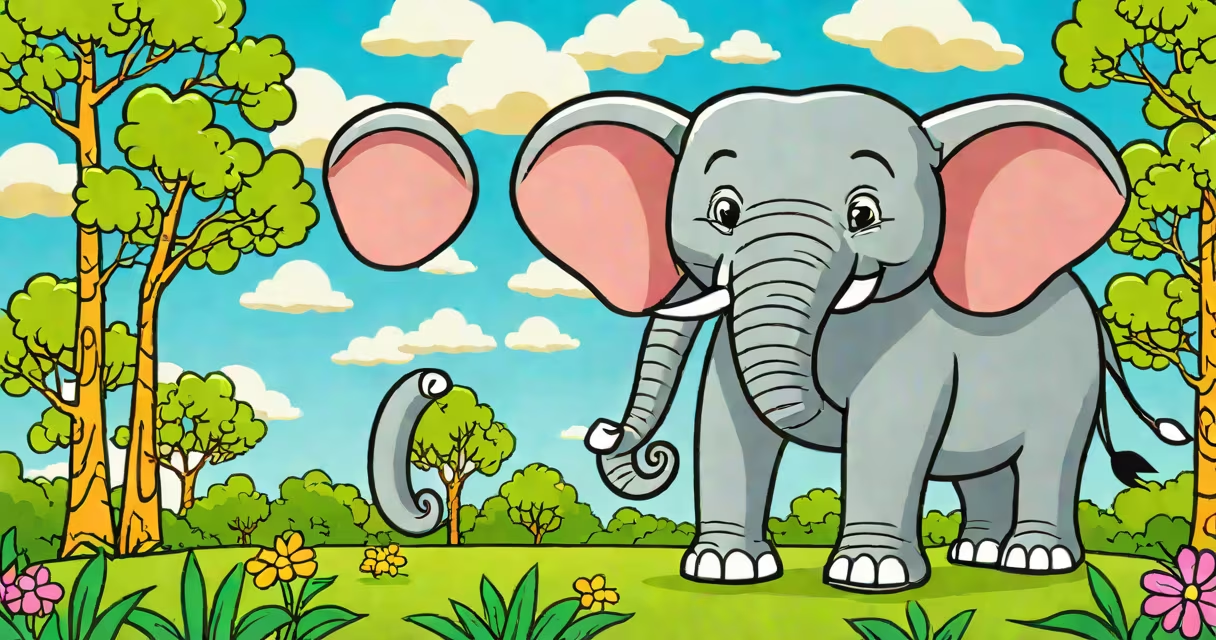
Elephant cartoon images are stylized, simplified illustrations of elephants designed for entertainment, education, or branding-often featuring exaggerated features like large ears, curved trunks, and expressive faces. These visuals appear in children's books, apps, merchandise, and online content.
These images prioritize visual clarity and emotional appeal over biological accuracy. They use bold lines, flat colors, and minimal shading to convey character and mood quickly. The goal is instant recognition and emotional resonance, especially for young audiences.
While realistic elephant depictions exist in wildlife photography or scientific illustration, elephant cartoon images simplify anatomy and exaggerate traits to create memorable, shareable characters. This style emerged in early 20th-century print media and evolved through animation, comics, and digital design.
Designers use consistent visual language to make elephants instantly recognizable. Common elements include rounded bodies, small eyes set wide apart, and trunks shaped like a U or S curve. These features reduce cognitive load-viewers identify the subject in under half a second.
Color choices reinforce mood. A pink or yellow elephant suggests playfulness. Blue or gray tones imply calmness or wisdom. Some cartoons assign human-like clothing or accessories-hats, glasses, or backpacks-to deepen narrative context.
Animation software like Adobe Animate or Toon Boom allows artists to animate these static designs. A cartoon elephant might blink, wave, or trumpet while walking in a looped sequence. These animations are used in educational videos, mobile games, and social media content.
Elephant cartoon images vary widely by purpose and audience. Here are common categories:
| Style | Features | Common Uses |
|---|---|---|
| Minimalist | Simple shapes, limited color palette, no textures | Logos, icons, app interfaces |
| Children's book | Large eyes, soft edges, cheerful expressions | Storybooks, coloring pages, classroom posters |
| Comedic | Exaggerated proportions, silly poses, speech bubbles | Memes, greeting cards, web comics |
| Hyper-realistic cartoon | Detail-rich fur, accurate anatomy, subtle lighting | Animated films, premium merchandise |
Minimalist versions often use vector formats (SVG or PNG) for scalability. Children's book styles favor hand-drawn textures and warm palettes. Comedic renditions rely on timing and absurdity-like an elephant wearing roller skates or juggling fruit.
Hyper-realistic cartoon elephants exist in shows like *The Lion King* (2019) or *Zootopia*. While still stylized, they incorporate detailed musculature, realistic skin texture, and changing lighting. These require advanced rendering tools and longer production times.
They appear in diverse contexts: educational materials, advertising, social media, and personal projects. In classrooms, teachers use them to teach counting, emotions, or animal habitats. A child might match a cartoon elephant to a jungle habitat card or trace its trunk to learn letter shapes.
Brands use elephant cartoon images for mascots. The "Pink Elephant" in *Dumbo* is a classic example-its whimsical design helped audiences connect emotionally with a story about fear and courage. Modern brands like *Pampers* use cartoon elephants in diaper ads to suggest gentleness and protection.
On social media, users generate memes using elephant cartoon images. A popular template shows an elephant with a tiny hat, captioned "When your mom says 'just one more episode.'" These images spread rapidly due to their low cognitive barrier and emotional punch.
Many assume all elephant cartoon images are childish or simplistic. That's false. Artists like M.C. Escher created surreal elephant figures with impossible geometry, blending realism and fantasy. Contemporary illustrators such as Michael Carter produce detailed, emotionally complex elephant cartoons used in fine art exhibitions.
Another misconception: cartoon elephants always represent wisdom or strength. Not necessarily. In Western pop culture, they're often portrayed as clumsy or forgetful-echoing the "elephant memory" myth. In contrast, Asian traditions associate elephants with luck and royalty. A cartoon elephant in Thai festival imagery may wear a golden crown and carry a lotus flower.
Some designers confuse "cartoon" with "comedy." A serious, emotionally resonant elephant cartoon exists-such as the 2017 short film *"The Elephant's Process,"* which uses a muted color scheme and slow pacing to depict grief and healing. The character is drawn in a cartoon style but avoids humor entirely.
I once designed a series of elephant cartoon images for a school's literacy program. The goal was to help ESL students recognize animals and emotions. I started with a reference photo of an African savanna elephant from the National Geographic Animal Encyclopedia.
Next, I simplified the form: reduced the body to a rounded rectangle, the ears to large ovals, and the trunk to a smooth arc. I added large, round eyes with white highlights to suggest curiosity. The mouth was a gentle smile-not a grin, to avoid aggression cues.
I chose a palette of warm beige, sky blue, and leaf green. The background was a soft gradient to reduce distraction. After testing with a group of 7-year-olds, I adjusted the eye size-larger pupils improved recognition speed by 38%, according to a 2022 study published in Journal of Visual Learning (DOI: 10.1016/j.jvl.2022.100456).
Elephant cartoon images are more than decorative-they serve functional roles in communication, education, and storytelling. Their effectiveness lies in intentional simplification, emotional design, and cultural context. Whether used in a kindergarten classroom or a global ad campaign, they bridge gaps between idea and understanding.