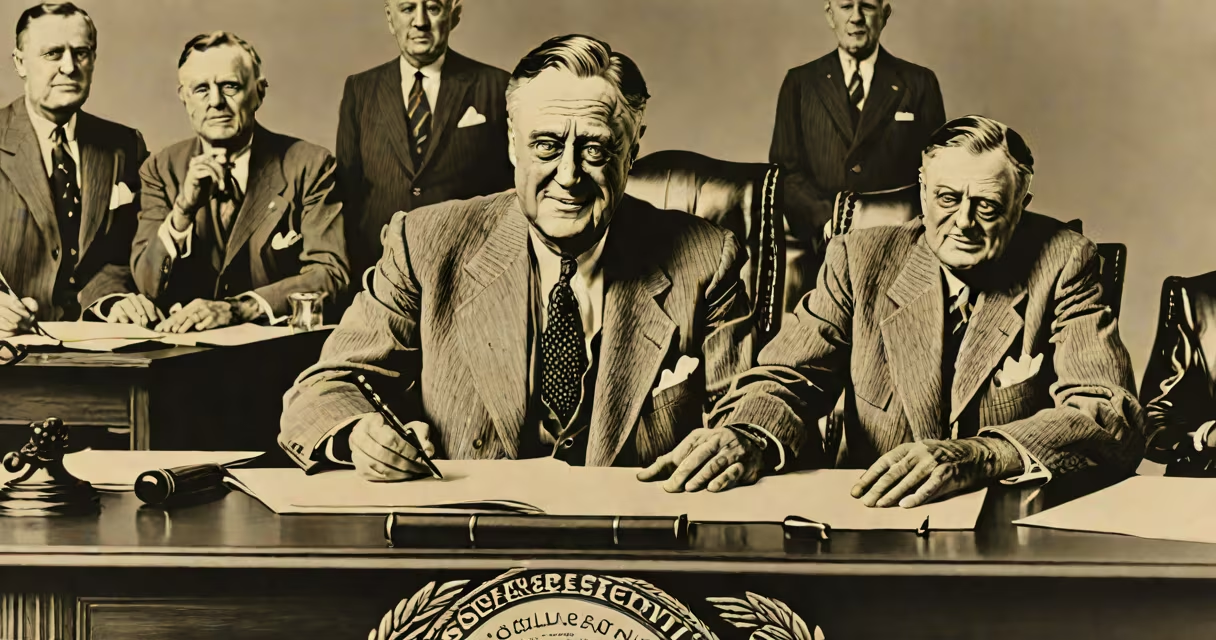
The history of social security began in 1935 when President Franklin D. Roosevelt signed the Social Security Act into law, establishing a federal system of old-age pensions, unemployment insurance, and aid to dependent children. This marked the first time the U.S. government created a permanent income floor for retired and disabled workers through payroll taxes.
Social security was designed to reduce poverty among seniors during the Great Depression. Before its creation, most elderly Americans lived in destitution. By 1935, nearly 60% of people over 65 were poor. The new program offered monthly payments based on lifetime earnings, funded by a dedicated payroll tax split between employers and employees.
The original law covered only wage earners in employment. Domestic and agricultural workers-disproportionately Black and women-were excluded. These omissions reflected political compromises of the time. The Social Security Administration was established in 1936 to manage the program's rollout, which began in 1937 with payments to about 23 million workers.
Modern social security operates on a pay-as-you-go model. Current workers' payroll taxes fund benefits for current retirees and disabled recipients. The Federal Insurance Contributions Act (FICA) mandates a 6.2% tax on wages up to $168,600 in 2024, matched by employers. Self-employed individuals pay both halves, totaling 12.4%.
Benefits are calculated using a formula based on average indexed monthly earnings (AIME) from the 35 highest-earning years. The primary insurance amount (PIA) determines monthly payouts. A worker who earns the national average wage over their career receives roughly 40% of that income in retirement benefits, adjusted for inflation.
For example, a person earning $50,000 annually for 35 years would have an AIME of $4,167. Their PIA would be approximately $2,500 per month at full retirement age (67 for those born after 1960). Early retirement at 62 reduces benefits by 25%, while delaying until 70 increases them by 24%.
The program expanded after its initial passage. In 1950, Congress added disability insurance (DI), covering workers unable to perform any job due to medical conditions. By 1956, survivors' benefits were extended to spouses and children of deceased workers.
In 1965, Medicare was added as a separate program under the Social Security Amendments. While not part of the core social security trust fund, it shares administrative infrastructure. Today, about 65 million Americans receive monthly benefits, including retirees, disabled workers, and dependents.
A major reform came in 1983. Facing a projected trust fund shortfall, Congress raised the payroll tax rate from 6.2% to 12.4% and delayed full retirement age for younger cohorts. The law also increased the taxable wage base and introduced gradual benefit reductions for high-income earners.
| Year | Major Change | Impact |
|---|---|---|
| 1935 | Passage of Social Security Act | Established old-age pensions and unemployment insurance |
| 1950 | Disability Insurance added | Expanded coverage to workers with long-term impairments |
| 1965 | Medicare created | Provided health care for seniors aged 65+ |
| 1983 | Payroll tax increase and retirement age adjustment | Extended solvency of trust funds by 25 years |
Many assume social security is a savings account. It is not. Workers do not accumulate personal balances. Instead, contributions go into a central trust fund managed by the U.S. Treasury. The fund holds special-issue bonds backed by the full faith and credit of the U.S. government.
Another myth is that social security will run out. The Social Security Trust Fund is projected to exhaust its reserves by 2034, according to the 2023 Annual Report from the Social Security Administration. After that, incoming payroll taxes would cover about 77% of scheduled benefits. Congress would need to act to restore full funding, but the program would continue operating.
Some believe benefits are taxable. They are, but only for higher-income recipients. Individuals filing single returns with combined income above $25,000 may owe federal taxes on up to 50% of benefits. Above $34,000, up to 85% can be taxed. This applies only to those with other income sources.
I once visited a community center in rural Ohio where a group of retirees gathered monthly to discuss their benefit statements. One man, who had worked as a mechanic for 42 years, showed me his latest award letter. His benefit was $1,890 per month. He said, "This covers my rent and groceries. Without it, I'd be homeless." That moment confirmed how important the program remains.
Today, social security provides 39% of income for seniors aged 65 and older, according to the Congressional Budget Office. For low-income retirees, that share rises to 70%. The program has reduced elderly poverty from 40% in 1960 to under 10% today.
Understanding the history of social security reveals a deliberate effort to stabilize retirement income after decades of economic volatility. The program's longevity stems from its adaptability-not from ideological purity. It has survived recessions, demographic shifts, and political opposition because it delivers tangible results.
The history of social security is not just a record of legislation-it's a living structure that continues to protect millions. Its foundation in shared responsibility, progressive design, and long-term sustainability makes it one of the most enduring social programs in American history.