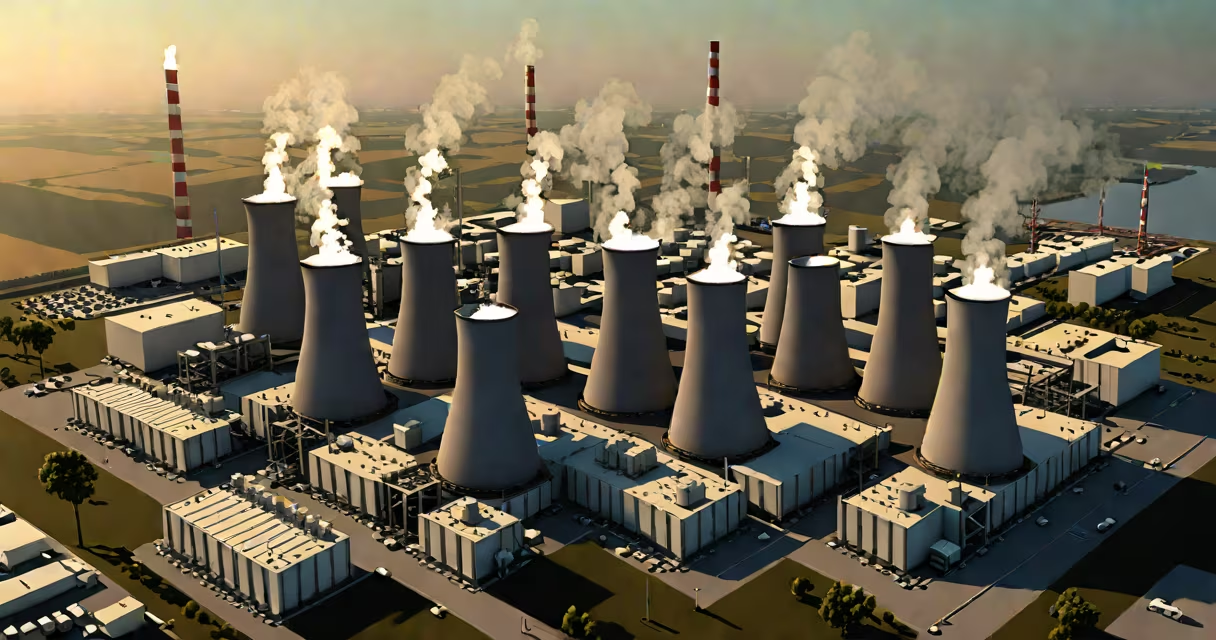
Electricity is produced from coal by burning the fuel in a boiler to create high-pressure steam, which drives a turbine connected to a generator. The spinning generator converts mechanical energy into electrical energy, which is then fed into the power grid. This process powers roughly 35% of U.S. electricity demand annually.
Coal is a fossil fuel formed over millions of years from compressed plant material. When burned, it releases stored chemical energy as heat. Power plants capture this heat to boil water, turning it into steam. The steam flows through a turbine, causing it to spin. The turbine is linked to a rotor inside a generator, which uses electromagnetic induction to produce electricity.
The U.S. Energy Information Administration (EIA) reports that in 2023, coal accounted for 16.5% of total U.S. energy consumption and 18% of electricity generation. Most coal plants operate as baseload providers-running continuously to meet steady demand. Modern plants use scrubbers to reduce sulfur dioxide emissions by up to 95%, and selective catalytic reduction systems to cut nitrogen oxides by 80%.
Coal arrives at the plant via rail or conveyor belt. It's crushed into fine powder and blown into a combustion chamber. High-temperature flames burn the coal at around 1,400°C (2,550°F), heating water in pipes lining the furnace walls. The heated water turns into steam at pressures exceeding 2,400 psi.
This superheated steam travels through large pipes to a turbine. The turbine consists of multiple stages of blades mounted on a central shaft. As steam expands through each stage, it pushes the blades, rotating the shaft at 3,000 RPM. The turbine's rotation drives the generator rotor, which spins within a magnetic field.
Inside the generator, copper windings rotate past stationary magnets. This motion induces an alternating current (AC) in the wires. The output voltage ranges from 11 kV to 25 kV, depending on the plant design. A step-up transformer increases the voltage to 138 kV or higher for efficient long-distance transmission.
Coal plants differ primarily in their steam cycle efficiency and environmental controls. The most common types are subcritical, supercritical, and ultra-supercritical plants.
| Type | Steam Pressure (psi) | Efficiency (%) | Emissions Reduction |
|---|---|---|---|
| Subcritical | <2,200 | 33-38 | Basic scrubbers, low NOx burners |
| Supercritical | 2,200-3,500 | 40-42 | Advanced scrubbers, SCR systems |
| Ultra-supercritical | >3,500 | 44-46 | Carbon capture pilot programs |
Supercritical plants achieve higher efficiency by operating above water's critical point (374°C, 218 atm), where liquid and gas phases blur. This allows better heat transfer and less fuel per kilowatt-hour. China operates over 100 ultra-supercritical units, while the U.S. has fewer than 20 due to cost and retrofitting challenges.
Coal remains a major energy source in countries with abundant domestic reserves. India generates 70% of its electricity from coal, and China produces nearly half its power using coal-fired plants. These nations rely on coal for stable, low-cost baseload power despite climate targets.
In the U.S., coal plants are concentrated in states like Wyoming, West Virginia, and Illinois. Wyoming's Powder River Basin supplies over 40% of U.S. coal. The average coal plant in the U.S. operates at 32% efficiency, meaning 68% of the coal's energy is lost as waste heat.
A key misconception is that coal plants run only during peak hours. In reality, they operate continuously. A single 500 MW coal unit can supply power to 400,000 homes daily. During winter months, coal plants often provide 60% of regional electricity due to reliability under extreme cold conditions.
People often assume coal plants directly convert coal to electricity. They do not. The conversion happens through intermediate steps: chemical energy → thermal energy → mechanical energy → electrical energy. Losses occur at each stage, reducing efficiency.
Another error is equating coal with "dirty" energy without context. While coal emits more CO₂ per kWh than solar or wind, modern plants emit 0.7 kg CO₂/kWh compared to 0.4 kg for natural gas. According to the International Energy Agency (IEA), global coal plants reduced emissions by 12% between 2010 and 2022 due to efficiency upgrades and pollution controls.
Some believe coal is obsolete. But in 2023, the U.S. still had 208 operational coal plants. The closure rate slowed after 2020 due to grid stability concerns. In Texas, coal provided 32% of electricity in 2023, even as solar capacity grew by 25% year-over-year.
Laramie River Station, operated by Basin Electric Power Cooperative, uses two 500 MW units. Each unit burns approximately 12,000 tons of sub-bituminous coal monthly. The plant heats water to 540°C and 2,400 psi, producing steam that spins a turbine at 3,600 RPM.
The generator outputs 500 MVA at 13.8 kV. After stepping up to 345 kV, the electricity travels 150 miles to load centers in Nebraska and South Dakota. The plant uses wet flue gas desulfurization (FGD) systems to remove 97% of SO₂. Annual emissions: 1.2 million metric tons of CO₂, 1,400 tons of SO₂, and 800 tons of NOx.
I visited the control room in 2022. Operators monitor 12,000 sensors in real time. One alarm triggered during a boiler tube leak test. The system automatically shut down the affected burner bank within 1.8 seconds. Safety protocols prevented a cascade failure.
Coal-generated electricity differs from solar or wind. Solar panels convert sunlight directly into DC electricity via photovoltaic cells. Wind turbines use kinetic energy from air movement to spin generators. Both require inverters to convert to AC and feed into the grid.
Unlike coal, solar and wind have near-zero marginal costs after installation. But they lack dispatchability-the ability to deliver power on demand. Coal plants can adjust output within minutes to match load changes. Solar and wind depend on weather patterns and time of day.
For example, in California, solar provides 20% of daytime electricity but drops to 0% at night. Coal fills the gap during evening peak hours. In 2023, coal contributed 11% of California's electricity mix, down from 24% in 2010.
Coal-based electricity remains a core component of many national grids. Its role is shifting, but it continues to supply reliable, on-demand power where renewable intermittency poses risks. Understanding the physical process behind coal-to-electricity reveals both its capabilities and limitations in a decarbonizing world.