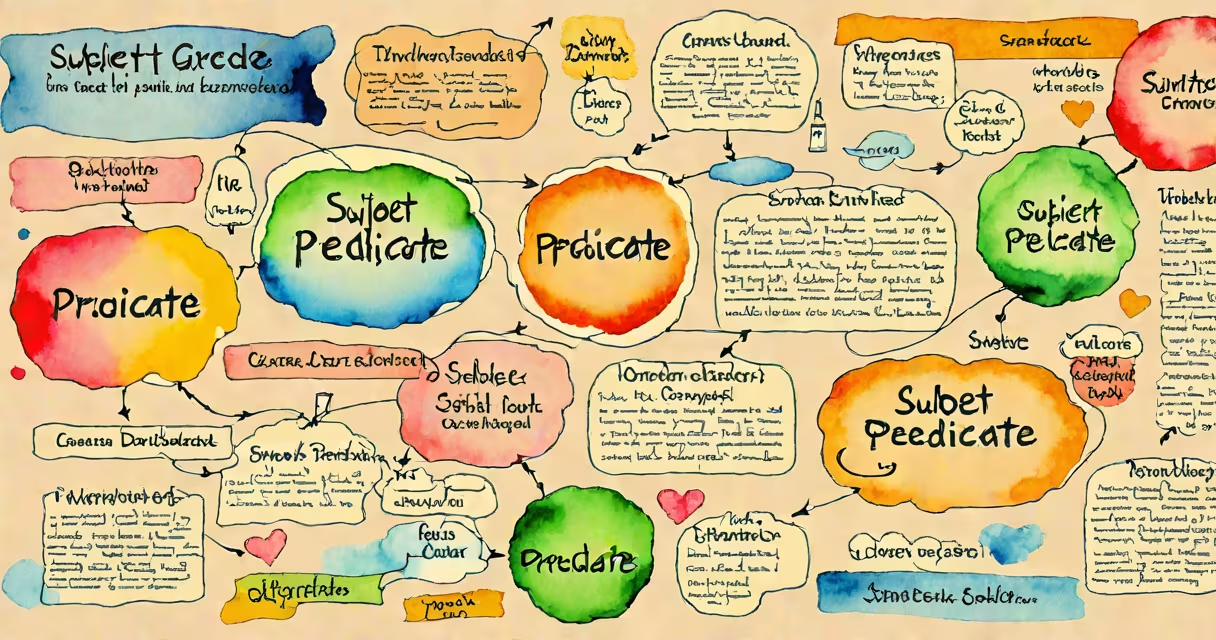
The subject and predicate are the two core parts of a sentence. The subject names who or what the sentence is about. The predicate explains what the subject does or is. Together, they form a complete idea.
A sentence must have both elements to be grammatically complete. Without a subject, you have a fragment. Without a predicate, you have a noun phrase. Both are required for clarity and correctness in written and spoken English.
For example: "The dog barks." Here, "The dog" is the subject-it identifies the entity performing the action. "Barks" is the predicate-the verb describing the action. This combination creates a full, meaningful statement.
The subject typically includes a noun or pronoun and may contain modifiers. It answers the question "Who or what?" in the sentence. The predicate contains the verb and often includes objects, complements, or adverbial phrases that describe the action or state.
In "She reads books every evening," "She" is the subject. "Reads books every evening" is the predicate. The verb "reads" shows the action, while "books" is the direct object and "every evening" is an adverbial phrase indicating frequency.
Even complex sentences follow this pattern. In "After the rain stopped, the children ran outside," the main clause is "the children ran outside." "The children" is the subject. "Ran outside" is the predicate. The introductory phrase "After the rain stopped" adds context but doesn't alter the core subject-predicate structure.
Predicates vary based on the verb type and additional components. There are two main kinds: simple and compound.
| Predicate Type | Description | Example |
|---|---|---|
| Simple Predicate | Contains only the main verb. No objects or modifiers. | "He sleeps." |
| Compound Predicate | Includes two or more verbs joined by a conjunction. | "She sings and dances." |
| Complete Predicate | Includes the verb and all related objects, complements, and modifiers. | "They painted the wall blue after lunch." |
Understanding these types helps identify the full scope of what a sentence communicates. A simple predicate focuses on the action only. A complete predicate gives the full picture of what happened, including results and timing.
Many people confuse the subject with the beginning of a sentence. The subject is not always the first word. In "Under the tree, the cat napped," the subject is "the cat," not "Under the tree." The prepositional phrase "Under the tree" modifies the location but is not part of the subject.
Another error is assuming that every noun in a sentence is part of the subject. In "The teacher gave the students homework," "students" is part of the indirect object, not the subject. The subject remains "The teacher."
A non-obvious point: the subject must agree with the verb in number and person. In "The list of items is long," the subject is "list"-singular-even though "items" is plural. The verb "is" agrees with "list," not "items." This is a common mistake in formal writing.
Consider this sentence: "The team won the championship after months of training." Break it down:
This sentence is grammatically correct because the singular subject "team" matches the singular verb "won." If the sentence were "The team won the championships," the verb would still be singular, even though "championships" is plural. The subject determines verb agreement, not the object.
When teaching grammar, educators often use visual diagrams to show the subject and predicate. A simple line drawn under the subject and a wavy line under the predicate helps learners see the division. This method is widely used in K-12 curricula and appears in resources from the English Grammar Guide and British Council Learn English.
Knowing subject and predicate meaning improves clarity in writing. Sentences lacking either component sound incomplete or confusing. For example, "Running through the park" is not a sentence-it's a fragment. It lacks a subject and a finite verb.
Professionals in editing, publishing, and technical writing rely on this structure to ensure accuracy. A single misplaced modifier or missing subject can change the intended meaning. In legal documents, medical reports, and academic papers, precision matters.
I once reviewed a student essay where a series of fragments were used to create a dramatic effect. While stylistically bold, the lack of clear subjects and predicates made the argument hard to follow. After correcting the structure, the message became sharper and more persuasive. This experience reinforced how foundational subject and predicate understanding is.