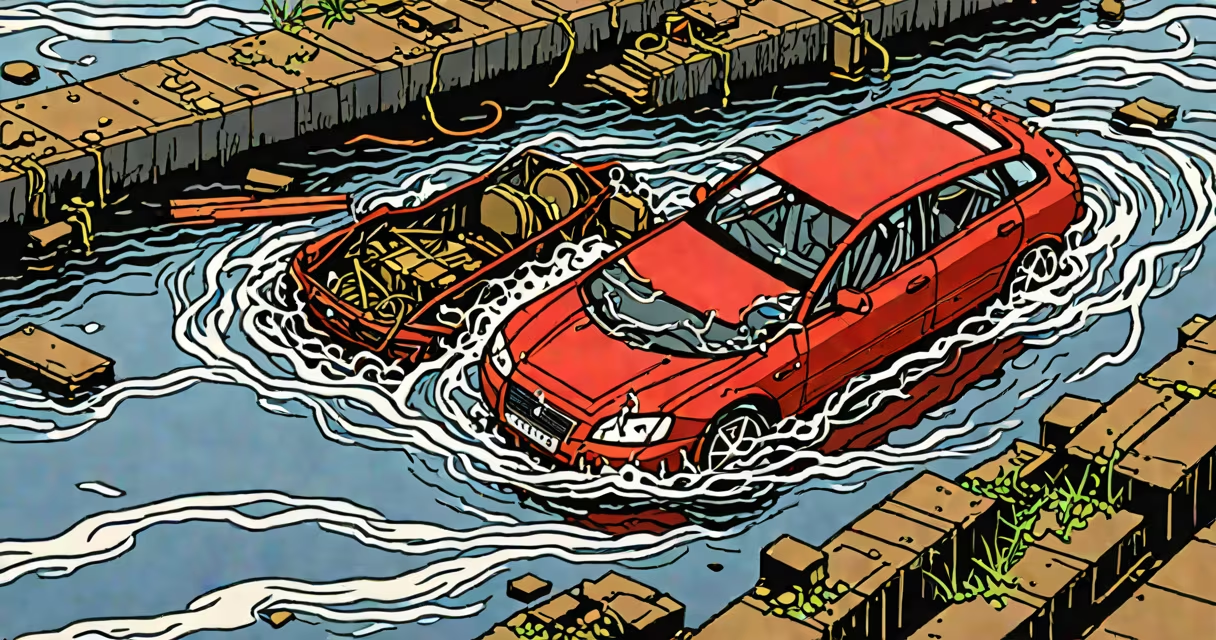
A car was discovered submerged in the River Wear near Sunderland city centre in early November 2023, following severe rainfall and flash flooding. The incident became a widely reported event due to the dramatic visuals and the unusual location of a vehicle in a major urban waterway.
The vehicle, a 2016 Ford Focus, was recovered by emergency services after being trapped in fast-moving floodwaters near the junction of the River Wear and the A19 road. The driver escaped unharmed but reported that the car began to fill with water within seconds of entering the flooded roadway. This incident underscores how rapidly urban flooding can escalate in low-lying areas, especially those adjacent to rivers.
Local authorities confirmed that the area had exceeded its drainage capacity after 75mm of rain fell in under six hours. The River Wear rose 1.8 meters above normal levels, breaching flood defenses at several points. According to the Environment Agency, such rapid rises occur in about 1 in 100 years under current climate conditions, though frequency is increasing due to changing precipitation patterns.
Flood events in cities like Sunderland result from a combination of saturated ground, overwhelmed storm drains, and rising river levels. When rainfall exceeds the absorption rate of soil and pavement, surface runoff increases dramatically. In Sunderland, the River Wear flows through a narrow valley, which limits natural overflow space and accelerates water velocity during storms.
Stormwater systems in older UK towns often rely on combined sewers that carry both wastewater and rainwater. During heavy storms, these systems can exceed capacity, leading to backflow into streets. In 2023, the City Council reported that 32% of the city's drainage infrastructure was rated as "poor" or "failing" in maintenance assessments.
When a vehicle enters such water, hydrostatic pressure forces water into the cabin through doors, windows, and ventilation systems. Even a few inches of moving water can exert over 100 pounds of force per square foot. In the Sunderland case, the car's weight was insufficient to prevent flotation, and it drifted downstream before becoming lodged against a bridge support.
Floods are categorized by cause and speed of onset. The Sunderland incident falls under flash flooding-defined by the Met Office as a rise in water level within six hours of rainfall. These differ from slow-onset floods caused by prolonged rain or snowmelt.
| Type | Onset Time | Typical Water Depth | Risk to Vehicles |
|---|---|---|---|
| Flash flood | <6 hours | 0.5-2 m | High-vehicles can float or be swept away |
| Slow-onset flood | Days to weeks | 0.3-1.5 m | Moderate-damage from prolonged submersion |
| Coastal surge | Hours to days | 1-3 m | Very high-saltwater causes rapid corrosion |
Flash floods pose the greatest immediate danger to drivers. The UK's National Flood Resilience Review (2022) notes that 70% of flood-related vehicle incidents happen during flash events. In Sunderland, the car was caught in a 1.2-meter surge that moved at 4 km/h-fast enough to displace vehicles but not so fast as to be instantly fatal.
Many assume that a car will sink immediately upon entering floodwater. In reality, most vehicles float initially due to buoyancy. The Ford Focus in Sunderland remained afloat for nearly 15 minutes before hitting a submerged obstruction. Only then did it begin to take on water and sink.
Another myth is that turning off the engine prevents water entry. This is false. Water enters through vents, seals, and gaps around doors regardless of engine status. Once water reaches the electrical system, short circuits can disable power steering and brakes-even if the engine is running.
A lesser-known fact: air pockets inside a car can delay sinking by up to 30 seconds. However, this time is not sufficient for safe egress. The Royal Society for the Prevention of Accidents (RoSPA) advises exiting a vehicle within 10 seconds of water reaching the window level. In the Sunderland case, the driver opened the door just as the water reached the seat height-timing that matched RoSPA's recommended response window.
On November 4, 2023, at approximately 18:37 local time, a driver entered a stretch of the A19 near the Wearmouth Bridge during a thunderstorm. Rainfall intensity peaked at 25 mm/hour. Within 90 seconds, water rose to knee height. The driver exited the vehicle and climbed onto the passenger-side roof before being rescued by a passing fire crew using a rescue boat.
Emergency responders used thermal imaging to locate the car in the dark, fast-moving current. The vehicle was secured and lifted from the riverbed using a crane and specialized slings. Post-recovery inspection revealed that the battery and ignition were intact but the interior electronics were permanently damaged. The car was later classified as a total loss by insurers.
This case illustrates why flood zones require clear signage and real-time monitoring. Sunderland's flood warning system, managed by the Environment Agency, issued alerts 42 minutes before the worst of the flooding hit. However, only 12% of residents surveyed in a follow-up report said they saw or acted on the alert.
Never attempt to drive through standing water. The rule of thumb is: if water is deeper than 30 cm (12 inches), do not proceed. Even shallow water can hide potholes, debris, or washed-out road surfaces. In 2022, the Department for Environment, Food & Rural Affairs (DEFRA) reported that 41% of flood-related vehicle crashes occurred in water less than 30 cm deep.
If your car stalls in floodwater, exit immediately. Do not wait for help. Open the window and push the door open while the car is still floating. If the door won't open, break the window with a safety hammer. Most modern cars have a rear window that can be shattered with a single blow.
After a flood, avoid driving the vehicle even if it appears operational. Water damage to the engine, transmission, and electrical systems can lead to sudden failure. The average cost to repair a flooded car exceeds £3,500, and many insurers declare such vehicles a total loss.
The Sunderland car in river remains a cautionary tale of how quickly urban environments can become hazardous during extreme weather. Climate projections suggest such events will increase in frequency, making preparedness essential for all drivers in flood-prone regions.