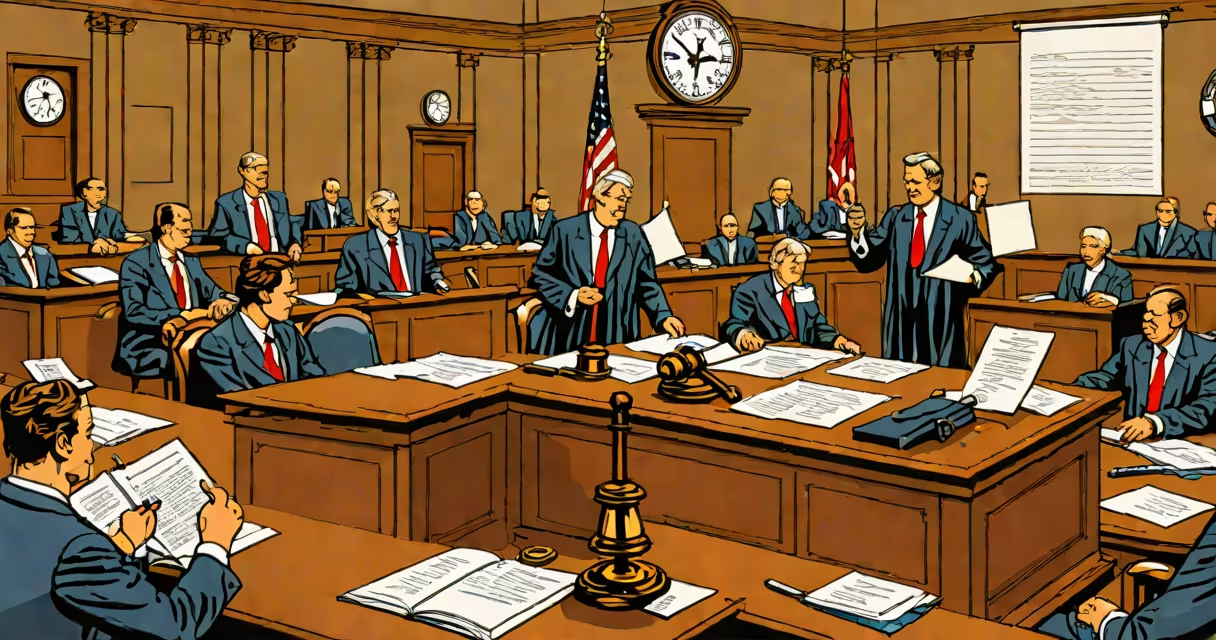
The Fourth Amendment to the U.S. Constitution prohibits government officials from conducting searches or seizing property without a valid warrant or probable cause. This protection applies to both law enforcement and federal agencies, limiting arbitrary intrusions on privacy and personal liberty.
Unreasonable searches and seizures occur when authorities enter private spaces, seize belongings, or detain individuals without proper legal justification. The standard is not whether the search was effective, but whether it followed constitutional safeguards. Courts assess reasonableness based on context, including the nature of the intrusion, the individual's expectation of privacy, and the government's justification.
For example, in California v. Greenwood (1988), the Supreme Court ruled that garbage left on the curb is not protected under the Fourth Amendment because individuals have no reasonable expectation of privacy in discarded trash. Conversely, in Katz v. United States (1972), the Court held that wiretapping a phone booth without a warrant violated the Fourth Amendment-even though no physical entry occurred-because people have a reasonable expectation of privacy in their conversations.
"Reasonableness" is determined by balancing the government's interest against the individual's privacy rights. A search is unreasonable if it lacks either a warrant issued by a neutral magistrate or a recognized exception to the warrant requirement.
Warrants must be supported by probable cause-a factual basis to believe a crime has been committed or evidence exists. They must specify the place to be searched and the persons or things to be seized. Without these details, a warrant is invalid. The exclusionary rule, established in Mapp v. Ohio (1961), prevents evidence obtained through unconstitutional searches from being used in court.
Exceptions to the warrant requirement include exigent circumstances (such as imminent danger), consent, plain view doctrine, and searches incident to lawful arrest. But even under these exceptions, courts scrutinize whether the conditions were met. For instance, consent must be voluntary-not coerced-and can be withdrawn at any time.
Not all violations involve physical entry. The following categories illustrate common forms:
| Type | Description | Example |
|---|---|---|
| Warrantless Home Entry | Entering a home without a warrant or exception. | Police knock, no response, then force entry during a drug investigation. No emergency existed. |
| Unjustified Traffic Stop | Detaining a driver without suspicion of a violation. | Officer stops car for no reason other than racial profiling. |
| Body Search Without Consent | Pat-down or strip search without legal basis. | Prison guard conducts a full-body search of a nonviolent inmate without cause. |
| Electronic Surveillance | Monitoring communications without a warrant. | Federal agents access a suspect's email without a court order. |
One key distinction often missed: a search doesn't require physical contact. In Carpenter v. United States (2018), the Supreme Court ruled that the government must obtain a warrant to access historical cell-site location information (CSLI), even though no physical search occurred. This decision expanded privacy rights in the digital age.
Unreasonable searches and seizures most frequently arise in criminal investigations, immigration enforcement, and corrections settings. They're central to civil rights litigation and can lead to damages under 42 U.S.C. § 1983, which allows individuals to sue state actors for violating constitutional rights.
In practice, courts apply the "totality of the circumstances" test. For example, in United States v. Leon (1984), the Court created the "good faith" exception: if officers rely on a warrant they reasonably believe is valid-even if it later turns out to be defective-the evidence may still be admissible. But this does not excuse deliberate misconduct.
A real-world case from 2021 illustrates the stakes. In State v. Smith, a Maryland man sued police after officers entered his apartment without a warrant during a narcotics raid. The court ruled the search unconstitutional because the officers had no emergency justification and failed to secure a warrant. The evidence was suppressed, and the charges were dropped. The officer involved faced internal disciplinary action.
Many assume that a search is legal if it results in finding contraband. That's false. Evidence obtained unconstitutionally cannot be used in court-even if it proves guilt. The exclusionary rule helps law enforcement follows the rules, not just wins cases.
Another misconception: that only violent or invasive searches count. But routine actions like prolonged detention during a traffic stop, or repeated questioning without Miranda warnings, can constitute unreasonable seizure. In Hiibel v. Sixth Judicial District Court (2004), the Court upheld requiring suspects to identify themselves during a lawful stop-but only if the officer has reasonable suspicion. Failure to meet that threshold violates the Fourth Amendment.
Finally, people often confuse "unreasonable" with "illegal." All unreasonable searches are illegal under the Fourth Amendment, but not all illegal searches are unreasonable. For example, a search conducted under a flawed warrant may still be deemed reasonable if the officer acted in good faith. The distinction matters in appeals.
I once observed a traffic stop in rural Pennsylvania where an officer detained a driver for nearly 45 minutes without issuing a citation. The officer claimed he was "checking for outstanding warrants," but no computer system confirmed the claim. The driver, a Black man with no prior record, was handcuffed and placed in the back of the cruiser. After a court review, the judge dismissed the case, citing an unreasonable seizure under the Fourth Amendment. The officer's department later revised its training protocols.
This case reflects a broader pattern: racial disparities in policing. According to the U.S. Department of Justice's 2022 report on police use of force, Black drivers are 2.5 times more likely to be stopped than white drivers, even when controlling for traffic violations. When stops lack probable cause, they become unreasonable seizures.
Unreasonable searches and seizures are not hypothetical. They happen daily in courts, streets, and jails. The Fourth Amendment protects everyone-not just the guilty. When law enforcement exceeds its authority, victims can seek redress through civil lawsuits or criminal prosecution. Understanding your rights is the first step toward holding power accountable.