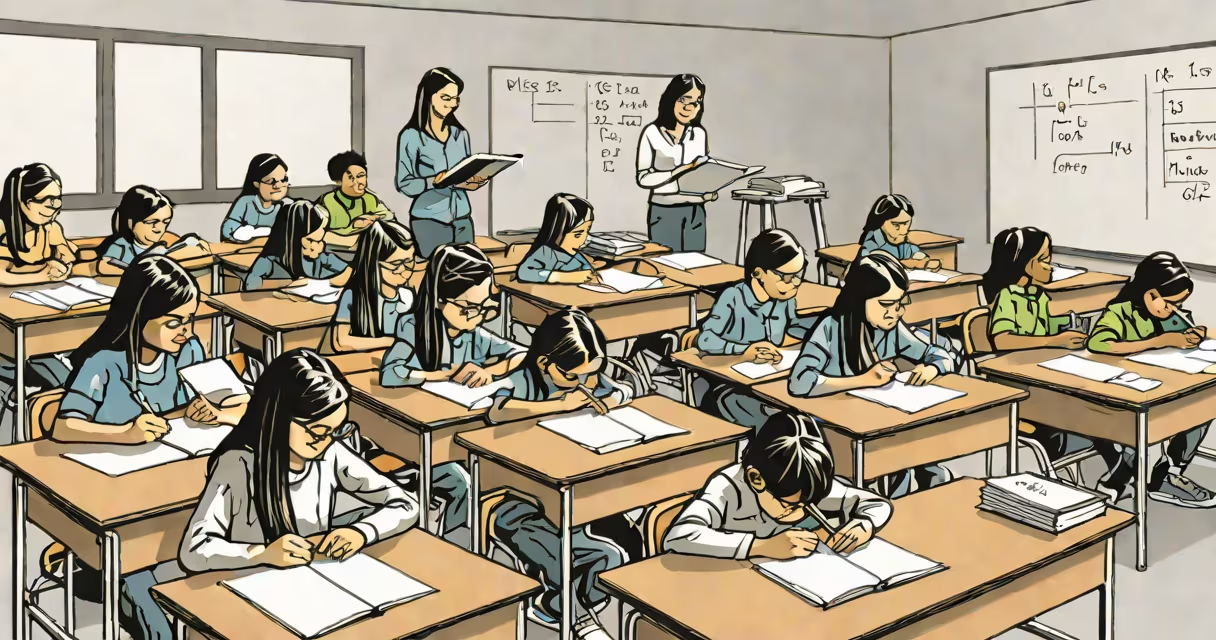
K-12 education refers to the 12 years of formal schooling in the United States that begin with kindergarten and end with 12th grade. It encompasses both elementary and secondary education, covering ages 5 to 18. This structure forms the foundation of the American public school system and is standardized across states.
The term "K-12" combines "K" for kindergarten and "12" for the final year of high school. It represents a continuous educational pathway designed to prepare students for college, careers, or military service. The U.S. Department of Education defines K-12 as including all levels from early childhood education through high school completion, regardless of school type.
Public K-12 schools receive funding from federal, state, and local governments. They are free to attend and legally required for children between ages 6 and 18 in most states. Private and charter schools also follow the K-12 model but operate under different governance structures. Homeschooling is another option, though it must meet state-specific academic standards to be valid.
K-12 education is structured around grade levels, with each year building on prior learning. Students typically start in kindergarten at age 5 or 6, progress through 1st through 5th grade in elementary school, then move to middle school (grades 6-8), and finally attend high school (grades 9-12).
Each level has distinct curricular goals. In elementary school, students focus on reading, writing, math, science, and social studies basics. Middle school introduces more complex topics such as algebra, introductory biology, and history timelines. High school offers advanced courses in subjects like calculus, chemistry, U.S. government, and foreign languages, often leading to college credit via AP or IB programs.
Students must pass state-mandated assessments in core subjects. For example, in California, students take the Smarter Balanced Assessment in English language arts and math during grades 3-8 and again in grade 11. These tests determine whether schools meet federal accountability standards under the Every Student Succeeds Act (ESSA).
Not all K-12 institutions are the same. The primary models differ in governance, funding, and curriculum delivery.
| Model | Funding Source | Curriculum Control | Example |
|---|---|---|---|
| Public School | State and local taxes | Local school board and state education department | New York City Public Schools |
| Charter School | Public funds, but independently operated | Charter contract with authorizing body | Success Academy Charter Schools (New York) |
| Private School | Tuition and donations | School leadership and governing board | St. Paul's School (New Hampshire) |
| Homeschool | Parental funding | Parent or tutor | State-specific compliance (e.g., Texas TEA guidelines) |
Charter schools are publicly funded but operate independently of traditional district control. They must meet performance targets outlined in their charter agreements. If they fail to meet benchmarks, they can be closed. In 2022, the National Alliance for Public Charter Schools reported over 7,700 charter schools operating in the U.S., serving approximately 3.7 million students.
Many people assume K-12 education ends at high school graduation. But the term refers to the entire span of formal schooling from age 5 to 18. Some confuse it with higher education, which begins after high school with college or vocational training.
A frequent error is equating K-12 with only public schools. While public schools dominate the field, private and charter schools also serve K-12 populations. According to the National Center for Education Statistics (NCES), in 2021-2022, about 50.8 million students were enrolled in K-12 schools, with 49% in public schools, 10% in private schools, and 1% in homeschool settings.
Another misconception is that K-12 education is uniform nationwide. While all states follow the K-12 structure, curricula, graduation requirements, and testing protocols vary. For example, Florida requires students to pass the End-of-Course (EOC) exams in Algebra 1, Geometry, and U.S. History to graduate, while New York uses Regents Exams in similar subjects.
Consider Maya, born in 2008. She started kindergarten in 2013 at Lincoln Elementary, a public school in Portland, Oregon. Her school followed the Common Core State Standards in math and English language arts. By 5th grade, she scored in the 85th percentile on the statewide MAP test in reading.
In 6th grade, she moved to Jefferson Middle School. There, she took honors science and began studying Spanish. Her school offered a STEM-focused curriculum, including robotics and coding classes. In 9th grade, she transferred to Grant High School, a public magnet school with a college preparatory track.
She completed four years of high school, taking AP Calculus AB, AP Biology, and dual-enrollment courses in psychology and economics through a local community college. She graduated in 2026 with a GPA of 3.8 and earned admission to the University of Washington.
This path reflects the typical progression within the K-12 system: structured grade levels, cumulative learning, and alignment with state and national standards. Her experience demonstrates how K-12 education prepares students for post-secondary success.
K-12 education is not synonymous with distance education. While some K-12 schools offer online programs, the term itself refers to the institutional structure and age-based progression, not the delivery method. For example, the Florida Virtual School serves K-12 students remotely, but it remains part of the K-12 system because it follows the same grade structure and state standards.
Similarly, K-12 is not equivalent to religious or faith-based education. Some private schools incorporate religious teachings, but the K-12 label applies to any institution that covers kindergarten through 12th grade, regardless of doctrine. The U.S. Supreme Court ruled in *Employment Division v. Smith* (1990) that public funding cannot support religious instruction, even in schools that serve K-12 students.
One non-obvious fact: K-12 education does not require attendance beyond age 16 in most states. Students may leave school early if they meet state exit requirements. In Texas, for example, students can earn a high school diploma through the Texas High School Equivalency Test (T-HSET) at age 16, allowing them to enter the workforce or pursue vocational training earlier.
I once taught 10th-grade biology in a suburban public high school in Colorado. The district used a standards-based grading system aligned with the Colorado Academic Standards. I observed how students who struggled in 9th grade often fell behind in 10th grade due to gaps in foundational science concepts. We implemented targeted interventions using small-group tutoring and diagnostic assessments to close those gaps.
That experience confirmed how critical the K-12 structure is in identifying and addressing learning deficiencies early. Without consistent tracking across grades, students risk falling through the cracks. The system's strength lies in its ability to monitor progress annually and adjust instruction accordingly.
Understanding what does K-12 education mean involves recognizing it as a structured, state-regulated system spanning ages 5 to 18. It includes public, private, charter, and homeschool options, all following the same grade progression. The term is not interchangeable with higher education, distance learning, or religious schooling. Its purpose is to provide a standardized foundation for lifelong learning and civic participation.