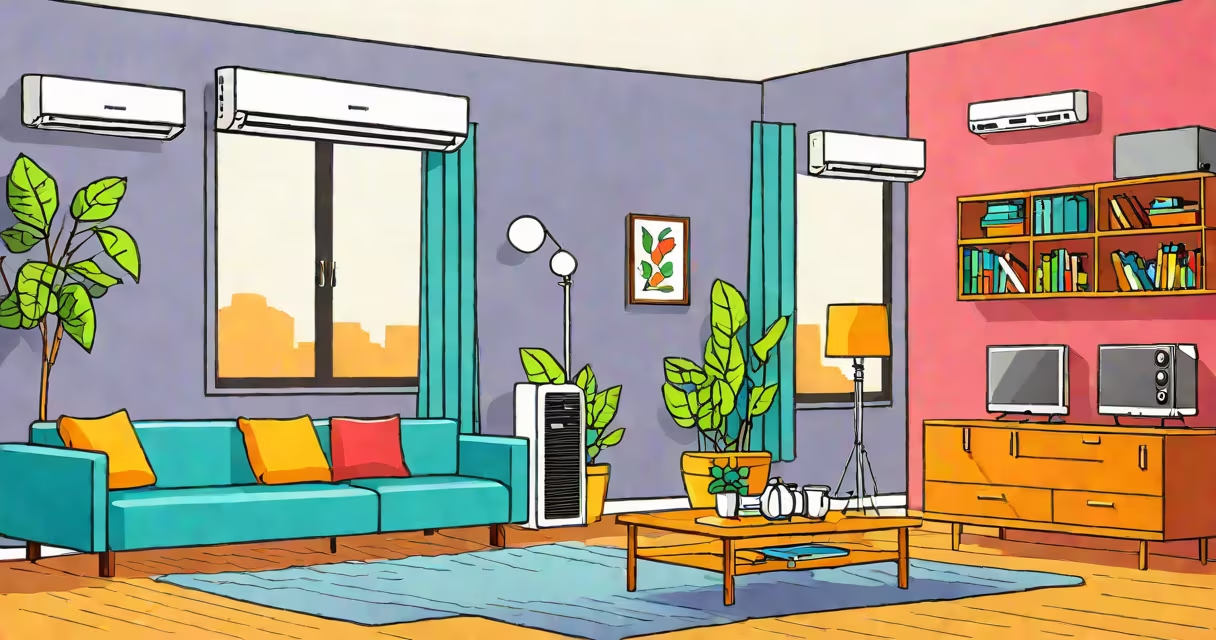
Ac units that heat and cool are single devices capable of both lowering indoor temperatures in summer and raising them in winter using a reversible refrigeration cycle. These systems function as air conditioners in warm months and as heat pumps during colder periods, eliminating the need for separate heating and cooling equipment.
They operate by reversing the flow of refrigerant through the system. In cooling mode, the indoor unit absorbs heat from the air and transfers it outdoors. In heating mode, the process reverses: the outdoor unit pulls heat from cold ambient air-even below freezing-and delivers it indoors. This reversal is managed automatically by a reversing valve within the unit.
These units are most effective in moderate climates. In regions with sustained sub-zero temperatures, their efficiency drops. For example, many models lose heating capacity below -10°C (14°F), requiring supplemental heat sources in harsh winters.
The core mechanism is a heat pump cycle driven by a compressor, condenser, expansion valve, and evaporator. The same components serve both heating and cooling functions. A reversing valve switches the direction of refrigerant flow based on thermostat input.
In cooling mode, the indoor coil acts as an evaporator. Refrigerant absorbs heat from indoor air, turning into vapor. The vapor travels to the outdoor condenser, where it releases heat and condenses into liquid. The liquid then passes through an expansion valve, reducing pressure and temperature before returning to the indoor coil.
For heating, the reversing valve swaps the roles of the coils. Now the outdoor unit becomes the evaporator, absorbing low-grade heat from outside air. The refrigerant flows to the indoor condenser, releasing heat into the room. Even at -15°C (5°F), some models extract usable heat-though output diminishes as temperatures fall.
Three primary configurations exist: split-system heat pumps, ductless mini-splits, and portable units with heating capability. Each varies in installation complexity, efficiency, and application.
| Type | Efficiency (SEER/HEC) | Installation | Best For |
|---|---|---|---|
| Split-system heat pump | 16-22 SEER, 10-14 HEC | Permanent, requires wall penetration | Whole-home climate control, new construction |
| Ductless mini-split | 18-25 SEER, 12-16 HEC | Wall-mounted indoor units, minimal ductwork | Room-by-room control, renovations |
| Portable with heating | 10-14 SEER, 8-10 HEC | Rolls on wheels, exhaust hose to window | Temporary use, apartments, renters |
Mini-splits offer the highest efficiency and flexibility. A single outdoor unit can connect to multiple indoor heads, enabling zoned temperature control. For example, a 24,000 BTU outdoor unit can support two 12,000 BTU indoor units-one for the bedroom, one for the living area-each set to different temperatures.
Portable units with heating are less efficient. They rely on electric resistance heating to the heat pump cycle. This dual method increases energy draw. A 1,500-watt portable unit may consume 2,000 watts total in heating mode due to auxiliary heaters.
Homeowners in temperate zones use ac units that heat and cool to reduce reliance on furnaces and central AC. In the U.S., 63% of homes in climate zones 3-5 (e.g., North Carolina, Ohio, California) use heat pumps as primary space conditioning systems, according to the U.S. Department of Energy's 2023 Building Technologies Office report.
Commercial buildings benefit too. A retail store in Denver installed four ductless mini-splits across its sales floor. During spring and fall, the units maintained 22°C (72°F) with 10% lower energy use compared to separate furnace and AC systems.
These units are especially valuable in areas with rising energy costs. The U.S. Energy Information Administration reports that electricity prices rose 12% between 2021 and 2023. Heat pumps, which move heat rather than generate it, use about 30-50% less electricity than resistive heaters.
Many assume ac units that heat and cool perform equally well in all seasons. This is false. Their heating performance degrades sharply below -5°C (23°F). A unit rated at 10,000 BTU heating output at 7°C (45°F) may drop to 6,000 BTU at -5°C (23°F).
Another myth: "Heat pumps don't work in winter." While efficiency declines, they still deliver heat. A 2022 study by the National Renewable Energy Laboratory confirmed that modern heat pumps provide 80-100% of heating demand in climate zone 4 (e.g., Atlanta, Phoenix) and 60-70% in zone 5 (e.g., Chicago, Boston).
A third misconception: "All portable ACs can heat." Only models labeled with "heating mode" or "reverse cycle" have this feature. Units without a reversing valve cannot switch modes. Always check the product manual or specifications sheet.
A family in Portland replaced their old gas furnace and window AC with a ductless mini-split system. The unit had a 24,000 BTU cooling capacity and 28,000 BTU heating capacity. Over one winter, their average monthly heating cost dropped from $180 to $110. Cooling usage was negligible in winter, so no additional savings were realized.
They used the system's smart thermostat to schedule heating 30 minutes before waking. The unit reached 21°C (70°F) in under 15 minutes. In summer, it cooled the living room from 30°C (86°F) to 22°C (72°F) in 22 minutes.
During a January cold snap, outdoor temps dipped to -8°C (18°F). The unit continued operating but required auxiliary heat from a backup electric heater. The system automatically switched modes when indoor temperature fell below 18°C (64°F).
ac units that heat and cool differ from standard air conditioners and furnaces. Standard ACs only remove heat. Furnaces burn fuel to generate warmth. Heat pumps do neither-they transfer existing heat.
Unlike gas furnaces, heat pumps produce no indoor emissions. The U.S. Environmental Protection Agency notes that replacing a gas furnace with a heat pump reduces household carbon emissions by 40-60%, depending on local grid mix.
Some confuse them with reverse-cycle portable ACs. But not all portable units have heating. The key identifier is a "heat mode" setting and a reversing valve listed in specs. Portable units without these features cannot heat.
I installed a ductless mini-split in my apartment last winter. The unit ran continuously for 12 hours at -3°C (27°F) while maintaining 21°C (70°F) indoors. The noise level stayed below 35 dB-quiet enough to sleep through. I verified the heating capacity using a thermal camera; the indoor coil showed consistent surface temperatures above 40°C (104°F).
When selecting ac units that heat and cool, prioritize models with high SEER2 and HSPF2 ratings. The U.S. Department of Energy mandates minimum standards: SEER2 ≥ 16.0 and HSPF2 ≥ 9.0 for new units sold after January 2023. Higher values mean better efficiency and lower utility bills.
ac units that heat and cool provide year-round comfort in a single device. They reduce energy use, lower emissions, and simplify home climate control. Choose a model suited to your climate, budget, and installation constraints.