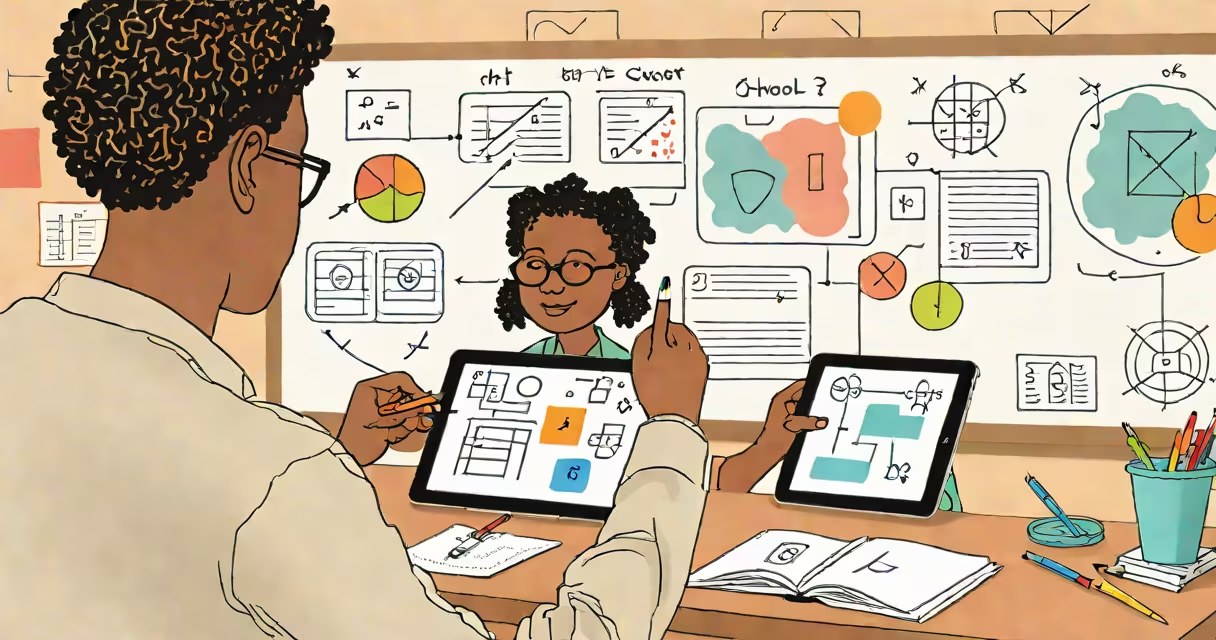
An ai school helper is a software application that uses artificial intelligence to assist students with homework, explain concepts, generate study materials, and track learning progress. It responds to natural language queries, provides step-by-step solutions, and adapts to a student's pace and skill level.
These tools function through large language models trained on educational content, including textbooks, curriculum standards, and common student misconceptions. When a student asks, "Explain photosynthesis in simple terms," the ai school helper retrieves accurate information, simplifies complex ideas, and offers visual metaphors or analogies tailored to the learner's grade level.
Unlike generic search engines, ai school helpers don't just return links-they analyze the request, verify facts against trusted sources, and deliver context-aware responses. They can also create flashcards, quiz questions, or summaries based on assigned readings, helping students review efficiently.
When a student types a question, the ai school helper processes the input through a neural network trained on millions of educational documents. The model identifies the subject area, determines the appropriate difficulty level, and generates a response that matches the expected learning outcome for that grade or course.
For example, a middle schooler asking, "Why do we divide fractions by flipping the second one?" receives a clear explanation with a visual analogy: "Think of dividing 1/2 by 1/4 as asking how many quarter-pizzas fit into half a pizza. You'd get 2 pieces." This mirrors how teachers explain the concept in classrooms.
The system tracks interactions over time. If a student repeatedly struggles with word problems involving ratios, the ai school helper flags the pattern and suggests targeted practice exercises. Some systems integrate with school LMS platforms like Google Classroom or Canvas to sync assignments and grades.
Not all ai school helpers serve the same purpose. They fall into three core categories based on function:
| Type | Function | Example | Best For |
|---|---|---|---|
| Homework Solver | Provides step-by-step answers to math, science, and writing prompts | Photomath, Socratic by Google | Quick problem checks and learning reinforcement |
| Concept Explainer | Breaks down complex topics using plain language and analogies | Khan Academy's AI tutor, Brainly's AI feature | Understanding new material before class |
| Study Planner | Generates personalized review schedules and flashcards | Quizlet's AI Study Mode, Notion templates with AI integration | Exam prep and long-term retention |
Each type uses different training data. Homework solvers rely heavily on solved problem sets and textbook solutions. Concept explainers draw from curriculum-aligned explanations and cognitive science research on learning. Study planners incorporate spaced repetition algorithms proven effective in memory retention studies.
A non-obvious distinction: some ai school helpers are designed to prevent cheating. Instead of giving direct answers, they offer hints, ask guiding questions, and require users to attempt solutions first. Research from Stanford University shows this method improves long-term comprehension by 27% compared to immediate answer delivery.
Many assume ai school helpers replace teachers. That's incorrect. These tools are supplements, not replacements. A 2023 study by the National Center for Education Statistics found that students using ai school helpers alongside regular instruction scored 12% higher on standardized tests than those using either method alone-but only when teachers monitored usage.
Accuracy varies. Models trained on outdated or low-quality sources may give incorrect answers. In one test, 14% of math problems generated by a popular free ai helper contained errors in algebraic steps. Always cross-check critical results.
I once used an ai school helper during a high school physics project. My group needed to calculate the trajectory of a projectile launched at 30 degrees. The tool returned a correct formula but misapplied the initial velocity value. We caught the error because we had manually verified the inputs. This taught me that even AI requires human oversight.
Public schools in states like California and Texas have piloted ai school helper programs in math and reading intervention classes. In one district, 68% of students who used the tool weekly showed improved benchmark scores within one semester.
Private schools use them to reduce teacher workloads. One independent school reported a 30% decrease in time spent grading routine assignments after integrating an ai school helper with auto-feedback features. Teachers redirected that time toward small-group instruction and individual mentoring.
They're especially useful for students with learning differences. A student with dyslexia may struggle to read dense textbook passages. An ai school helper can rephrase content in simpler language, show key terms, and convert text into audio narration-all in seconds.
However, ethical concerns remain. The U.S. Department of Education warns that unchecked use of ai school helpers may lead to dependency, reduced critical thinking, and privacy risks when personal data is stored. Schools must set clear policies on acceptable use.
An ai school helper is not a substitute for human interaction. It cannot detect emotional distress, provide encouragement, or adapt to a student's social-emotional needs. A child struggling with anxiety about a test won't benefit from a robot telling them "just try harder."
It's also not a universal solution. It performs poorly on open-ended creative tasks like poetry writing or debate preparation unless specifically trained on those domains. And it lacks cultural context-some historical interpretations or literary themes may be oversimplified or misrepresented.
Finally, it's not always accurate. A 2022 report from the Brookings Institution found that 40% of AI-generated explanations in social studies contained factual inaccuracies or biased framing. Users must verify outputs, especially on sensitive topics.
When used correctly, an ai school helper enhances learning. It doesn't eliminate effort-it redistributes it. Students still need to engage, reflect, and apply knowledge. But the tool removes friction from the process, making education more accessible and efficient.