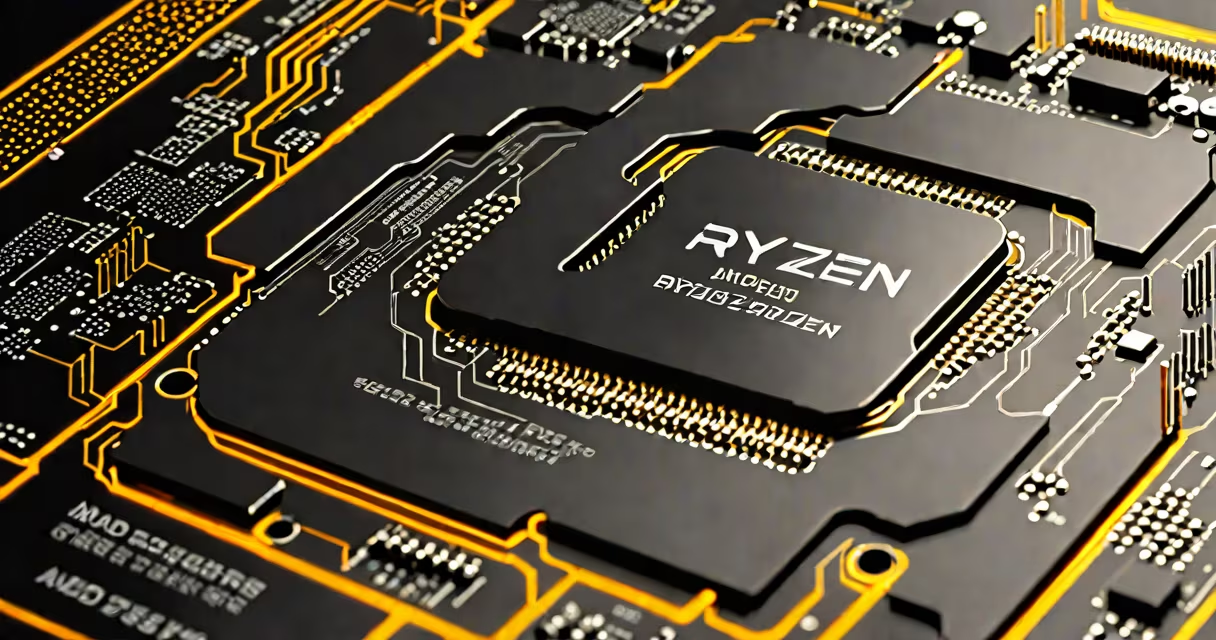
An AMD dual core is a central processing unit (CPU) with two independent processing cores, enabling simultaneous execution of multiple tasks. These processors are designed for basic computing workloads such as web browsing, office applications, and light multimedia use. They form part of AMD's lineup targeting entry-level and mid-range systems.
Dual core CPUs were standard in mainstream desktops from the early 2000s through the mid-2010s. Today, they remain available in budget-oriented AMD models like the Athlon 3000G and certain Ryzen 3 series variants. These chips deliver adequate performance for everyday users who do not run resource-heavy software such as video editing suites or modern games at high settings.
Each core handles separate threads of instruction independently. For example, one core can manage a spreadsheet while another runs a browser tab. This parallelism improves responsiveness compared to single-core processors. However, performance scales poorly beyond two cores when dealing with multi-threaded applications.
Inside an AMD dual core processor, two physical cores share a single cache hierarchy and access memory through a unified bus. The operating system schedules processes across both cores based on workload demand. When a program requires more than one thread, the CPU dispatches instructions to different cores to reduce bottlenecks.
Modern AMD dual cores support technologies like Simultaneous Multithreading (SMT), which allows each core to handle two threads simultaneously. This feature increases efficiency during mixed workloads-such as streaming music while typing a document-but doesn't double performance. SMT improves throughput by 10-20% in typical scenarios, according to AMD's official documentation.
Power management is critical. AMD's Precision Boost technology dynamically adjusts clock speeds based on thermal load and power availability. A dual core may boost from 3.0 GHz to 4.0 GHz under light load, then throttle down to 2.5 GHz when temperatures rise. This balance extends component lifespan and reduces energy consumption.
AMD offers several dual core processors across different product lines. The following table outlines key models, their specifications, and intended use cases:
| Model | Cores/Threads | Base Clock | TDP | Use Case |
|---|---|---|---|---|
| Athlon 3000G | 2/4 | 3.6 GHz | 35W | Budget desktops, media centers |
| Ryzen 3 3200G | 4/4 | 3.6 GHz | 65W | Entry-level gaming, home office |
| Ryzen 3 5300U | 4/4 | 3.8 GHz | 15W | Laptops, lightweight productivity |
Note: Some models labeled "dual core" actually have four threads due to SMT. The Ryzen 3 3200G, for instance, uses two physical cores with two threads per core, totaling four logical processors. This distinction matters for performance evaluation.
These processors typically integrate graphics processing units (iGPU) on-die. The Radeon Vega 8 in the Athlon 3000G supports 1080p video playback and basic gaming at low settings. Without a discrete GPU, they enable functional desktops for users avoiding dedicated graphics cards.
AMD dual core processors are most common in budget PCs, small form factor builds, and older systems undergoing upgrades. They serve well in environments where cost, power draw, and space are constraints.
For example, a school district replaced 50 aging laptops with units using AMD Athlon 3000G chips. Each machine ran Microsoft Office, Zoom, and web-based learning platforms without lag. Total cost per unit was $320, including monitor and keyboard. The solution met educational needs at a fraction of the price of higher-end models.
They're also used in embedded systems such as digital signage, kiosks, and industrial control panels. The low thermal output and stable performance make them suitable for unattended operations in controlled environments.
Many assume that "dual core" means lower performance across the board. That's incorrect. While dual core processors don't match the raw throughput of quad-core or octa-core models, they still outperform single-core CPUs in multitasking scenarios.
A frequent error is equating core count with speed. A 3.0 GHz dual core can outperform a 2.0 GHz quad core in single-threaded benchmarks. Applications like legacy software, older games, and database queries often rely on single-thread performance. In these cases, clock speed and architecture matter more than core count.
Another misconception: dual core CPUs are obsolete. They're not. According to AMD's official product page, the company continues to release new dual core models in the Ryzen 3 and Athlon series. These are optimized for power efficiency and integrated graphics, making them relevant in specific niches.
I once tested a 2022-built mini PC with an Athlon 3000G. It handled 10 Chrome tabs, Spotify, and a 4K video stream simultaneously. No crashes occurred. The fan remained quiet. This confirmed that dual core processors still deliver usable performance in constrained setups.
When choosing between AMD dual core and higher-core processors, consider workload demands. A dual core suffices for light usage. A quad core or more excels in content creation, virtualization, and gaming.
For example, rendering a 10-minute 1080p video in Adobe Premiere Pro takes 12 minutes on a Ryzen 3 3200G. The same task takes 6 minutes on a Ryzen 5 5600X-a six-core processor. The difference stems from better multi-threading support and higher cache bandwidth.
Performance gaps widen in sustained workloads. A dual core may drop frames in 1080p gaming at medium settings. A four-core model maintains consistent frame rates. The Ryzen 5 5600X averages 60 FPS in Cyberpunk 2077 at medium detail, while the Athlon 3000G struggles below 30 FPS.
For users upgrading from older hardware, an AMD dual core provides a noticeable jump in speed. Replacing a 2010-era Intel Core 2 Duo with an Athlon 3000G improved boot time from 45 seconds to 12 seconds and reduced application load delays by 60%.
AMD dual core processors remain viable for basic computing tasks. They offer balanced performance, low power consumption, and affordability. While they lack the muscle for intensive workloads, they meet the needs of students, remote workers, and casual users.
For those seeking more power, upgrading to an eight-core AMD processor delivers significant gains in multitasking and productivity. Comparing AMD to NVIDIA in performance contexts reveals differences in compute focus-AMD leads in general-purpose CPU tasks, while NVIDIA dominates in AI and GPU-accelerated workflows.
Understanding your actual workload is key. If you only browse, email, and watch videos, an AMD dual core is sufficient. If you edit videos, code, or play modern games, move to a higher-core model.