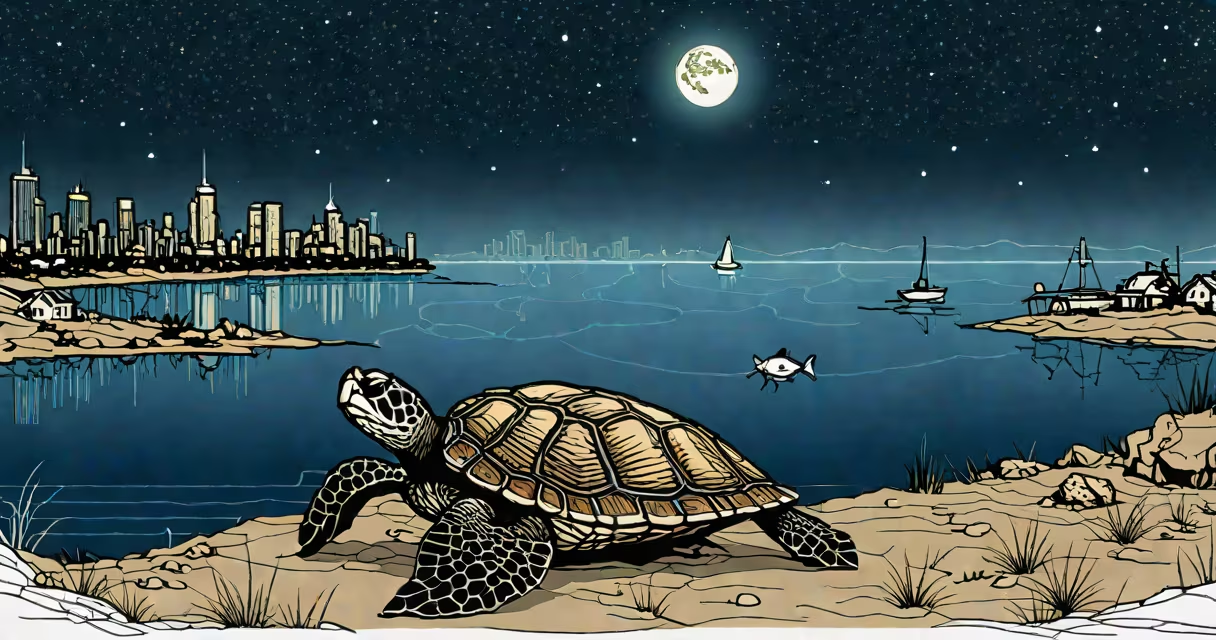
Animals affected by light pollution are species whose natural behaviors-such as feeding, mating, migration, and nesting-are disrupted by excessive or misdirected artificial light at night. This includes birds, sea turtles, insects, and mammals that rely on darkness for survival.
Light pollution alters the timing and intensity of nighttime cues that animals use to regulate their internal clocks. For example, streetlights near coastal areas disorient sea turtle hatchlings, which instinctively move toward the brightest horizon-the ocean. When cities glow brighter than the moonlit sea, hatchlings turn inland, where they face dehydration, predation, and death.
Research from the International Dark-Sky Association shows that over 60% of the world's population lives under light-polluted skies, affecting species across ecosystems. The problem is not just brightness-it's the spectrum and duration of artificial light. Blue-rich LEDs, common in urban lighting, are especially disruptive because they mimic dawn and suppress melatonin production in animals.
Artificial light at night interferes with biological rhythms known as circadian cycles. These cycles govern sleep, hormone release, and activity patterns. When light disrupts them, animals may become active during unsafe times or fail to enter rest states essential for recovery and reproduction.
For birds, light pollution increases collision rates with buildings. A study published in Science Advances found that 90 million birds die annually in the U.S. from window strikes, many during migration events triggered or prolonged by illuminated skyscrapers. Birds orient using stars and moonlight; artificial lights override these signals, causing disorientation and exhaustion.
Even small creatures suffer. Moths, attracted to bright lights, fly in spirals until they tire and fall. This reduces their ability to pollinate plants and becomes easy prey for predators. A 2022 study in Nature Ecology & Evolution documented a 50% decline in moth populations in regions with high LED density over five years.
The following table outlines key animal groups impacted by light pollution, their specific vulnerabilities, and documented consequences.
| Animal Group | Vulnerability | Observed Impact |
|---|---|---|
| Sea turtle hatchlings | Navigation failure | 50-90% mortality in some nesting zones due to inland movement |
| Migratory songbirds | Disrupted orientation | Increased building collisions; 10-20% higher mortality in lit urban corridors |
| Nocturnal insects (moths, beetles) | Attraction to light sources | Population drops; reduced pollination in nearby ecosystems |
| Small mammals (bats, rodents) | Altered foraging and predator avoidance | Reduced feeding time; increased risk of predation near lit areas |
| Reptiles (e.g., lizards, snakes) | Thermoregulation interference | Abnormal basking behavior; lower reproductive success in lit habitats |
One non-obvious fact: light pollution doesn't just affect animals that are active at night. Diurnal species-those active during the day-can also suffer. For example, some bird species nest earlier in spring when nights remain artificially lit, reducing chick survival due to mismatched food availability.
Many assume light pollution only affects visibility or astronomy. But its ecological toll is measurable and severe. Unlike plastic pollution, which accumulates in tissues, light pollution acts through behavioral disruption-often invisible but equally lethal.
Another misconception is that all artificial light harms equally. In reality, blue wavelengths (400-500 nm) are most disruptive. Red and amber lights have less impact on melatonin suppression and navigation. The National Park Service recommends using amber LEDs (500 nm or above) in conservation zones to reduce wildlife disturbance.
I once observed this firsthand while volunteering at a sea turtle sanctuary in Florida. During nesting season, volunteers used red flashlights to minimize disorientation. Hatchlings emerged under moonlight and moved toward the water. But when a visitor used a white LED flashlight, several turtles veered inland-some never recovered. That night reinforced how subtle changes in light quality can alter survival outcomes.
When key species like moths or bats vanish due to light pollution, entire food webs destabilize. Moths pollinate night-blooming flowers; bats control insect pests. Their absence leads to cascading effects-reduced plant diversity, increased pesticide use, and declining system resilience.
Urban planning decisions often ignore these impacts. Yet solutions exist. Cities like Tucson, Arizona, and Flagstaff, New Mexico, adopted dark-sky ordinances limiting outdoor lighting hours and requiring shielded fixtures. In Flagstaff, researchers reported a 35% drop in bird collisions after implementing such policies.
Understanding animals affected by light pollution is not about nostalgia for a darker past. It's about recognizing that human infrastructure must coexist with natural systems. Simple changes-using motion sensors, shielding lights downward, switching to warmer color temperatures-can preserve critical behaviors in wild populations.
Animals affected by light pollution represent a growing threat to biodiversity. Addressing it requires awareness, policy, and design choices that prioritize ecological function over convenience. The night belongs to more than humans.