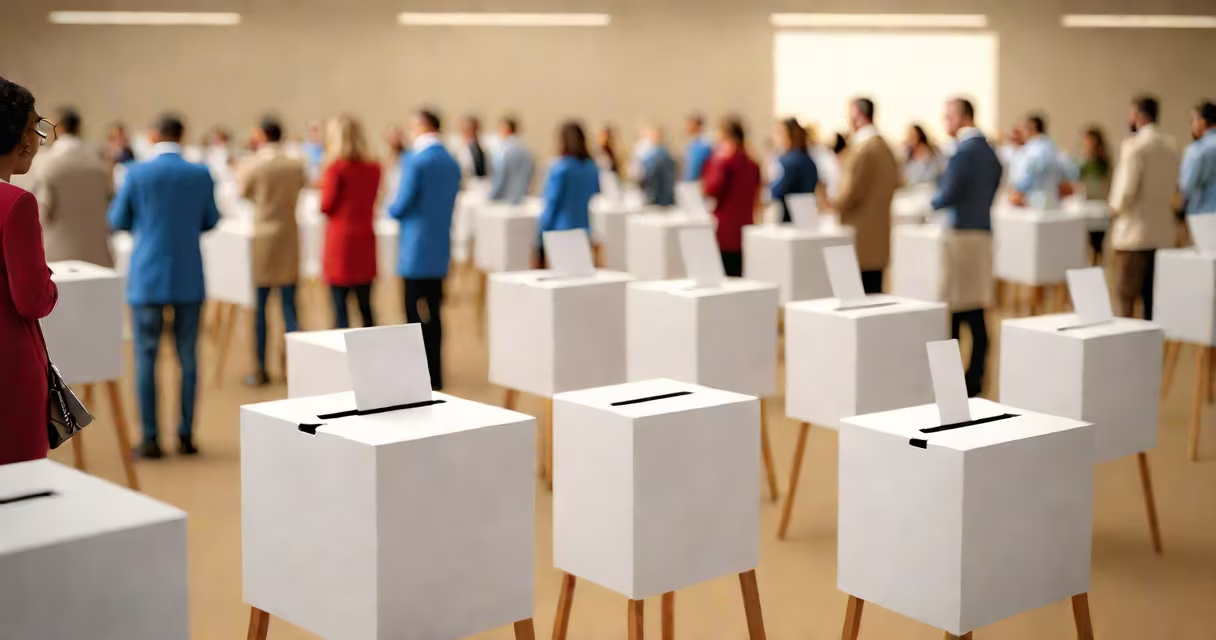
A democracy is a system of government where power rests with the people, who choose their leaders through free and fair elections. Citizens participate directly or through elected representatives to make decisions about laws and policies.
Democracy operates on the principle that everyone has a voice in shaping the rules that govern them. This includes the right to vote, run for office, speak freely, and assemble peacefully. The system relies on regular elections, transparency, and protection of individual rights.
According to the United Nations, democracy requires more than just elections-it demands accountability, rule of law, and inclusive participation. Countries like Sweden, New Zealand, and Costa Rica consistently rank high in democratic performance due to strong institutions and citizen engagement.
In a representative democracy, citizens elect individuals to serve in legislative bodies such as parliaments or congresses. These officials debate and pass laws on behalf of the population. The United States Congress and the UK Parliament are examples of representative systems.
Direct democracies allow voters to decide on issues directly through referendums or initiatives. Switzerland uses direct democracy extensively-citizens vote on national laws and constitutional changes multiple times a year. In 2023, Swiss voters approved a ban on new minarets and rejected a proposal to limit foreign worker quotas.
For democracy to function, mechanisms must exist to ensure fairness. This includes independent electoral commissions, free media, and access to information. In countries with weak institutions, elections may be manipulated or suppressed, undermining democratic legitimacy.
Democracies fall into two broad categories based on how decisions are made:
| Type | How It Works | Examples |
|---|---|---|
| Representative | Citizens elect officials to make laws and govern on their behalf. | United States, Germany, Japan |
| Direct | Citizens vote directly on laws and policies. | Switzerland, some U.S. states via ballot initiatives |
Some systems blend both models. The Netherlands uses proportional representation in parliamentary elections but allows citizens to propose legislation through a national initiative process.
Not all democracies are equal in practice. The Varieties of Democracy (V-Dem) Institute tracks global democratic quality using indicators like electoral fairness, civil liberties, and government effectiveness. As of 2023, only 21% of countries were classified as "high-quality" democracies.
Many assume democracy means majority rule alone. But effective democracies protect minority rights. In the U.S., the Constitution guarantees freedoms even when they're unpopular-such as freedom of speech for hate groups or religious minorities.
Another mistake is equating democracy with stability. Some nations hold elections but lack independent courts or free press. Venezuela held presidential elections between 2013 and 2021, yet international observers reported widespread voter suppression and ballot stuffing. The country's democracy score dropped from 6.5 to 2.1 on the V-Dem index during that period.
Democracy is not automatic. It requires active citizenship. A 2022 study by the Pew Research Center found that only 44% of Americans believed their government was responsive to public opinion. Voter turnout in U.S. midterm elections averages around 40%, far below the 70%+ seen in Nordic countries.
The 2020 U.S. presidential election demonstrated how democratic processes work under stress. Over 150 million votes were cast-about 66% of eligible voters. Results were certified in all 50 states after recounts and legal challenges.
Despite false claims of fraud, courts upheld the results. The Electoral College formally confirmed Joe Biden's victory in December 2020. This outcome reflects the resilience of democratic institutions when safeguards are respected.
Compare this to Belarus in 2020, where opposition candidate Sviatlana Tsikhanouskaya won 60% of the vote in unofficial counts, but the government declared Alexander Lukashenko the winner. International monitors called the election neither free nor fair. The contrast shows that elections alone don't guarantee democracy.
Democracy is not the same as a republic, though many democracies are republics. A republic is a state without a monarchy, while democracy refers to decision-making power. France is both-a republic and a democracy. North Korea calls itself a "people's republic," but lacks democratic features like free elections or independent media.
Also, democracy differs from authoritarianism. Authoritarian regimes may hold elections, but they control candidates, suppress dissent, and manipulate outcomes. China holds local elections, but only members of the Communist Party can run for national office. The Chinese government describes this as "socialist democracy," but independent analysts classify it as authoritarian.
One non-obvious fact: Not all democracies use majority rule. Some systems use consensus-based decision-making. In the Māori Parliament of New Zealand, decisions require agreement among tribal leaders, not a simple majority. This reflects indigenous governance traditions that prioritize harmony over competition.
I once observed a community meeting in Portland, Oregon, where residents voted on zoning changes using ranked-choice ballots. After three rounds of elimination, a compromise plan passed with 57% support. The process revealed how structured voting methods prevent gridlock and encourage collaboration-something often missing in polarized national politics.
Democracy is not perfect. It faces challenges like misinformation, gerrymandering, and voter suppression. But when institutions function, it enables peaceful change and protects human dignity. The definition of democracy simple captures this: power belongs to the people, exercised through fair processes and shared values.
Understanding what is a democracy simple definition helps clarify expectations. It's not about perfection-it's about process, participation, and accountability. When citizens engage, systems improve. When they disengage, risks grow.