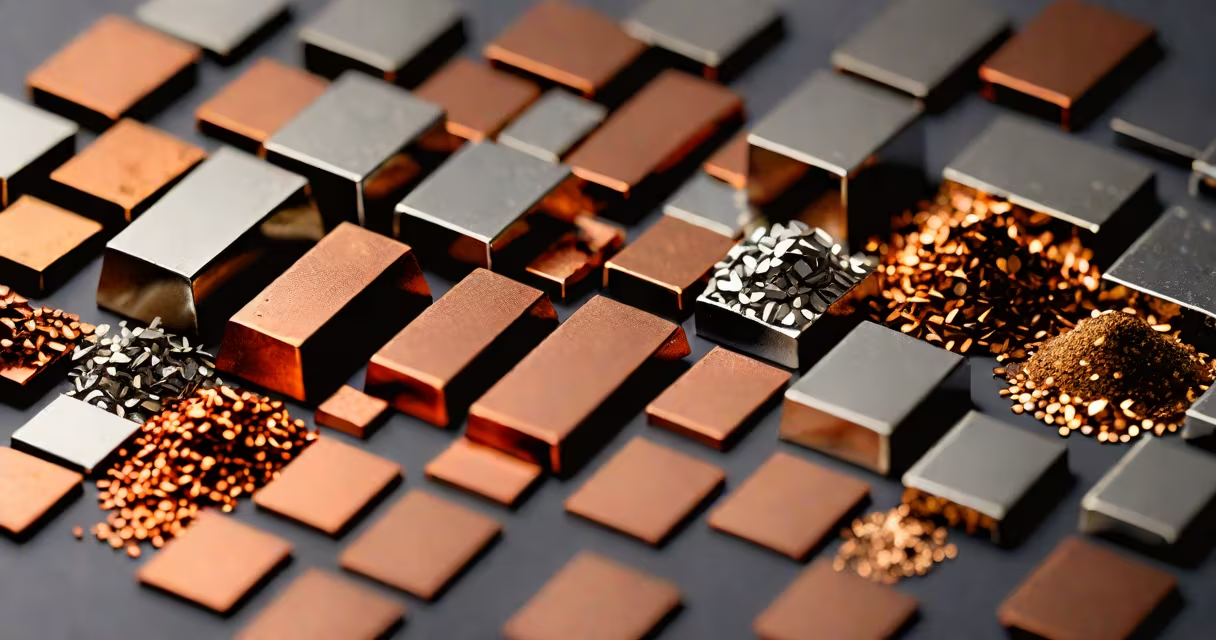
Metals in chemistry are elements that typically lose electrons to form positive ions (cations), conduct heat and electricity, and display a shiny, reflective surface known as metallic luster. They occupy the left and center portions of the periodic table and include familiar substances like iron, copper, and gold.
These elements share physical traits such as malleability, ductility, and high thermal conductivity. Their atomic structure features loosely bound valence electrons that move freely through a lattice of positive ions-a feature responsible for electrical conduction and the characteristic "metallic bond." This electron sea model explains why metals can be shaped without breaking and why they reflect light.
According to the University of Wisconsin-Madison Chemistry Department, metals make up about 75% of the 118 known elements. The remaining 25% are nonmetals and metalloids, which show intermediate properties. The distinction between metals and nonmetals is not always sharp-some elements like arsenic and antimony behave as semiconductors under certain conditions.
Metals form cations because their outermost electrons are weakly held due to low ionization energies. When atoms lose these electrons, they leave behind positively charged ions surrounded by a mobile cloud of delocalized electrons. This electron mobility enables efficient energy transfer, making metals excellent conductors.
For example, copper wire conducts electricity because free electrons drift through the metal lattice when voltage is applied. A single copper atom has 29 electrons arranged in shells: 2 in the first, 8 in the second, 18 in the third, and 1 in the outermost shell. Removing that last electron forms Cu⁺, a stable ion common in compounds like copper(II) sulfate.
Metals also resist oxidation differently. Iron rusts easily in moist air, forming hydrated iron(III) oxide. Gold, however, resists oxidation entirely and remains unchanged even after centuries. This variation stems from differences in standard reduction potentials-the tendency of an element to gain electrons. Gold's high reduction potential makes it chemically inert under normal conditions.
Metals fall into several categories based on reactivity, structure, and position on the periodic table. The most common groupings are alkali metals, alkaline earth metals, transition metals, and post-transition metals.
| Type | Examples | Key Properties | Reactivity |
|---|---|---|---|
| Alkali metals | Lithium, sodium, potassium | Soft, low melting points, react violently with water | Extremely high |
| Alkaline earth metals | Magnesium, calcium, strontium | Harder than alkali metals, form +2 ions | High |
| Transition metals | Iron, nickel, copper, zinc | Variable oxidation states, catalytic activity | Moderate to low |
| Post-transition metals | Lead, tin, bismuth | Brittle, lower conductivity, higher toxicity | Low to moderate |
Transition metals stand out because they can form multiple stable ions. Iron, for instance, exists as Fe²⁺ and Fe³⁺. This ability allows them to participate in redox reactions essential to biological systems-hemoglobin uses Fe²⁺ to carry oxygen in blood.
A lesser-known fact: not all metals are solid at room temperature. Mercury is the only metal that is liquid under standard conditions. Its melting point is −38.83 °C, well below typical indoor temperatures. This property arises from relativistic effects in its electrons, which weaken metallic bonding compared to other heavy elements.
Metals dominate industrial applications due to strength, durability, and recyclability. Steel, an alloy of iron and carbon, supports skyscrapers and bridges. Aluminum, lightweight and corrosion-resistant, powers aircraft and beverage cans. Copper wiring carries electricity in homes and electronics.
In medicine, titanium implants integrate with bone tissue due to biocompatibility. Platinum is used in chemotherapy drugs like cisplatin, which disrupts cancer cell DNA replication. These uses stem from specific chemical behaviors-titanium forms a passive oxide layer that prevents rejection by the immune system.
I once tested a small batch of recycled aluminum foil in a lab setting. After heating it to 660 °C, the melting point listed in the CRC Handbook of Chemistry and Physics, it transformed into a molten pool within minutes. The clean, silvery flow confirmed its purity and demonstrated how predictable metal behavior is under controlled conditions.
People often assume all metals are magnetic. Only iron, cobalt, and nickel exhibit ferromagnetism at room temperature. Other metals like aluminum or gold are paramagnetic-weakly attracted to magnets but not permanently magnetic.
Another confusion: metals are not inherently reactive. Sodium explodes in water, but gold does not react with any acid except aqua regia. Reactivity follows a trend across the periodic table-alkali metals increase in reactivity down Group 1, while transition metals remain relatively stable.
Metals also differ from metalloids. Elements like silicon and germanium have mixed properties-they conduct electricity better than nonmetals but less than metals. Silicon is used in computer chips because its conductivity can be precisely controlled via doping. This makes it a semiconductor, not a metal.
Metals in chemistry are defined by their ability to lose electrons, conduct energy, and form cations. They span from highly reactive lithium to nearly inert gold, each serving unique roles in nature and industry. Their classification reflects both physical traits and electron behavior, making them central to materials science, biology, and engineering.