The meaning of beatitudes in the Bible centers on Jesus' declarations of blessing for those who live with humility, mercy, and justice-offering spiritual reward rather than material gain. Found in Matthew 5:3-12 and Luke 6:20-23, they define a counter-cultural path to true happiness rooted in moral integrity and dependence on God.
Beatitudes appear in two forms: Matthew's eightfold list in the Sermon on the Mount and Luke's four paired with woes. Both emphasize inner qualities over external success. The word "blessed" translates Greek μακάριοι (makarioi), meaning "happy" or "fortunate," but not in the sense of fleeting joy-it implies lasting well-being derived from divine favor.
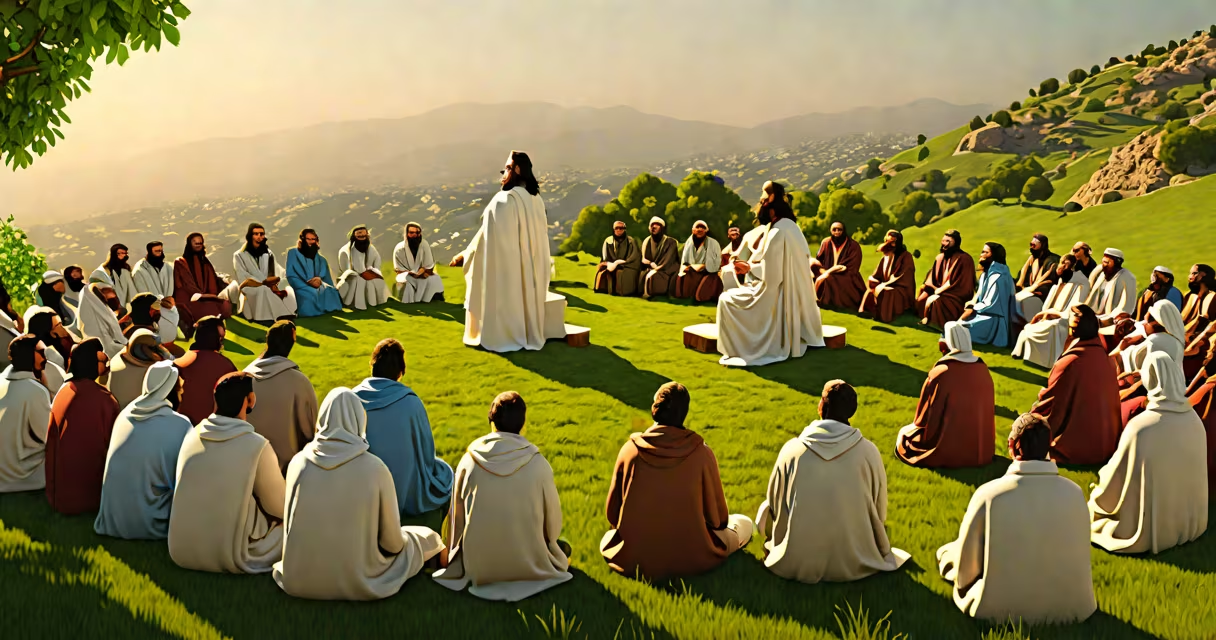
These teachings were delivered during a key moment in Jesus' ministry. He climbed a hill near Capernaum, gathered disciples, and spoke directly to a crowd. His message reframed values: mourning brings comfort, the meek inherit the earth, the peacemakers are called children of God. This was not abstract philosophy-it was a call to action for daily living under God's kingdom.
Each beatitude follows a pattern: a condition (e.g., "those who mourn"), a promise ("they will be comforted"), and often a reversal of worldly expectations. The poor in spirit receive the kingdom of heaven-not because they lack wealth, but because they recognize their spiritual need.
Jesus didn't promise earthly prosperity. The blessed are not the rich, useful, or popular. Instead, he blesses the persecuted, the merciful, the pure in heart. These traits aren't optional extras-they're foundational to the new way of life he introduced.
A key insight from theologian N.T. Wright is that the beatitudes aren't about earning salvation through behavior. They describe the character of those already part of God's kingdom. As Wright writes in Matthew for Everyone, Part 1, "The beatitudes are not a checklist for entry-they are a portrait of what life looks like when God's rule is truly present."
Matthew presents the beatitudes as a formal list, structured around eight virtues. Luke offers a shorter version focused on social inversion-blessing the poor, hungry, and weeping, while warning the rich, full, and laughing. This contrast highlights the radical nature of Jesus' message.
| Gospel | Number of Beatitudes | Key Themes | Distinctive Features |
|---|---|---|---|
| Matthew 5 | 8 | Holiness, purity, peacemaking | Formal structure; emphasizes internal state |
| Luke 6 | 4 | Social justice, reversal of fortune | Pairs blessings with woes; focuses on material conditions |
Matthew's version includes "blessed are the peacemakers, for they will be called children of God"-a direct link between human action and divine identity. Luke's version says, "Blessed are you who are poor, for yours is the kingdom of God," emphasizing economic reality.
These differences reflect the authors' audiences. Matthew wrote for Jewish Christians concerned with law and righteousness. Luke addressed a broader, Gentile-influenced audience where poverty and marginalization were visible realities.
Many assume the beatitudes promise immediate relief from suffering. But the blessings are not always visible in this life. The persecuted are promised comfort-but not necessarily deliverance from persecution. The reward is spiritual and eternal, not always temporal.
Another mistake is treating the beatitudes as a ladder of virtue. People think being "poor in spirit" comes before being "meek," but Jesus doesn't rank them. Each is equally valid. The beatitudes are not a hierarchy of holiness-they are interconnected marks of kingdom living.
A lesser-known point: the term "blessed" in Greek carries a passive sense. The recipients don't earn the blessing-they receive it. This is not self-improvement. It's grace. As scholar Craig L. Blomberg notes in Matthew (NAC), "The beatitudes are not about what people do to achieve blessing-they are about what God does in response to faithful posture."
In practice, the beatitudes challenge modern assumptions about success. A person who is "poor in spirit" may be someone who admits their limits-like a leader who says, "I don't have all the answers." That honesty opens space for wisdom and collaboration.
Consider a teacher who chooses to stay in a low-income school despite better-paying offers. She's not wealthy, but she embodies "blessed are the poor in spirit" through her reliance on purpose over pay. Her impact isn't measured in test scores alone-it's seen in students who feel seen and valued.
Another example: a man who forgives his estranged brother after years of silence. He's not seeking recognition. He's acting out "blessed are the merciful." His peace isn't guaranteed, but the act itself aligns him with the kingdom's values.
I once visited a community center in rural Appalachia where volunteers served meals to people facing housing instability. One woman, after serving food, knelt to pray quietly. She wasn't performing-she was embodying "blessed are the peacemakers." Her actions weren't flashy, but they reflected the beatitudes in motion.
The beatitudes are not a formula for personal success. They are not a list of behaviors to check off for divine approval. They are not motivational slogans to hang on walls.
They are not equivalent to prosperity theology, which teaches that faith leads to wealth. The beatitudes reverse that idea: the poor in spirit, the hungry, the mourners-all are promised something greater than money.
They are also not identical to the Ten Commandments. The commandments set boundaries. The beatitudes describe the character of those who live within God's reign. One tells you what to avoid; the other shows you what to become.
The beatitudes are not a blueprint for perfection. They are a compass for direction. They show what life looks like when God's rule is real-not in grand gestures, but in quiet acts of kindness, forgiveness, and integrity.
The meaning of beatitudes in the Bible is not about achieving a certain emotional state. It's about becoming a person shaped by God's priorities-where humility, justice, and mercy are not ideals, but habits of the heart.