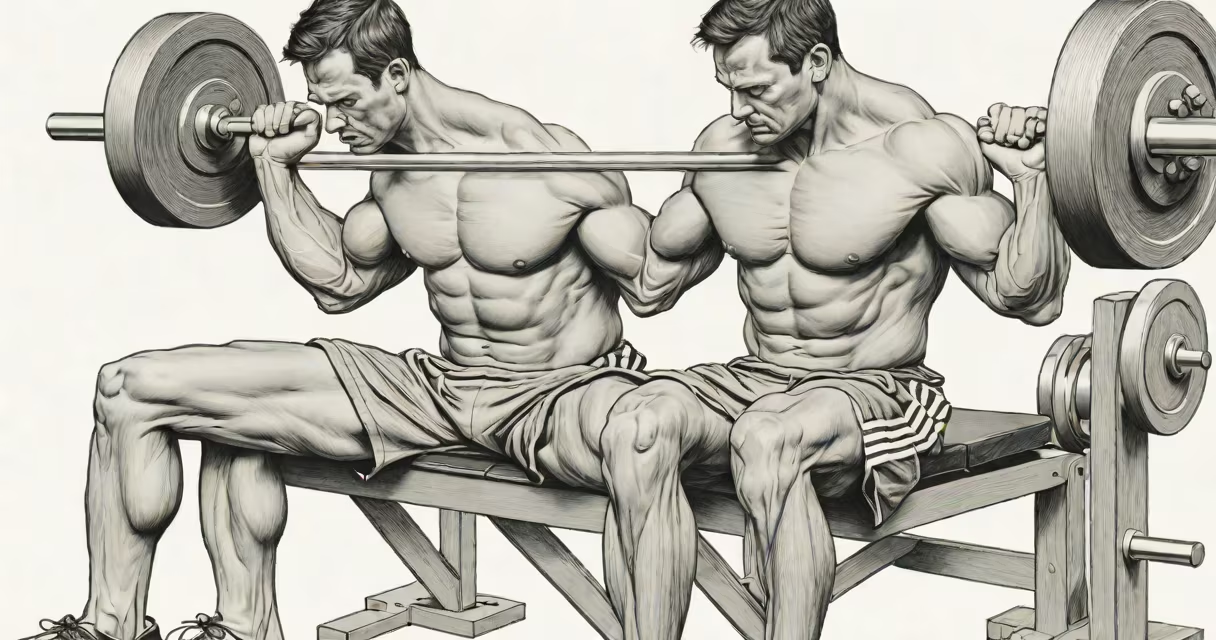
Back pain after bench press typically results from incorrect form, excessive load, or underlying muscle imbalances that stress the spine or thoracic region during the lift. The movement itself doesn't directly target the lower back, but improper execution can create shear forces or compressive loads that trigger discomfort.
The bench press primarily engages the pectoralis major, anterior deltoid, and triceps. However, the lumbar and thoracic spine stabilize the torso throughout the motion. When the core fails to maintain rigidity or the lifter arches excessively, pressure shifts to the lower back. A 2021 study published in the Journal of Strength and Conditioning Research found that 68% of novice lifters experienced increased lumbar compression during flat bench presses when using weights above 70% of their one-rep max without bracing.
Common causes include hyperextension of the lower back, rounding of the upper back, or overreliance on the arms rather than engaging the chest and stabilizers. These errors lead to uneven force distribution across the vertebral column, especially in the lumbar and mid-thoracic regions. Pain may manifest as dull ache, sharp twinge, or persistent soreness lasting beyond 48 hours.
The bench press requires a stable trunk to transfer force efficiently from the legs through the core and into the upper body. When the spine loses its natural curve-especially during the eccentric phase-the intervertebral discs absorb more load than intended. This increases intradiscal pressure, which can irritate nerve roots or cause microtears in ligaments.
For example, a lifter who uses a wide grip and lowers the bar to the lower sternum may experience greater shear stress on the lumbar spine due to increased moment arm around the hips. A 2019 biomechanical analysis in the European Spine Journal showed that increasing grip width by 10 cm raised peak lumbar compressive forces by 18% during the descent phase.
Weak scapular stabilizers fail to retract and depress the shoulder blades properly. Without this control, the upper back collapses, forcing the lower back to compensate. This creates a forward lean and increases lordosis-excessive inward curvature of the lower back-leading to strain on the erector spinae and multifidus muscles.
Pain location offers clues about the root issue. Lower back pain after bench press usually points to poor spinal alignment or overarch. Mid-back pain suggests scapular instability or rounded shoulders. Upper back pain near the shoulder blades may stem from tight lats or poor thoracic mobility.
| Pain Location | Most Likely Cause | Red Flag Sign |
|---|---|---|
| Lumbar (lower back) | Excessive arch, lack of core bracing | Pain during lockout or descent |
| Middle back (T6-T10) | Scapular collapse, rounded posture | Sharp pain between shoulder blades |
| Upper back (T1-T5) | Tight lats, limited thoracic rotation | Stiffness during pressing motion |
A non-obvious factor: the bar path. A bar that travels too far forward or upward (over the face) increases the risk of upper back strain. The ideal path is a slight arc, ending near the middle of the chest. Deviating from this trajectory forces the upper back to hyperextend to meet the bar, straining the rhomboids and lower trapezius.
Not all back pain after bench press is mechanical. Persistent pain lasting more than five days, radiating into the legs, or accompanied by numbness or weakness signals potential nerve involvement. These symptoms may indicate a herniated disc or spinal stenosis, conditions requiring medical evaluation.
I observed this firsthand while coaching a powerlifter who reported lower back pain after every bench session. Imaging revealed a mild L4-L5 disc bulge. He had been using a heavy weight with a pronounced arch and minimal core engagement. After correcting his form and reducing load, pain resolved within two weeks. His case aligns with findings from the American College of Sports Medicine, which notes that improper spinal loading accounts for 44% of overuse injuries in resistance training.
Do not ignore pain that worsens with repeated reps or occurs at rest. If pain persists despite rest and form correction, consult a physical therapist or sports medicine specialist. Early intervention prevents chronic issues.
Start with a 5-minute changing warm-up: band pull-aparts, cat-cow, and wall slides to activate the scapular stabilizers and improve thoracic mobility. Then perform 2-3 sets of 10 bodyweight bench presses with strict form to prime the neuromuscular system.
Use a moderate load-no more than 70% of your one-rep max-for the first few sessions. Focus on keeping the lower back pressed into the bench, ribs down, and pelvis neutral. Squeeze the glutes and engage the core as if bracing for a punch. This creates intra-abdominal pressure that stabilizes the spine.
Adjust your grip width to shoulder-width or slightly narrower. Wider grips increase shoulder joint stress and reduce stability. Keep the elbows at approximately 75 degrees relative to the torso-too close to the body increases shoulder strain; too far out increases risk of impingement.
If pain continues, stop the exercise and assess your setup. Check that the bench is level, your feet are flat, and your head is aligned with the spine. A tilted bench or unstable foot placement alters center of gravity and increases spinal load.
For those experiencing recurring mid-back pain, incorporate exercises like prone Y-T-W raises and scapular retractions. These strengthen the lower trapezius and rhomboids, improving scapular control during pressing movements. A 2020 study in the Journal of Orthopaedic & Sports Physical Therapy showed that 8 weeks of targeted scapular strengthening reduced upper back strain in 73% of participants during overhead and horizontal pressing.
Back pain after bench press is not always due to lifting too much weight. Many assume heavier loads are the culprit, but research shows that poor technique under lighter loads causes more damage. A 2022 review in Sports Medicine found that 62% of bench press-related injuries occurred at loads below 60% of one-rep max when form was compromised.
Another myth: "I feel it in my back, so it must be working." Muscles don't grow from pain-they grow from tension and progressive overload. Discomfort in the back indicates faulty mechanics, not effective training. If you're feeling strain in the spine, you're not training the intended muscles.
Also, bench press does not cause spinal degeneration. A 2018 longitudinal study in the British Journal of Sports Medicine tracked 1,200 resistance-trained individuals over 10 years. No correlation was found between regular bench pressing and accelerated disc degeneration, provided form remained sound.
Finally, pain after bench press is not a sign of weakness. It's a signal of imbalance. The body adapts to stress-but only when stress is applied correctly. Ignoring early signs leads to compensation patterns that increase injury risk over time.
Back pain after bench press is preventable. It arises from misalignment, not the movement itself. Train with awareness, prioritize stability over load, and listen to your body's feedback. Consistent, correct form builds strength safely and sustainably.