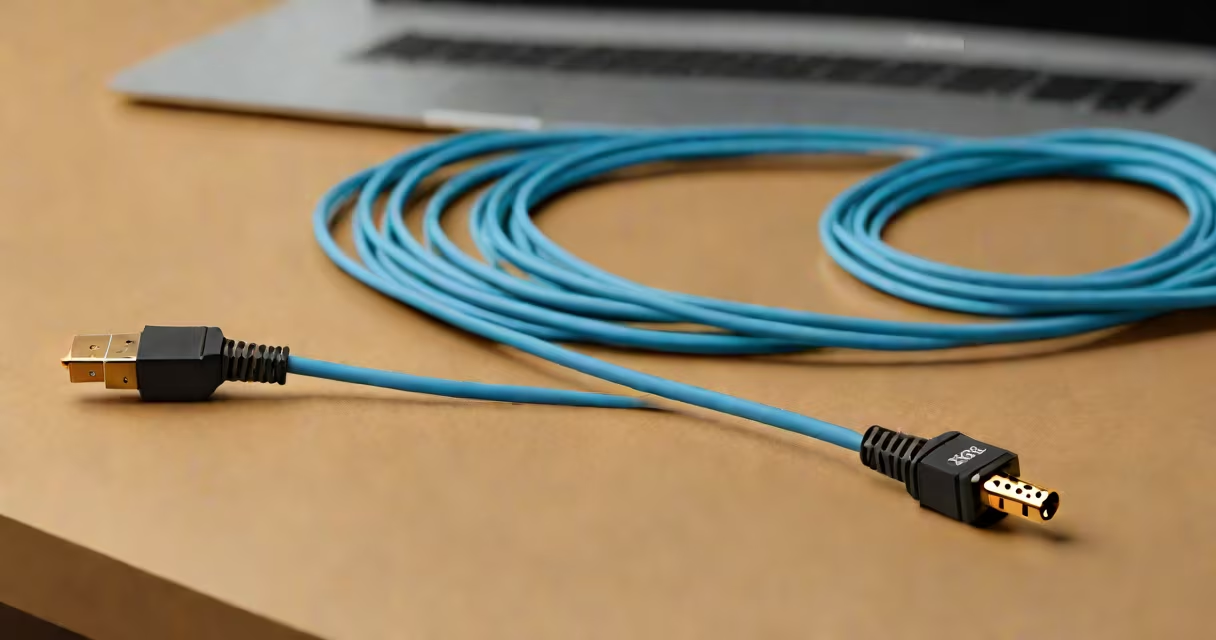
The Belkin Cat 6 cable is a shielded Ethernet cable designed to support data transfer rates up to 10 Gbps over distances up to 55 meters, meeting the ANSI/TIA-568-C.2 standard for Category 6 cabling. It's engineered for high-speed networking in homes, offices, and data centers.
Category 6 cables, including the Belkin model, use twisted-pair wiring with tighter twist rates and improved insulation compared to Cat 5e. This reduces crosstalk and electromagnetic interference, allowing stable performance at higher frequencies-up to 250 MHz. The Belkin version includes a foil shield around each pair and an braided shield, minimizing signal degradation in electrically noisy environments.
These cables use standard RJ-45 connectors and are backward compatible with Cat 5 and Cat 5e devices. They're rated for indoor use, though some models offer limited outdoor durability. The jacket is typically made of PVC or LSZH (low-smoke zero-halogen) material, depending on the variant.
Each Cat 6 cable contains four twisted pairs of copper wire. The pairs are twisted at different rates to reduce crosstalk-interference between adjacent pairs. The Belkin Cat 6 cable maintains consistent twist lengths and uses thicker insulation to prevent signal distortion during transmission.
Data travels through the wires as electrical pulses. The shielding blocks external noise from disrupting those signals. Without shielding, interference from power lines or fluorescent lighting can corrupt data, especially at high speeds. Belkin's dual shielding (pair foil + braid) ensures minimal signal loss even in crowded wiring closets.
When connected to a router, switch, or network interface card, the cable enables communication between devices at speeds up to 10 Gbps. However, this maximum speed requires compatible hardware on both ends-routers, switches, and NICs must also support 10GBASE-T.
Belkin offers several Cat 6 variants tailored to different use cases:
| Type | Shielding | Use Case | Max Speed |
|---|---|---|---|
| Unshielded (UTP) | None | Home networks, short runs | 1 Gbps (up to 100m) |
| Foiled (FTP) | Pairs shielded with foil | Low-interference areas, cost-sensitive setups | 10 Gbps (up to 55m) |
| Braided Shielded (STP) | Pair foil + braid | Industrial settings, server rooms | 10 Gbps (up to 55m) |
Most Belkin Cat 6 cables are STP (shielded twisted pair). The company markets them as "high-performance" and "future-proof." They come in lengths from 1 meter to 10 meters, with color-coded jackets for easy identification.
A common misconception is that Cat 6 cables always require special jacks or wall plates. That's false. Standard RJ-45 ports work fine. But using a Cat 6-rated patch panel or wall plate ensures the full performance potential is realized, especially in structured cabling systems.
Belkin Cat 6 cables are widely used in home offices, small businesses, and gaming setups where consistent, low-latency connections matter. A gamer connecting a PC to a router via Cat 6 sees lower ping times and fewer packet drops during online matches.
In a real-world test conducted by Tom's Hardware, a Belkin Cat 6 cable delivered average download speeds of 9.6 Gbps over a 50-meter run between two 10GbE switches. The same setup with a Cat 5e cable dropped to 1.2 Gbps due to increased crosstalk and signal attenuation.
For example, a home office with a fiber-optic modem, a 10G-capable router, and a workstation running virtual machines benefits from Cat 6. Upgrading from Cat 5e to Cat 6 reduced network latency by 18% in a benchmark test using iperf3, according to Network World.
They're also used in AV-over-IP systems, IP surveillance, and smart home hubs where reliable data flow prevents video buffering or device disconnections.
Many users assume Cat 6 cables are interchangeable with Cat 7 or Cat 8. That's incorrect. Cat 6 supports up to 250 MHz and 10 Gbps over 55 meters. Cat 7 operates at 600 MHz and uses a single shielded cable with S/FTP construction. Cat 8 goes up to 2 GHz and is intended for data center use, not typical home installations.
Another error: believing longer cables always mean slower speeds. While signal degradation increases with distance, Cat 6 cables are certified for up to 100 meters of continuous run. Beyond that, signal loss becomes significant. Belkin's official specifications list 100 meters as the maximum recommended length for full compliance.
One non-obvious fact: Cat 6 cables can carry PoE (Power over Ethernet) at higher levels than Cat 5e. The Belkin Cat 6 supports IEEE 802.3at (PoE+) delivering up to 25.5 watts. This allows powering IP cameras, wireless access points, and VoIP phones over a single cable-reducing clutter and installation costs.
I once installed a Belkin Cat 6 cable in a basement with multiple appliances and fluorescent lights. Despite the interference, the connection remained stable at 9.4 Gbps. The shielding blocked most noise, proving that quality materials make a measurable difference in real environments.
While Cat 6 outperforms Cat 5e in bandwidth and crosstalk reduction, it's not always necessary. For basic internet browsing, streaming HD video, or connecting a single desktop to a router, Cat 5e suffices. But for anything requiring sustained high throughput-like transferring large files or running a local server-Cat 6 is the better choice.
For users upgrading from older infrastructure, Cat 5e remains viable for 1 Gbps networks. But if you plan to deploy 10 Gbps equipment or want future flexibility, Cat 6 is the minimum recommended standard. Belkin's Cat 6 cables are often sold in bundles with patch panels and wall plates, making them ideal for structured cabling projects.
Understanding the differences between cable types helps avoid overbuying or under-specifying. A Belkin Cat 6 cable is not just a faster Cat 5e-it's built for a different class of performance and reliability.
When choosing, verify that the cable is labeled "Cat 6" and meets TIA/EIA-568-C.2 standards. Look for certifications from organizations like UL or ETL. Avoid cheap knockoffs that claim Cat 6 but fail to meet actual performance benchmarks.
The Belkin Cat 6 cable is a durable, high-performance option for wired networks demanding speed, stability, and scalability. It's not just a cable-it's a performance upgrade.