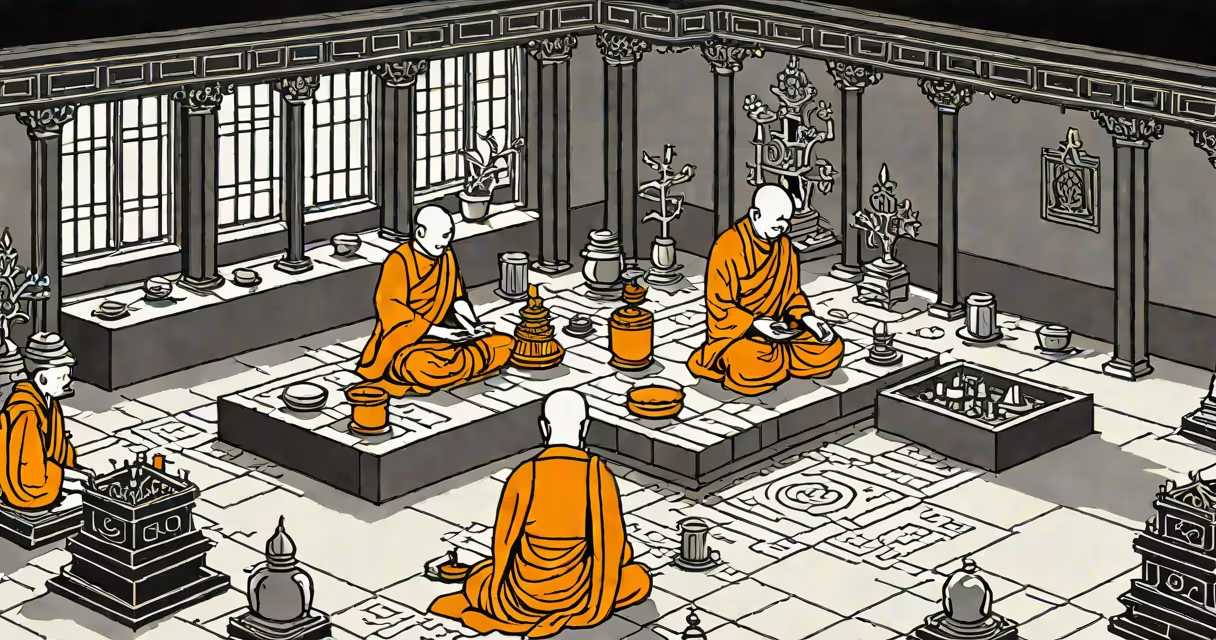
Buddhist death rituals 7 days refer to a sequence of daily ceremonies, meditations, and offerings conducted over seven days following a person's passing. These observances are based on beliefs about the intermediate state (bardo) between death and rebirth, particularly in Tibetan and East Asian traditions. The rituals aim to guide the consciousness, reduce suffering, and generate merit for the deceased.
The core practice involves reciting sacred texts such as the Profound Dharma of the Middle Way or the Tibetan Book of the Dead (Bardo Thodol) each day. Monks or family members lead chanting sessions, often lasting 30 to 60 minutes, while offerings of food, incense, and candles are placed at a shrine. The seventh day holds special significance as the final opportunity to influence the soul's direction before rebirth.
These rituals are not uniform across all Buddhist schools. Theravāda communities in Sri Lanka and Southeast Asia may observe a shorter period focused on almsgiving and merit transfer. Mahāyāna traditions in China, Korea, and Japan extend the observance to 49 days, but the seventh day remains a key milestone. In Tibet, the 7-day period is part of a larger cycle, with specific visualizations and mantra recitations tailored to the deceased's mental state.
Each day centers on a structured sequence: morning prayer, offering preparation, chanting session, and evening reflection. The chanting is performed in Pali, Sanskrit, or local languages depending on regional tradition. The sound of the chant is believed to create a protective field around the consciousness and remind the deceased of their true nature-emptiness and compassion.
Offerings are symbolic. Food is placed on a tray and later distributed to the poor or burned as a gesture of letting go. Incense represents purification, and light symbolizes wisdom dispelling ignorance. These acts are not magical but serve as focal points for collective intention. A 2018 study published in Journal of Religion and Health found that families who participated in daily rituals reported lower levels of anxiety and higher perceived closure compared to those who did not.
In a monastery in Sikkim, I attended a 7-day ceremony for a monk who died suddenly. The room was dim, lit only by butter lamps. Each evening, a group of five monks chanted for 45 minutes in unison. The air thickened with scent. On the seventh day, the head monk placed a small statue of Avalokiteśvara in the center of the altar and said, "May the light of compassion guide you." The silence afterward felt heavier than the sound had.
Differences in ritual form reflect doctrinal emphasis. Here's a comparison of major traditions:
| Tradition | Duration | Key Practice | Primary Text |
|---|---|---|---|
| Tibetan | 7 days (part of 49-day cycle) | Chanting of Bardo Thodol, visualization of deities | Tibetan Book of the Dead |
| Chinese Mahāyāna | 7 days (often extended to 49) | Recitation of the Smaller Sukhāvatīvyūha Sūtra, merit-making | Sukhāvatīvyūha Sūtra |
| Japanese Shingon | 7 days (with additional 3-day cycles) | Mantra recitation using mudras, mandala creation | Shingon Canon |
| Sri Lankan Theravāda | 3 days (occasionally extended) | Almsgiving to monks, merit transfer | Theragāthā, Udāna |
Despite differences, all traditions emphasize mindfulness and community participation. The 7-day mark is not arbitrary-it aligns with the belief that the soul's process through the bardo lasts up to seven weeks, with critical decision points at the end of each week.
Many assume Buddhist death rituals are purely funereal. They are not. The focus is not on grief but on spiritual care. The rituals do not guarantee rebirth in a pure land or enlightenment. Instead, they provide a structure for releasing attachment and generating positive karmic momentum.
A common error is equating the 7-day period with a "final judgment." There is no divine verdict in Buddhism. The soul's next form arises from accumulated karma and mental habits. The rituals help stabilize awareness during the transitional phase, which can last up to 49 days. The seventh day is not a deadline but a turning point.
Another misconception is that only monastics can perform the rites. While trained monks lead most ceremonies, laypeople can participate. In rural Japan, families conduct daily chanting at home altars. In Thai temples, volunteers take shifts reading sutras. The act of listening and repeating mantras is itself a form of devotion.
In 2022, a family in Kyoto observed the 7-day ritual for their grandmother, a lifelong practitioner of Pure Land Buddhism. Her son, a software engineer, arranged for a local temple to send a monk twice daily. Each morning, the monk arrived at 7 a.m. to chant the Amida Sutra for 20 minutes. The family gathered in the living room, bowing before a photo of the deceased.
On the third day, the family prepared a meal of rice, vegetables, and miso soup. After the monk left, they offered the food to a small altar and then ate it themselves. This act, called shōmyō, symbolized sharing merit. By the seventh day, the family had written letters to her spirit, expressing gratitude and release. The monk concluded with a short prayer: "May your path be clear. May you find peace."
Afterward, the family donated the remaining offerings to a nearby shelter. The ritual ended not with closure but with continued practice-weekly visits to the temple and monthly remembrance ceremonies.
Modern life often separates people from ritual. The 7-day structure provides a scaffold for emotional processing and spiritual continuity. According to the Encyclopedia of Buddhism (2020), daily observances reduce psychological distress by anchoring attention in disciplined action rather than rumination.
For those going through loss, the ritual offers a way to act with purpose. It is not passive mourning. It is active care. The seventh day is not a ritual endpoint-it is a threshold. As one monk in Bhutan told me, "The dead don't hear us. But we hear ourselves when we speak their name aloud."
Understanding buddhist death rituals 7 days reveals a practice grounded in compassion, not fear. It is not about controlling fate but about creating conditions for peace. Whether led by a monk or a family member, the daily acts of offering, chanting, and remembrance are a quiet act of love.