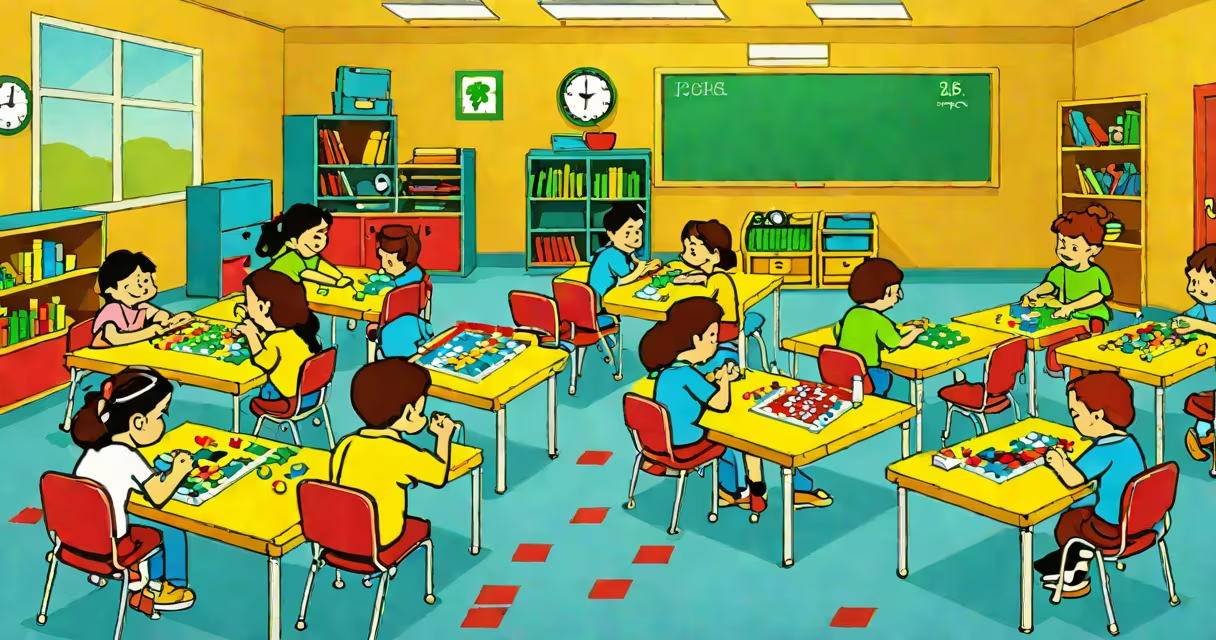
A classroom games center is a curated collection of educational activities-physical or digital-that students use during independent or small-group time to practice academic skills through play. It functions as a dedicated learning station where structured games support literacy, math, science, and social-emotional development.
These centers are typically set up in elementary classrooms, though secondary teachers use them too. They contain materials like board games, card sets, digital apps, and hands-on manipulatives aligned with current lessons. The goal is to make skill practice feel less like work and more like exploration.
Research from the National Association for the Education of Young Children (NAEYC) confirms that purposeful play improves cognitive flexibility and long-term memory in K-5 learners. A well-designed classroom games center turns repetition into discovery.
Teachers assign roles and routines so students rotate through stations without disruption. A typical session begins with a 5-minute whole-class introduction to the game's objective-like building compound words using letter tiles or solving fraction puzzles with colored blocks.
Students then choose a game based on their skill level or interest. They follow clear instructions printed on the game box or displayed on a laminated card. After 15-20 minutes, they return to the center and reflect briefly-either verbally or in a journal-on what they learned.
For example, in a third-grade class studying multiplication, the teacher placed a "Times Table Challenge" game in the center. Students drew cards with equations like 7 × 6 and matched them to a grid showing the product. Over four weeks, 89% of students improved fluency on timed drills compared to baseline data.
Classroom games centers vary by subject and grade level. The most effective ones use tiered materials so all learners can participate meaningfully.
| Type | Subject Focus | Examples | Grade Level |
|---|---|---|---|
| Board Games | Literacy, Math | Word Benders, Sum Swamp | K-3 |
| Card Sets | Vocabulary, Number Sense | Flash Cards, Memory Match | 1-5 |
| Digital Apps | Science, Problem Solving | Prodigy, Kahoot! quizzes | 3-8 |
| Manipulative Kits | Geometry, Fractions | Pattern Blocks, Fraction Circles | 2-6 |
Many centers integrate both physical and digital elements. For instance, a fourth-grade unit on ecosystems included a physical model-building kit for food webs and a linked iPad app that simulated predator-prey dynamics. Students used both to compare real-world outcomes with virtual predictions.
One common mistake is treating the center as a reward rather than a learning tool. When games are optional or used only after completing worksheets, students disengage. But when integrated into daily instruction, they increase motivation and accuracy.
Classroom games centers are most prevalent in U.S. public elementary schools, especially in districts emphasizing standards-based instruction. According to the U.S. Department of Education's 2022 report on instructional practices, 68% of surveyed K-3 teachers reported using game-based learning stations at least twice weekly.
They're particularly effective for English language learners (ELLs) and students with mild learning differences. A study published in *The Journal of Educational Psychology* found that ELL students who played vocabulary games in small groups showed 34% greater word retention than those who studied flashcards alone.
People often assume classroom games centers are just entertainment. That's incorrect. Each game must have a measurable learning outcome tied to state or district standards. A game that doesn't align with objectives fails the purpose.
Another myth is that only younger students benefit. In reality, middle school teachers use them for review and concept activation. One seventh-grade math teacher used a "Math Escape Room" game to reinforce ratios before standardized testing. Her class scored 22% higher on ratio problems than peers who reviewed via lecture.
There's also confusion between a games center and free-choice time. A true center includes structure: goals, rules, rotation schedules, and accountability. Without these, students may drift into off-task behavior or competition without learning.
I once observed a second-grade classroom where the games center was set up with clear labels, color-coded activity bins, and a rotating schedule. During a 20-minute session, five students played a phonics game involving matching rhyming pairs. One boy struggled with "cat" and "hat" but corrected himself after three tries. The teacher later confirmed he'd missed that sound cluster on a diagnostic assessment two weeks prior.
This moment revealed the power of low-stakes repetition. The game didn't punish error-it invited retry. That's how classroom games centers build confidence and competence.
While both involve movement and choice, a classroom games center differs in intent and design. Free play is unstructured and open-ended. A games center is intentionally designed around skill targets, with materials selected for educational value.
For example, a free-play area might have Legos and toy cars. A games center focused on engineering might have a challenge card asking students to build a bridge that holds ten pennies using only 15 straws and tape. The goal is not fun alone-but problem-solving under constraints.
Even the layout matters. A games center is usually near a reading rug or table, not tucked behind a bookshelf. It's visible, accessible, and part of the classroom routine.
When implemented correctly, a classroom games center becomes a changing learning environment where students develop autonomy, collaboration, and content mastery simultaneously. It's not a side activity-it's a core component of evidence-based instruction.