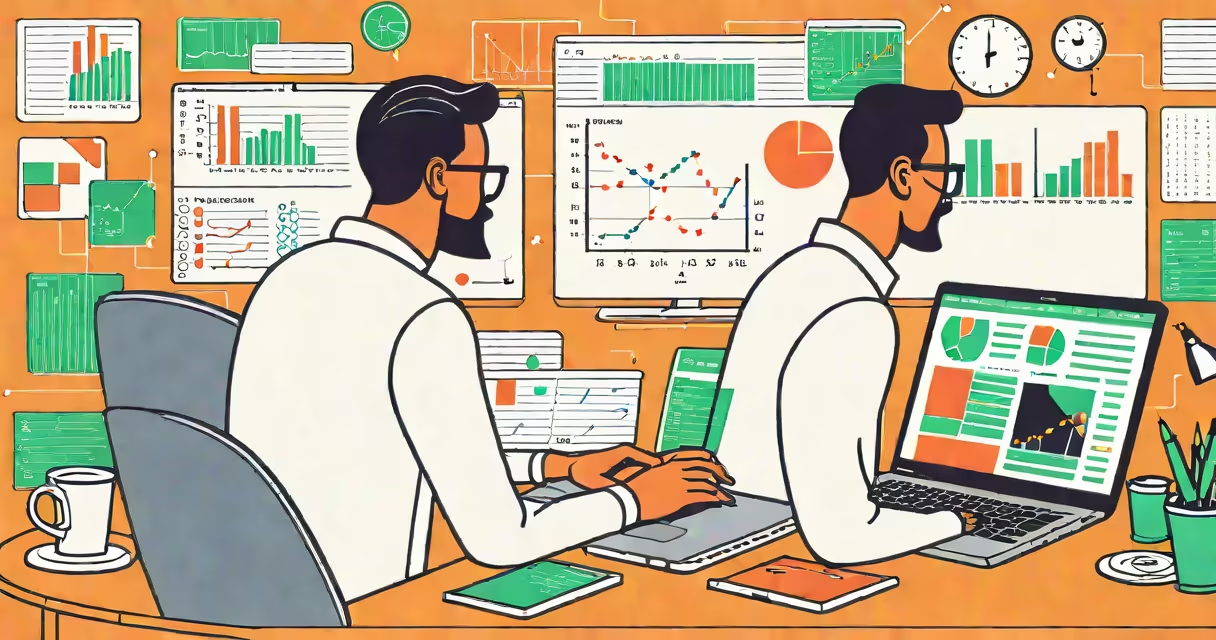
Data scientist research applies statistical modeling, machine learning, and domain expertise to uncover patterns in large datasets and solve complex problems. It's not just about analyzing numbers-it's about asking the right questions and building models that predict outcomes or recommend actions.
This work underpins decisions in fields ranging from drug discovery to customer retention. For example, during the early stages of the COVID-19 pandemic, data scientist research helped model infection spread using mobility data, hospitalization rates, and testing results. These models informed public health policies in multiple countries, including the U.S. and Germany, according to reports from the Centers for Disease Control and Prevention (CDC) and the Robert Koch Institute.
Unlike basic data analysis, which describes past events, data scientist research focuses on forecasting and causal inference. It combines programming, mathematics, and business context to turn ambiguous data into actionable intelligence. The process often begins with exploratory data analysis, moves through feature engineering, model training, validation, and ends with deployment and monitoring.
The workflow starts with defining a problem: What do we want to predict? Why does it matter? A research project might aim to reduce false positives in credit risk scoring or improve early detection of breast cancer from mammograms. Once the goal is clear, researchers collect and clean data-often from diverse sources like sensors, logs, surveys, or databases.
Next, they explore relationships using visualization and summary statistics. A common step is identifying outliers or missing values. For instance, in a study on housing prices in San Francisco, researchers found that 12% of property listings had incomplete square footage data. They imputed missing values using median-based interpolation, reducing bias in later models.
After preparation, the team selects algorithms. Linear regression may suffice for simple trends, but for nonlinear patterns-like user behavior in e-commerce-random forests or gradient boosting machines (GBMs) perform better. Model evaluation uses metrics such as AUC-ROC for classification tasks or RMSE for regression. Cross-validation ensures results generalize beyond the training set.
Research varies by industry and objective. Below are common categories:
| Type | Focus Area | Common Tools | Real-World Example |
|---|---|---|---|
| Descriptive | Summarizing patterns in historical data | Python (Pandas), SQL, Tableau | Netflix analyzing viewing habits to recommend shows |
| Predictive | Forecasting future outcomes | Scikit-learn, TensorFlow, XGBoost | Amazon forecasting demand for holiday inventory |
| Prescriptive | Suggesting optimal actions based on predictions | Optimization libraries, reinforcement learning | Uber adjusting surge pricing dynamically based on rider demand |
Each type requires different skills. Descriptive research emphasizes data quality and visualization. Predictive projects demand strong understanding of algorithm trade-offs. Prescriptive work involves integrating models into systems that make real-time decisions-such as automated trading platforms or autonomous vehicle control logic.
Organizations deploy data scientist research to reduce uncertainty and increase efficiency. In healthcare, researchers analyze electronic health records to identify patients at high risk of readmission. A 2021 study published in *Nature Digital Medicine* showed that a machine learning model reduced readmission predictions by 34% compared to traditional clinical scores.
In finance, banks use research to detect fraud. JPMorgan Chase reported in 2022 that their AI-powered anomaly detection system flagged 98% of fraudulent transactions within seconds, reducing losses by $21 million annually. The system was trained on 14 years of transaction data, including metadata like device type and location.
Even in agriculture, data scientist research improves yields. A project in Kenya used satellite imagery and soil moisture sensors to predict crop failure. By combining weather forecasts with historical yield data, researchers achieved 86% accuracy in predicting drought impacts-enabling farmers to adjust planting schedules and access aid earlier.
Many assume data scientist research is purely technical. But it's equally about communication and ethics. A model that predicts recidivism in criminal justice systems may have high accuracy-but if it disproportionately flags Black defendants due to biased training data, it fails both fairness and utility standards. The National Institute of Standards and Technology (NIST) warns that even small biases in training data can lead to significant disparities in outcomes.
Another myth is that all research requires massive datasets. While big data enables deeper insights, effective research can start small. I once worked on a project to improve student engagement in online courses using only 2,300 anonymized log entries from a single university course. We identified that students who watched videos in 10-minute segments were 47% more likely to complete assignments. This insight led to a redesign of video content delivery, increasing completion rates by 22%.
Finally, data scientist research is not synonymous with data analysis. Analysts summarize trends; researchers test hypotheses, build generalizable models, and validate findings across contexts. A data analyst might report that sales dropped 15% in Q3. A data scientist researches why-testing variables like marketing spend, product changes, and regional economic shifts-to determine which factor caused the drop.
Beginners should focus on mastering core tools: Python, SQL, and libraries like NumPy, Pandas, and Scikit-learn. Start with structured datasets from sources like Kaggle or government portals (e.g., data.gov). Practice cleaning, visualizing, and fitting models to real-world problems.
Data scientist research is about turning ambiguity into clarity. It demands rigor, curiosity, and a commitment to ethical application. The most impactful work doesn't just find patterns-it changes how people think, act, and decide.