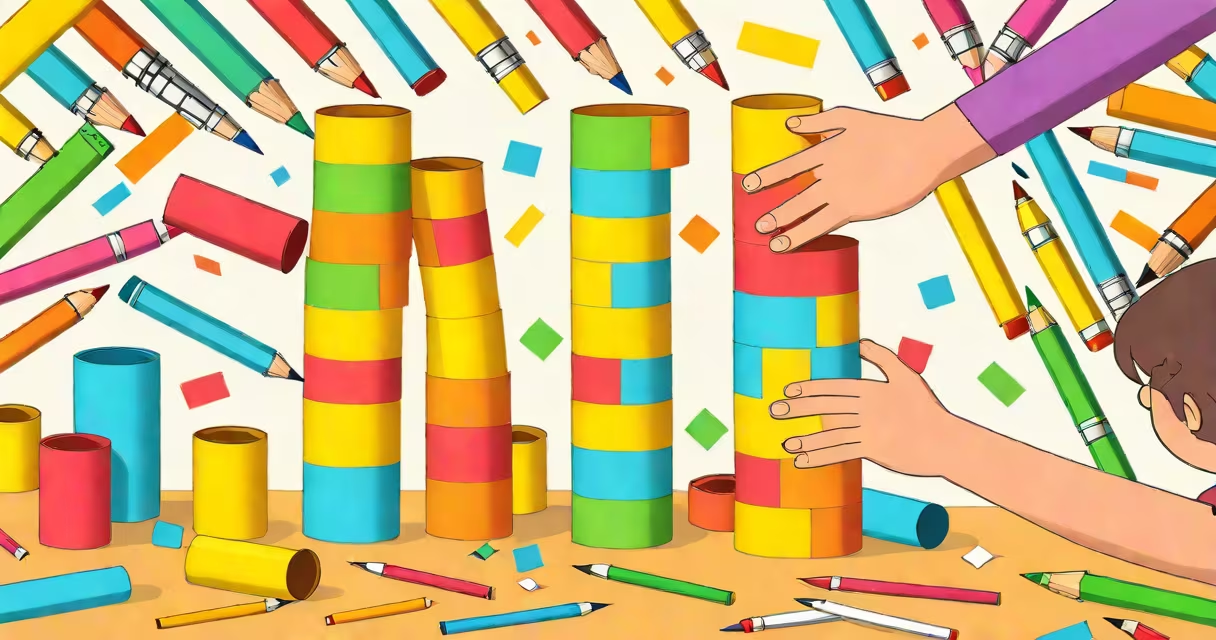
Easy stem activities for kids are short, engaging, hands-on exercises that introduce science, technology, engineering, and math concepts using common household items. These tasks require minimal setup, focus on exploration over perfection, and are designed for children ages 5 to 12.
These activities work by turning abstract ideas into tangible experiences. A child might test which shape holds more weight by building towers from straws and tape, or observe how water moves through different materials using cotton balls and plastic cups. The goal isn't to produce a perfect result-it's to ask "What happens if?" and then watch, adjust, and try again.
Each activity uses everyday supplies: paper, tape, scissors, water, food coloring, balloons, or recycled containers. No special equipment or prior knowledge needed. This accessibility makes them ideal for parents, teachers, and caregivers who want to spark interest in STEM without formal training.
They follow a simple cycle: observe, predict, test, reflect. For example, a child sees a balloon inflate when air is blown into it. They predict whether a larger balloon will hold more air. They test it by measuring how much air fits. Then they reflect: "The bigger balloon held more." This mirrors how scientists think-through trial and error.
Research from the National Science Teaching Association confirms that early exposure to inquiry-based learning improves long-term science achievement. Children who engage in hands-on experiments develop stronger reasoning skills and retain concepts better than those taught through lectures alone.
One key difference between easy stem activities and traditional science lessons is the focus on process, not product. A failed bridge made from popsicle sticks doesn't mean failure-it means data. The child learns that glue placement affects stability, or that wider bases resist tipping. These insights build foundational engineering thinking.
Activities fall into four core categories based on the STEM discipline they emphasize:
| Type | Focus Area | Example Activity | Supplies Needed |
|---|---|---|---|
| Science | Observation & experimentation | Make a rainbow with a glass of water and sunlight | Glass, water, sunlight, white paper |
| Technology | Simple tools & automation | Build a pulley system with string and a spool | String, wooden spool, small basket, tape |
| Engineering | Design & construction | Construct a bridge from spaghetti and marshmallows | Spaghetti, mini marshmallows, ruler |
| Math | Measurement & patterns | Create a patterned mosaic using colored tiles | Colored tiles, grid paper, pencil |
Each category builds specific skills. Engineering tasks improve spatial reasoning and structural awareness. Math-focused activities reinforce counting, symmetry, and sequencing. Science experiments teach observation and hypothesis testing. Technology tasks introduce cause-and-effect relationships through simple machines.
A non-obvious fact: the most effective easy stem activities for kids aren't the ones with the flashiest results-they're the ones that allow room for unexpected outcomes. When a child's paper airplane crashes into a wall, that's not failure. It's data. The crash reveals how wing shape affects flight. This kind of learning is more durable than memorizing facts.
Teachers use easy stem activities for kids during morning circles, after lunch, or as part of science rotations. In classrooms, they serve as low-pressure entry points into complex topics. A kindergarten class might explore floating and sinking with toys and water, while middle schoolers test how different shapes affect wind resistance using paper airplanes.
Parents use them at home during weekends or rainy days. A 2022 study by the American Psychological Association found that children who regularly engaged in informal STEM play showed higher levels of persistence and curiosity in academic settings. These activities don't replace curriculum-but they strengthen it.
One real-world example: a homeschool group in Oregon used a "build a boat" challenge with aluminum foil and marbles. Kids had 15 minutes to make a boat that could float five marbles. The winning design wasn't the biggest-it was the one with a wide, flat base and sealed edges. That design minimized water intake and maximized buoyancy. The lesson stuck because the child experienced it firsthand.
Many assume easy stem activities for kids require expensive kits or advanced planning. That's incorrect. Most activities take under 20 minutes and use items from the kitchen or recycling bin. A child can build a simple circuit with a battery, wire, and a flashlight bulb-all found in a junk drawer.
Another misconception: these activities are only for older kids. But even preschoolers can participate. A toddler can sort blocks by color and size, or pour water between containers to learn about volume. The key is adjusting language and complexity-not eliminating the task.
Some confuse easy stem activities with worksheets or coloring pages. But unlike passive tasks, these require physical manipulation. A child doesn't just read about gravity-they drop a ball and see it fall. They don't just draw a rocket-they build one from a toilet paper roll and tape. The difference is action versus observation.
I once watched a 6-year-old try to make a "flying" paper plane using a piece of notebook paper and a rubber band. It didn't fly. But he adjusted the wings, tried again, and eventually got it to glide across the room. He didn't care about the outcome-he loved the process. That moment captured the heart of easy stem activities for kids: joy in trying.
Easy stem activities for kids are not about producing engineers or scientists. They're about nurturing curiosity, resilience, and confidence. When a child says, "I did it," after building something that stands-even if it wobbles-they've learned more than any worksheet could teach.