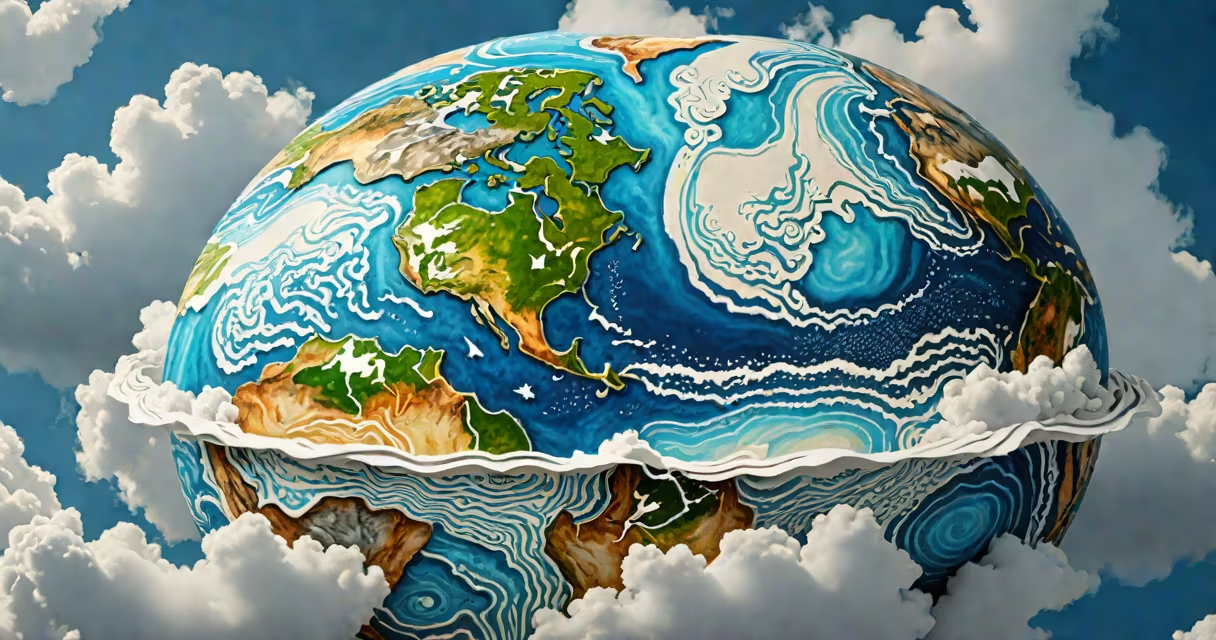
The earth is a rocky planet with a molten iron core, a changing mantle, and a surface shaped by water, plate tectonics, and life. It is the only known planet to support complex life and maintain stable liquid water on its surface.
Earth forms part of the inner solar system, orbiting the Sun at an average distance of 149.6 million kilometers. Its rotation takes 23 hours, 56 minutes, and 4 seconds (a sidereal day), while its orbit around the Sun lasts 365.256 days (a sidereal year). The tilt of its axis-23.5 degrees-drives seasonal changes across hemispheres.
Earth's internal structure consists of four main layers: the crust, mantle, outer core, and inner core. The crust averages 35 kilometers thick under continents and 5 kilometers under oceans. Beneath it lies the mantle, a 2,900-kilometer-thick layer of silicate rock that flows slowly over geological time. The outer core, composed of liquid iron and nickel, generates Earth's magnetic field through dynamo action. The inner core, solid due to immense pressure despite extreme heat, measures about 1,220 kilometers in radius.
Heat from radioactive decay and residual formation energy drives convection currents in the mantle. These currents move tectonic plates, which collide, slide past, or pull apart at boundaries. This motion causes earthquakes, volcanic eruptions, and mountain building. For example, the Himalayas formed when the Indian Plate collided with the Eurasian Plate about 50 million years ago, pushing land upward at roughly 5 millimeters per year.
Water covers 71% of Earth's surface, primarily in oceans. The Pacific Ocean alone spans 165 million square kilometers. Oceans regulate climate by absorbing carbon dioxide and distributing heat via currents like the Gulf Stream. They also host over 80% of Earth's biodiversity, much of it undiscovered-deep-sea hydrothermal vents harbor species that survive without sunlight, relying instead on chemosynthesis.
Earth's atmosphere contains 78% nitrogen, 21% oxygen, and trace gases including argon, carbon dioxide, and water vapor. Oxygen levels rose dramatically during the Great Oxidation Event around 2.4 billion years ago, triggered by cyanobacteria photosynthesis. This shift enabled aerobic life and led to the evolution of complex organisms.
Facts about Earth fall into three categories: physical, biological, and astronomical. Physical facts describe structure, composition, and processes. Biological facts relate to life, ecosystems, and evolutionary history. Astronomical facts concern orbital mechanics, planetary position, and solar interactions.
| Type | Examples | Source |
|---|---|---|
| Physical | Inner core temperature: ~5,400°C; Mantle viscosity: 10^21 Pa·s | NASA Earth Observatory |
| Biological | Over 8.7 million species estimated; 91% remain undescribed | Nature, 2019 |
| Astronomical | Orbital eccentricity: 0.0167; Axial precession cycle: 25,771 years | USGS |
One non-obvious fact: Earth's magnetic field reverses polarity irregularly, averaging every 200,000 to 300,000 years. The last reversal, the Brunhes-Matuyama reversal, occurred 780,000 years ago. Evidence from lava flows and seafloor spreading shows magnetic minerals aligning with the field direction as they cool, creating striped patterns on ocean floors.
Many assume Earth is perfectly spherical. It is not. Due to rotation, it bulges at the equator and flattens at the poles-a shape called an oblate spheroid. The equatorial diameter is 12,756 km, while the polar diameter is 12,714 km-about 42 kilometers wider at the equator.
Another misconception: Earth's core is molten throughout. The outer core is liquid, but the inner core is solid. Despite temperatures exceeding 5,400°C-hotter than the Sun's surface-the inner core remains solid because pressure exceeds 3.6 million times atmospheric pressure at sea level.
Some confuse Earth's magnetic field with gravity. Gravity results from mass and pulls objects toward the center of mass. Magnetic fields arise from moving electric charges-specifically, the flow of molten iron in the outer core. A compass points north because it aligns with the magnetic field lines, not because of gravitational attraction.
Earth's oceans did not form from rain alone. Early Earth was too hot for liquid water. Water arrived later via icy comets and asteroids during the Late Heavy Bombardment, 4.1 to 3.8 billion years ago. Studies show that hydrogen isotopes in seawater match those in certain carbonaceous chondrite meteorites, supporting this theory.
Once cooled, water accumulated in basins created by tectonic subsidence and impact craters. Over 100 million years, these basins filled to form the first oceans. Today, ocean volume totals approximately 1.332 billion cubic kilometers-enough to cover Earth's surface to a depth of 2.7 kilometers if evenly distributed.
I once observed a basalt outcrop near the Columbia River Gorge in Oregon. The rock showed columnar jointing-polygonal cracks formed as lava cooled. This structure revealed how rapid cooling under water can create such patterns. It confirmed that Earth's crust is constantly reshaped by thermal stress and fluid interaction.
Understanding facts about the earth reveals how interconnected systems-geological, atmospheric, biological-maintain habitability. Without the magnetic field, solar wind would strip away the atmosphere. Without plate tectonics, carbon recycling would halt, leading to runaway greenhouse conditions. Life depends on balance.
Earth is not static. It is a living system shaped by forces operating over millions of years. Knowing its structure, history, and behavior helps us protect it-and understand our place within it.