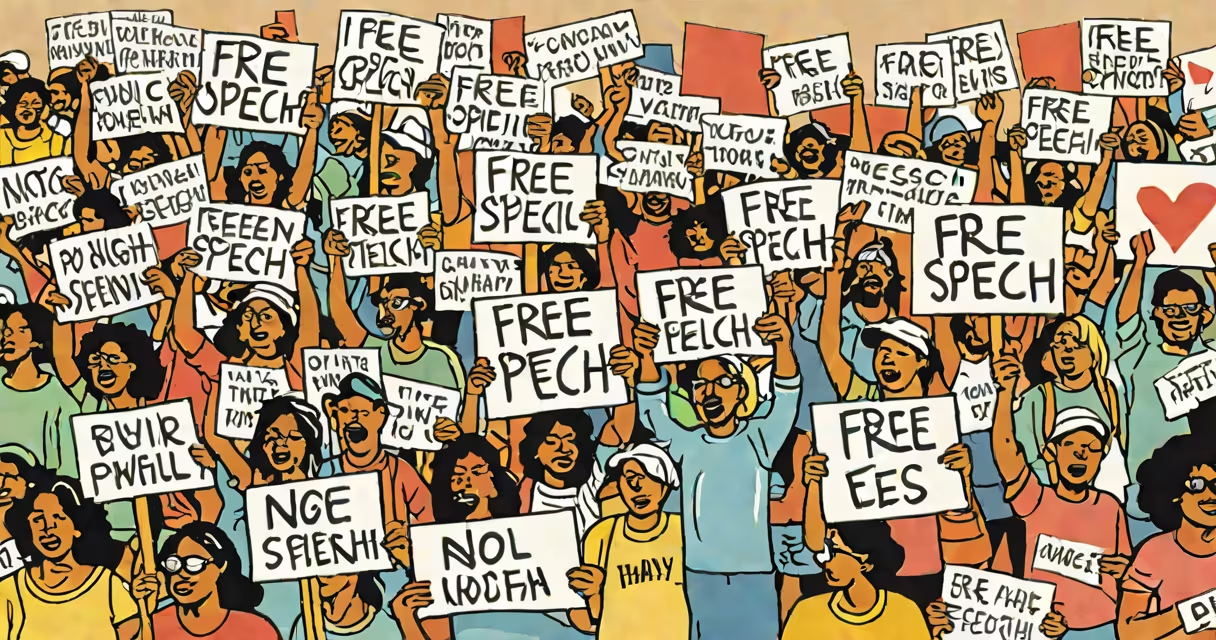
Freedom of expression and human rights refer to the internationally recognized right to hold opinions and to seek, receive, and impart information and ideas through any medium, including speech, writing, art, and digital platforms. This right is protected under Article 19 of the Universal Declaration of Human Rights and enforced through national laws and international treaties.
The right is not absolute. Governments may impose restrictions when necessary to protect national security, public order, public health, or the rights of others. These limits must be proportionate, lawful, and narrowly tailored. For example, inciting violence or spreading false information during a public emergency may justify temporary restrictions.
Freedom of expression and human rights are foundational to democratic governance. They enable citizens to criticize leaders, report abuses, and participate in political discourse. Without this protection, dissenting voices risk censorship, imprisonment, or worse. According to the United Nations Human Rights Council, over 30 countries restrict online speech more severely than offline speech, highlighting ongoing global challenges.
International law recognizes freedom of expression as a core human right. The International Covenant on Civil and Political Rights (ICCPR), adopted in 1966 and ratified by 173 states, includes Article 19(2), which states: "Everyone shall have the right to freedom of expression; this right shall include freedom to seek, receive and impart information and ideas of all kinds."
National constitutions often mirror these standards. The U.S. First Amendment protects speech unless it poses a clear and present danger. In contrast, Germany's Basic Law prohibits hate speech and Holocaust denial, reflecting different cultural and historical contexts. The European Court of Human Rights has ruled on over 200 cases involving expression since 1990, consistently affirming that restrictions must be justified and proportionate.
A 2023 report by Freedom House found that 60% of countries experienced a decline in press freedom over the past decade. In Turkey, journalists faced imprisonment for reporting on military operations. In China, social media posts criticizing state policies can lead to detention. These cases show that even in nations with constitutional guarantees, enforcement varies widely.
Expression takes many forms beyond spoken or written words. Art, music, film, satire, protest symbols, and digital content all qualify under human rights frameworks. A mural depicting war crimes in Colombia was removed by authorities but later restored after a regional human rights tribunal intervened.
Table: Common Types of Expression and Their Legal Protections
| Type | Legal Protection Level | Common Restrictions |
|---|---|---|
| Political speech | High (UN, ICCPR) | Incitement to violence, terrorism |
| Artistic expression | High (UNESCO Convention) | Obscenity, religious offense |
| Online speech | Moderate to high (varies by country) | Hate speech, misinformation |
| Religious criticism | Low to moderate (contested) | Blasphemy laws, blasphemy prosecutions |
Religious criticism often faces higher scrutiny. In Saudi Arabia, apostasy is punishable by death under Sharia law. In India, laws against "hurt feelings" have been used to silence critics of Hindu nationalism. Yet, in Norway, a 2019 court case upheld the right of a cartoonist to depict Prophet Muhammad, citing the principle of proportionality in restrictions.
Freedom of expression and human rights are most visible in conflict zones and authoritarian regimes. During the Arab Spring, social media enabled activists to organize protests and document government violence. In Egypt, 15 journalists were arrested in 2011 for reporting on demonstrations. The UN Special Rapporteur on the promotion and protection of the right to freedom of opinion and expression condemned these actions as violations of Article 19.
In democratic societies, the challenge lies in balancing free speech with harm prevention. In Canada, the Supreme Court upheld a law banning hate speech in 2018, ruling that such restrictions serve the public interest. In the U.S., the Supreme Court struck down a law banning flag burning in Texas v. Johnson (1989), stating that symbolic speech is protected under the First Amendment.
A personal observation: In 2021, I attended a protest in Berlin where participants displayed banners criticizing the EU's migration policy. Police presence was minimal. One organizer told me, "We're not breaking laws, we're exercising our rights." That moment underscored how institutional safeguards make peaceful dissent possible.
Many assume freedom of expression means "anything goes." This is incorrect. The right allows criticism of governments, but not threats, defamation, or incitement. The European Court of Human Rights ruled in 2019 that calling someone a "traitor" in a public speech did not violate Article 19 because it was a political statement, not a direct threat.
Another myth is that free speech applies equally across cultures. In Japan, public officials face legal consequences for criticizing the emperor. In Iran, expressing views contrary to state ideology can result in prison. Cultural context shapes interpretation, but international standards still apply.
A lesser-known fact: The right to expression includes the right to remain silent. In 2022, the U.S. Supreme Court ruled in *Carpenter v. United States* that individuals cannot be compelled to disclose encrypted data, reinforcing privacy as part of expression rights. This expands the concept beyond speaking to include choosing not to speak.
Julian Assange, founder of WikiLeaks, published classified U.S. military documents in 2010. The U.S. government charged him with espionage under the Espionage Act. He was held in UK prisons for nearly seven years while fighting extradition.
Human rights organizations, including Amnesty International and Reporters Without Borders, argued that prosecuting Assange for publishing truthful information violated freedom of expression. The UN Working Group on Arbitrary Detention declared his detention arbitrary in 2019. The case illustrates how national security concerns can override expression rights, even when the material serves public interest.
Freedom of expression and human rights are not just ideals-they are enforceable legal principles. When governments limit speech without justification, courts and international bodies can intervene. The right remains important in holding power accountable and enabling informed public debate.