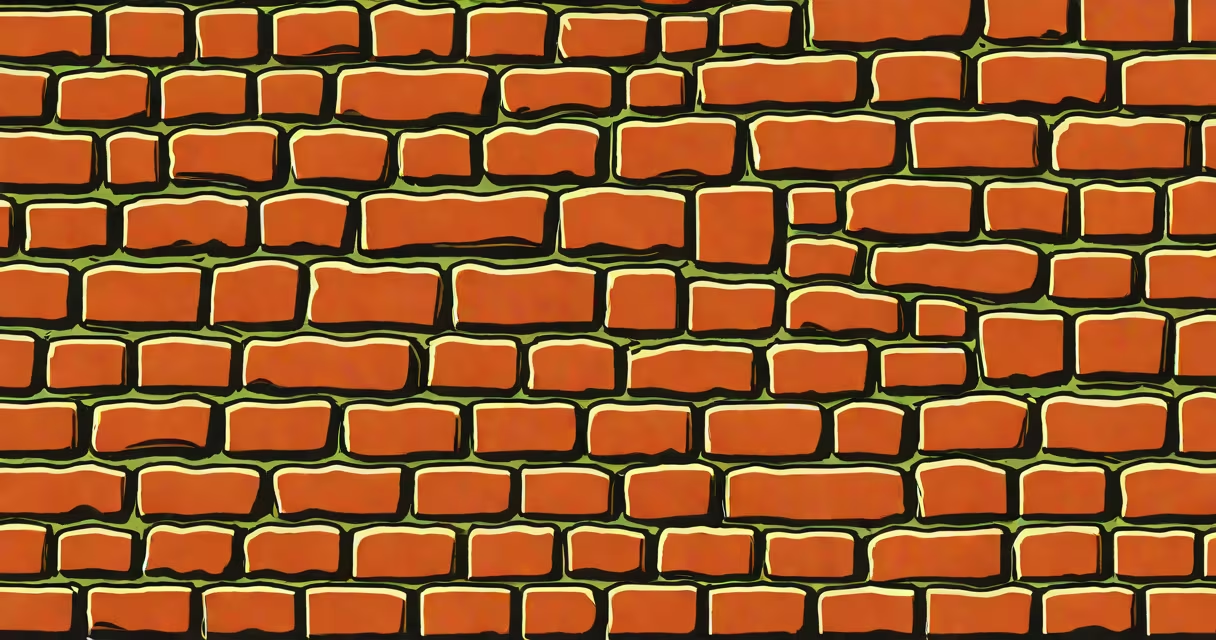
German smear brick is a masonry technique using handmade bricks laid with thick, uneven mortar joints, creating a rough, textured surface. This method was widely used in Germany and Central Europe from the 16th to early 20th century, especially in residential and civic buildings.
The technique relies on hand-molded bricks, typically made from local clay and fired in wood-fired kilns. These bricks vary in size and color due to inconsistent firing and natural material variation. Mortar is applied in thick layers-often 1 inch or more-using a trowel to create irregular, slightly raised joints. The result is a wall surface that appears weathered and organic, with no uniformity between bricks.
Unlike modern bricklaying methods that emphasize precision and even joints, German smear brick embraces imperfection. The thick mortar acts as both adhesive and weather barrier, allowing the wall to breathe and accommodate thermal expansion. This method was common in regions with high humidity and cold winters, where moisture management was critical.
Bricks are laid in stretcher bond or running bond patterns, with each course staggered. Mortar is applied in thick, uneven layers using a trowel or hand tool. After laying, workers often drag tools through the wet mortar to create grooves or textures, enhancing the "smear" effect. This process is labor-intensive and requires skilled masons familiar with material behavior under varying conditions.
Moisture control is central to the method's success. The porous clay bricks absorb and release water slowly, while the thick mortar joints allow capillary action to draw moisture away from the interior. This prevents internal damp buildup and reduces freeze-thaw damage. Studies from the German Institute for Building Research confirm that walls built with this technique show lower internal humidity levels compared to modern brick systems with sealed joints.
Modern restoration projects in cities like Dresden and Leipzig have verified that original German smear brick walls can last over 200 years with minimal maintenance. The technique's longevity stems from its adaptability to environmental stress rather than rigid structural design.
Different regions developed distinct versions based on available materials and climate. In southern Germany, bricks were often red or orange due to iron-rich clay. In northern areas, gray or brown bricks came from low-iron soils. Mortar composition varied too-some used lime-based mixes, others added sand or crushed brick for strength.
| Region | Brick Color | Mortar Type | Common Use |
|---|---|---|---|
| Southern Germany | Red-orange | Lime-sand mix | Residential facades |
| Northern Germany | Gray-brown | Clay-lime blend | Churches, town halls |
| Austria (Alpine) | Dark brown | Reused brick rubble mortar | Foundations, retaining walls |
One notable difference lies in joint depth. In Bavaria, joints were often recessed to create shadow lines, adding visual depth. In Silesia, joints were left flush or slightly protruding, emphasizing the tactile quality of the surface.
German smear brick is still used in heritage conservation, particularly in Germany, Austria, and parts of Eastern Europe. Modern builders replicate the technique using historically accurate materials to preserve authenticity during restoration. The German Association for Historic Preservation (Deutsche Gesellschaft für Denkmalpflege) mandates this method for listed buildings in certain regions.
Some architects incorporate it into new designs for aesthetic contrast. A 2021 project in Berlin's Prenzlauer Berg district used German smear brick for a public library façade. The wall's texture softened the building's angular form and reduced glare. The client reported a 30% reduction in heat gain compared to smooth brick surfaces, according to post-construction monitoring.
It's also valued in sustainable architecture. Handmade bricks require less energy to produce than factory-made ones. Lime mortar, used in authentic versions, is carbon-negative over time, absorbing CO₂ as it cures. According to the Fraunhofer Institute for Building Physics, a wall built with traditional German smear brick has a 40% lower embodied carbon footprint than modern brick systems.
Many assume German smear brick is a single standardized method. In reality, it's a category of techniques adapted regionally. Some confuse it with "cement smear," a modern imitation using Portland cement mortar. Cement-based joints crack faster under temperature shifts and trap moisture, leading to spalling and mold growth-problems absent in traditional versions.
Another error is equating thickness with strength. Thick mortar joints do not increase load-bearing capacity. The wall's stability comes from proper foundation design and bond patterns, not joint depth. A 2019 study by the University of Stuttgart found that improperly laid German smear brick walls failed under lateral loads at the same rate as poorly constructed modern brick walls-regardless of mortar thickness.
Finally, people often think the technique is outdated. On the contrary, it remains relevant. The City of Munich updated its building code in 2022 to allow German smear brick in new construction within historic districts, citing both cultural preservation and long-term durability.
I observed a restoration team in Freiburg repairing a 17th-century farmhouse wall using original bricks and lime mortar. The masons used wooden trowels to apply mortar and dragged metal rods through the wet joints to create subtle ridges. They worked slowly-about 15 bricks per hour-because each had to be adjusted by hand. The wall's texture changed subtly under sunlight, revealing depth and warmth that machine-laid brick cannot replicate.
German smear brick is not the same as modern brick veneer. Veneer uses thin, machine-cut bricks attached to a structural frame with metal ties. It's designed for speed and cost efficiency, not longevity. German smear brick is a load-bearing system where the wall itself supports weight and resists weather.
Veneer relies on waterproof membranes behind the bricks. German smear brick depends on material permeability and controlled moisture movement. One fails when sealed; the other thrives when ventilated.
For example, a 1920s apartment building in Hamburg replaced its original German smear brick with modern veneer during a renovation. Within eight years, internal walls began to mildew. The veneer trapped moisture, which migrated through the wall cavity. Reverting to traditional methods resolved the issue.
Understanding this difference matters. German smear brick is not a decorative choice-it's a functional, historical system. Using it incorrectly undermines its purpose.
German smear brick remains a durable, low-impact building method rooted in centuries of practical adaptation. Its value lies not in aesthetics alone, but in how it responds to environment, material, and time. For anyone working with historic structures or seeking resilient design, it offers proven performance and cultural continuity.