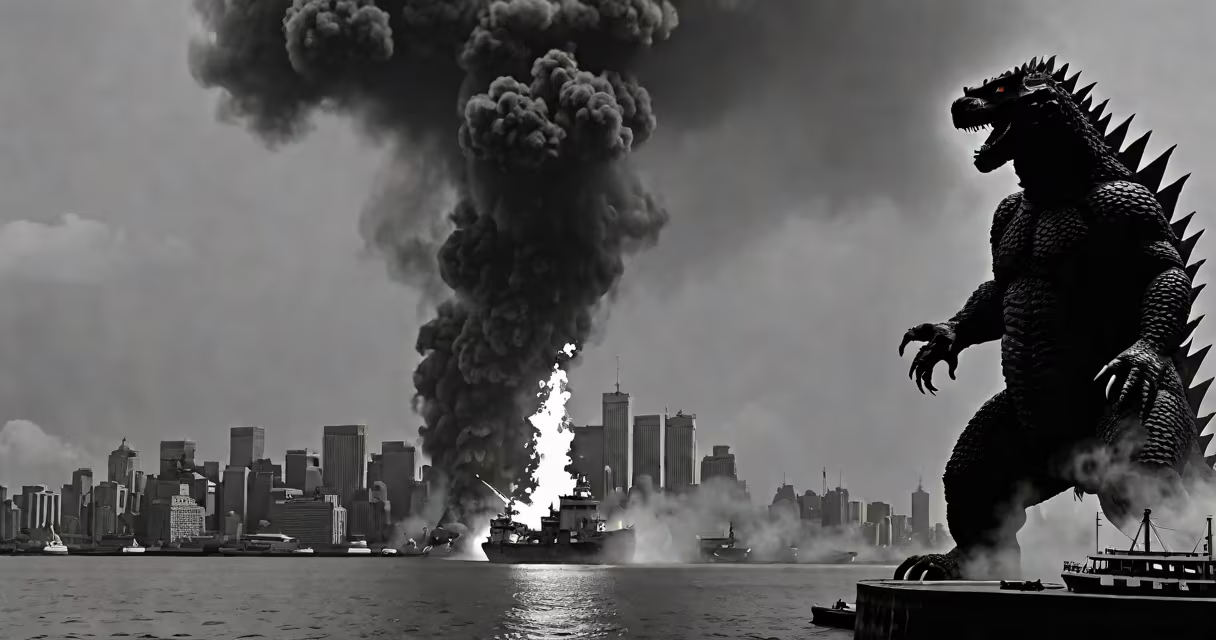
The 1954 Godzilla film is a Japanese science fiction horror movie directed by Ishirō Honda and produced by Toho. It depicts a prehistoric creature awakened and mutated by nuclear testing, which then attacks Japan. The film serves as a direct allegory for the trauma of the atomic bombings of Hiroshima and Nagasaki, using the monster as a symbol of nuclear destruction.
Godzilla was created through a combination of practical effects and stop-motion animation. The creature's design, based on a modified Tyrannosaurus rex skeleton, was crafted by special effects artist Eiji Tsuburaya. His team used miniatures, rear projection, and matte paintings to simulate city destruction. The monster's roar-recorded by layering animal sounds and reversing audio-became iconic.
Godzilla's appearance in the film is deliberate. He emerges from the ocean near Odo Island, where a hydrogen bomb test has disrupted the seabed. The creature grows larger after absorbing radiation, eventually attacking Tokyo. Military forces fail to stop him. The climax shows a massive explosion using the Oxygen Destroyer-a fictional weapon designed to disintegrate matter at the molecular level-killing Godzilla but leaving the world unhealed.
Godzilla operates as a narrative device rooted in postwar anxiety. The film opens with fishermen reporting strange activity in the sea. A military survey confirms the presence of a massive creature. When the beast attacks Odo Island, killing all inhabitants, the government scrambles to respond. This sequence mirrors real-life U.S. nuclear tests in the Pacific, including the 1954 Castle Bravo detonation, which contaminated the crew of the Japanese fishing boat Daigo Fukuryū Maru.
The film's pacing reflects a slow build toward inevitability. Godzilla moves deliberately, destroying infrastructure without malice-his actions are consequences of human intervention. The military's inability to stop him underscores the futility of technological solutions against uncontrollable forces. The Oxygen Destroyer, invented by Dr. Serizawa, is both a triumph and a tragedy: it ends the threat but risks being misused.
Dr. Serizawa's decision to destroy himself along with the weapon reinforces the film's central theme: the burden of knowledge. He says, "I have seen the face of death," referencing his own guilt over creating a weapon that could end life itself. This moment is not dramatic theater-it's a philosophical choice grounded in the ethics of scientific discovery.
The 1954 Godzilla film relies on physical models, miniature sets, and optical compositing. Toho's special effects team built a 3-meter-tall suit for the actor Haruo Nakajima, who portrayed Godzilla. The suit used foam rubber and wire mesh, weighted with lead to allow movement. Nakajima performed in a full-body costume under intense heat, often sweating through multiple takes.
Key visual techniques included:
These methods were standard in 1950s Japanese cinema but pushed to new levels in Godzilla. The film's visual language influenced later kaiju films and even Hollywood productions. Steven Spielberg cited Godzilla as an inspiration for Jurassic Park's dinosaur sequences.
The 1954 Godzilla film premiered in Japan on November 3, 1954. It grossed ¥1.6 billion ($1.5 million USD at 1954 exchange rates), making it one of the most profitable Japanese films of the decade. Its success led to a franchise that now includes 37 theatrical films, 11 television series, and numerous video games.
Outside Japan, the film gained global attention after being re-edited for Western audiences in 1956. The American version, distributed by Columbia Pictures, added new footage with actor Raymond Burr as a reporter. This cut removed much of the original's political subtext. The Japanese version, restored in 2004, reveals the film's deeper critique of militarism and nuclear policy.
Academic analysis confirms the film's symbolic weight. According to the National Film Archive of Japan, Godzilla represents "the return of the repressed" in national memory-unresolved trauma made visible. The University of California, Berkeley, notes that the film's structure follows a classic mythic arc: a monster appears, society fails to act, and a sacrifice restores balance.
Many assume Godzilla is a villain. In the original film, he is not evil-he is a victim of human experimentation. His rampage stems from displacement and radiation poisoning. The film never portrays him as sentient or malicious. He attacks because he is injured and disoriented.
Another misconception is that Godzilla was inspired by Western monsters like King Kong. While Kong influenced early kaiju design, Godzilla's roots lie in Japanese folklore. The name "Godzilla" comes from "Gojira," a portmanteau of "gorilla" and "kaiju" (monster). But the creature's form draws from Shinto kami-spiritual beings tied to nature and disaster. His emergence from water echoes myths of the sea god Ryūjin.
A lesser-known fact: the film's score was composed by Akira Ifukube, who later wrote music for 16 other Toho films. His theme for Godzilla features a low C-sharp played on a contrabassoon, repeated in descending intervals. This creates a sense of dread without melody. The theme has been sampled in electronic music, including tracks by Aphex Twin and Autechre.
While the 1954 film is the origin story, subsequent iterations differ in tone and purpose. Here's a comparison of key versions:
| Version | Year | Theme | Godzilla's Role |
|---|---|---|---|
| Original Godzilla | 1954 | Nuclear fear | Symbol of human recklessness |
| Godzilla vs. Biollante | 1989 | Genetic engineering | Reincarnated child spirit |
| Godzilla (2014) | 2014 | Climate change | Guardian of Earth |
| Shin Godzilla (2016) | 2016 | Bureaucratic failure | Metaphor for institutional paralysis |
The 1954 version stands apart: it is the only one where Godzilla dies. In later films, he becomes a recurring figure-sometimes ally, sometimes antagonist. The original film's ending, where Godzilla sinks into the ocean, is not closure. It is a warning: the threat returns.
I once watched the 1954 film at a screening in Kyoto during a summer festival. The theater had no air conditioning. The projector flickered. When Godzilla emerged from the waves, the audience gasped-not because of the visuals, but because of the silence that followed. That moment, the shared breath before the roar, made me understand why the film endures.
Godzilla 1954 film remains a benchmark in cinematic storytelling. It uses spectacle to convey grief, anger, and caution. Its legacy lives not in remakes or merchandise, but in the way it forced viewers to confront what they had ignored: the cost of progress.