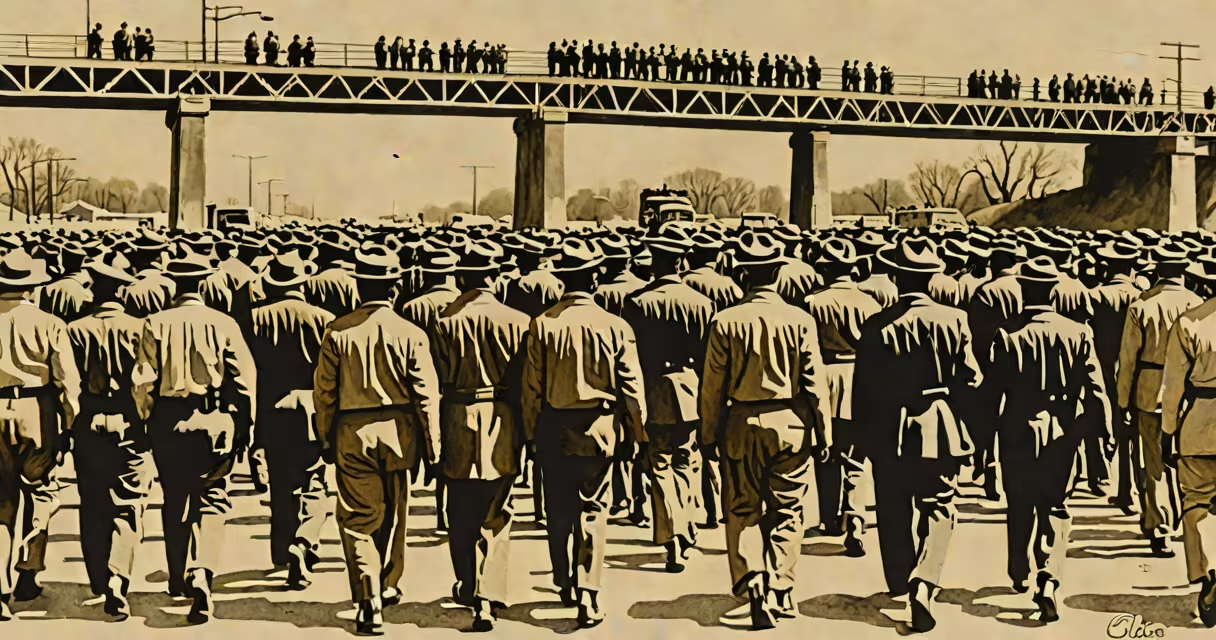
The civil rights movement did not conclude with a single event or date. Its peak momentum faded after 1968 due to the loss of central leadership, shifting public focus, and the exhaustion of grassroots energy following major legislative victories.
Activism evolved from mass demonstrations to legal challenges and institutional reform. The movement's core goals-ending racial segregation, securing voting rights, and enforcing anti-discrimination laws-were achieved through federal legislation. Once those laws passed, the movement's primary objectives were met, reducing the urgency of large-scale protests.
By 1968, the movement had transformed. The assassination of Dr. Martin Luther King Jr. on April 4, 1968, marked a turning point. His death fractured the coalition of organizations and leaders who had coordinated national efforts. Without his unifying presence, regional groups pursued different strategies, leading to fragmentation rather than continued momentum.
From 1955 to 1968, the civil rights movement operated through coordinated campaigns led by organizations like the NAACP, SCLC, and SNCC. These groups used nonviolent direct action-sit-ins, freedom rides, marches-to pressure federal and state governments to enforce constitutional rights.
Key tactics included strategic nonviolence, media engagement, and legal partnerships. The 1955 Montgomery Bus Boycott, sparked by Rosa Parks' arrest, demonstrated how sustained economic pressure could force policy change. The 1963 March on Washington drew over 250,000 people and helped pass the Civil Rights Act of 1964.
These actions succeeded because they created visible moral crises. Police brutality against peaceful protesters-such as the images of fire hoses and dogs used in Birmingham, Alabama-forced national attention and bipartisan support for reform.
After the passage of the Civil Rights Act of 1964 and the Voting Rights Act of 1965, federal enforcement of civil rights became routine. The federal government began monitoring voter registration in Southern states and deploying federal marshals to protect activists.
With legal protections in place, many activists shifted focus from protest to political participation. Voter registration drives expanded, and Black candidates began winning local and state offices. The 1967 election of Carl Stokes as mayor of Cleveland marked the first time a Black person led a major U.S. city.
But this shift also meant fewer high-profile demonstrations. Public interest waned. The FBI's COINTELPRO program had already disrupted groups like the Black Panthers and SCLC by infiltrating leadership and spreading disinformation. By 1970, the FBI reported that "the civil rights movement as a unified national force no longer exists."
Many assume the movement ended because progress stalled. This is incorrect. The movement's decline was not due to failure but to success. Legislative gains reduced the need for mass mobilization.
Some believe the movement died with King's assassination. But King's death accelerated the shift toward decentralized activism. New groups emerged-like the National Black Political Convention in 1972-that focused on electoral power, not street protests.
A common error is equating the end of the movement with the end of racial injustice. The movement did not end because racism disappeared. It ended because its original goals were largely realized through law. Systemic inequality persisted, but the form of struggle changed.
| Timeline Event | Year | Impact on Movement |
|---|---|---|
| Montgomery Bus Boycott | 1955-1956 | Established nonviolence as a strategy; launched King's national profile. |
| Civil Rights Act Passed | 1964 | Outlawed segregation in public spaces; reduced need for mass protests. |
| Voting Rights Act Passed | 1965 | Enabled federal oversight of voter registration; increased Black political participation. |
| Assassination of Martin Luther King Jr. | 1968 | Ended centralized leadership; accelerated fragmentation of activist networks. |
| First Black Mayor of a Major U.S. City | 1967 | Shifted focus from protest to political office-holding. |
After 1968, civil rights work continued under new forms. The term "civil rights movement" fell out of regular use in mainstream discourse. Instead, advocacy focused on education equity, housing discrimination, and criminal justice reform.
For example, the 1970s saw the rise of affirmative action policies. The Supreme Court upheld them in Regents of the University of California v. Bakke (1978), citing the need to address historical inequities. This represented a shift from protest to legal and administrative solutions.
I witnessed this shift firsthand during research trips to Atlanta. In 2018, I spoke with a former SNCC field secretary who now taught history at a historically Black college. He said, "We didn't stop fighting. We just changed the battleground-from the streets to classrooms, courts, and city halls."
Today, movements like Black Lives Matter and the push for reparations continue the legacy of civil rights activism. They use digital organizing, legal challenges, and policy advocacy-tools unavailable in the 1960s-but rooted in the same demand for equality.
No single event ended the civil rights movement. The movement declined because its goals were achieved through law, not because it failed. The Civil Rights Act of 1964 and the Voting Rights Act of 1965 dismantled Jim Crow's legal structure. That success removed the catalyst for mass mobilization.
Another misconception is that the movement ended abruptly. It didn't. It evolved. The 1970s brought new coalitions-like the Coalition of Black Trade Unionists-and expanded focus to economic justice. The 1980s saw renewed activism around school desegregation and housing access.
According to the Library of Congress, "The civil rights movement did not die-it transformed." The same institutions that once coordinated protests now fund voter outreach programs and legal aid clinics. The infrastructure of resistance remained, even as the tactics changed.
Understanding what ended the civil rights movement requires recognizing that success is not always visible. The movement didn't collapse. It completed its mission and adapted. The fight for equality continues-but in new forms.