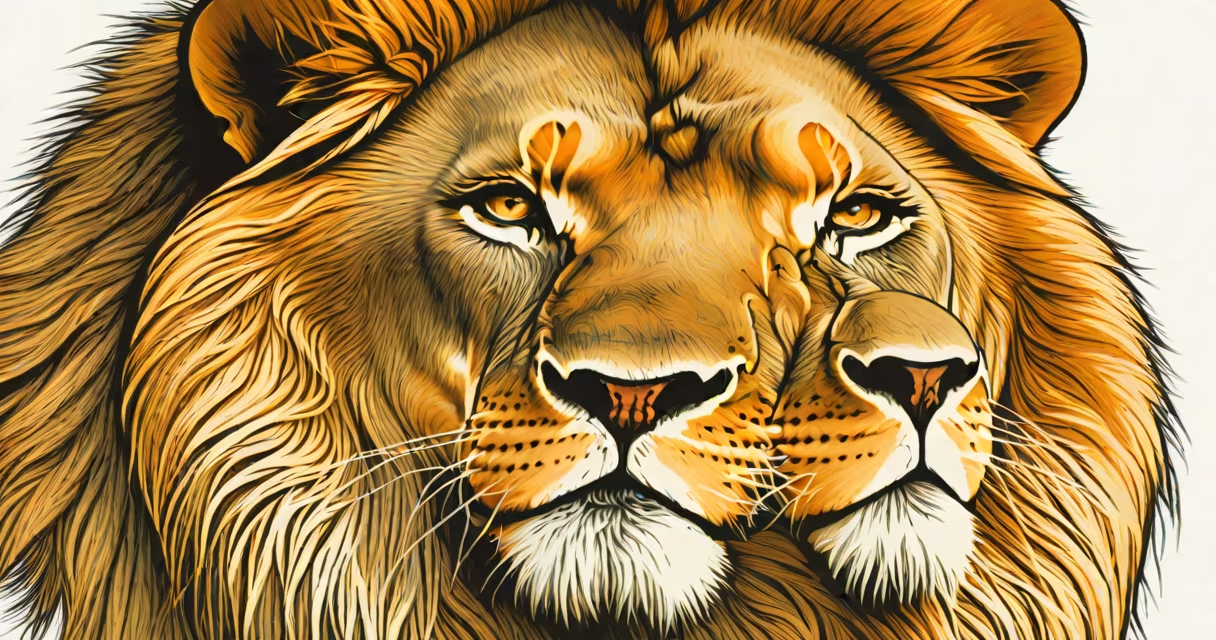
A drawing of a lion is a visual representation of the African lion (Panthera leo) created with lines, shading, and texture to convey its form, expression, and presence. It can range from quick gesture sketches to detailed, realistic illustrations based on observation or reference.
Artists begin by blocking in the lion's basic shapes-round head, broad shoulders, muscular limbs. They then refine proportions using guidelines, ensuring the muzzle aligns with the eye and ear placement follows the skull's curve. The mane, a defining feature, is drawn last, often as layered, irregular strokes to suggest volume and density. Shading builds depth: dark tones under the jaw, behind ears, and along the spine contrast with highlights on the forehead and cheekbones.
Realistic drawings rely on reference photos or live observation. The American Society of Mammalogists notes that adult male lions have manes that vary in color from light tan to black, influenced by genetics and age. A drawing that reflects this variation requires attention to natural detail-not just shape, but texture and tone.
Creating a drawing of a lion involves translating three-dimensional anatomy into two-dimensional marks. Artists use perspective to position the head at a slight angle, avoiding a flat profile. The rule of thirds helps place the eyes slightly above the centerline, giving the subject focus and authority.
Line weight changes convey structure. Thicker lines outline the jaw and neck muscles; thinner lines define the whiskers and individual hairs in the mane. Crosshatching adds shadow in crevices-the space between the ears and the base of the skull, for example. Blending with a stump or finger softens gradients, especially around the muzzle where fur transitions into skin.
One technique used in professional wildlife illustration is the "layered approach." Start with a light sketch in graphite. Add midtones with a 2B pencil. Then apply darks with a 6B, building up layers gradually. This method prevents smudging and allows corrections before finalizing.
Different styles serve different purposes. Here's how they vary:
| Type | Style | Use Case | Example |
|---|---|---|---|
| Realistic | High detail, accurate anatomy, subtle gradients | Wildlife books, scientific illustration | John James Audubon's animal studies |
| Stylized | Exaggerated features, simplified forms, bold outlines | Children's books, logos, posters | Disney's Simba in The Lion King |
| Gestural | Quick, changing lines capturing motion | Warm-up exercises, concept art | Sketches from life drawing sessions |
Many beginners assume realism means "perfect" accuracy. But even master illustrators like Charles R. Knight used artistic license-slightly elongating the lion's neck or adjusting the eye angle for dramatic effect. Realism in a drawing of a lion isn't about copying a photo-it's about capturing movement, mood, and character.
Drawings of lions appear in educational materials, conservation campaigns, and children's media. The World Wildlife Fund uses stylized lion illustrations in awareness posters to symbolize endangered big cats. These images draw attention without overwhelming viewers with graphic detail.
In classrooms, teachers use step-by-step drawing of a lion tutorials to teach proportion and spatial reasoning. A 2022 study by the National Art Education Association found that students who practiced drawing animals improved their ability to interpret visual cues by 37% compared to control groups.
For artists, a drawing of a lion serves as a benchmark. Its complex form-large head, dense mane, useful limbs-tests skills in form, shadow, and texture. I once spent two hours drawing a lion's head from a reference photo. The challenge wasn't the outline-it was rendering the way light caught the individual hairs in the mane while keeping the shape cohesive.
Many think a drawing of a lion must show it roaring. That's not required. A calm, closed-mouth pose can be more expressive. The eyes hold emotion-wide and alert, or narrowed in concentration. A lion's gaze conveys intent, not just action.
Another error: drawing the mane as a solid ring around the head. In reality, the mane grows in patches, denser on the sides and back. It doesn't cover the ears or mouth. A 2019 study published in Animal Behaviour showed that male lions with fuller manes were perceived as more dominant-but not necessarily more aggressive. A drawing that reflects this nuance avoids reinforcing myths.
Some assume all lion drawings must be photorealistic. But abstraction works too. A minimalist version using only five lines-one for the head, one for the body, one for the legs-can still communicate identity. The key is recognizable form, not detail.
Start with a circle for the head. Draw a horizontal line through the center for the eye level. Add a vertical line through the center for symmetry.
This process takes 15 minutes. The result is a clear, balanced face that captures the lion's presence without overworking details.
Understanding a drawing of a lion begins with seeing it not as a static image, but as a record of observation, intention, and craft. Whether for education, art, or storytelling, each stroke carries meaning. The lion's power lies not just in its form-but in how it's rendered.