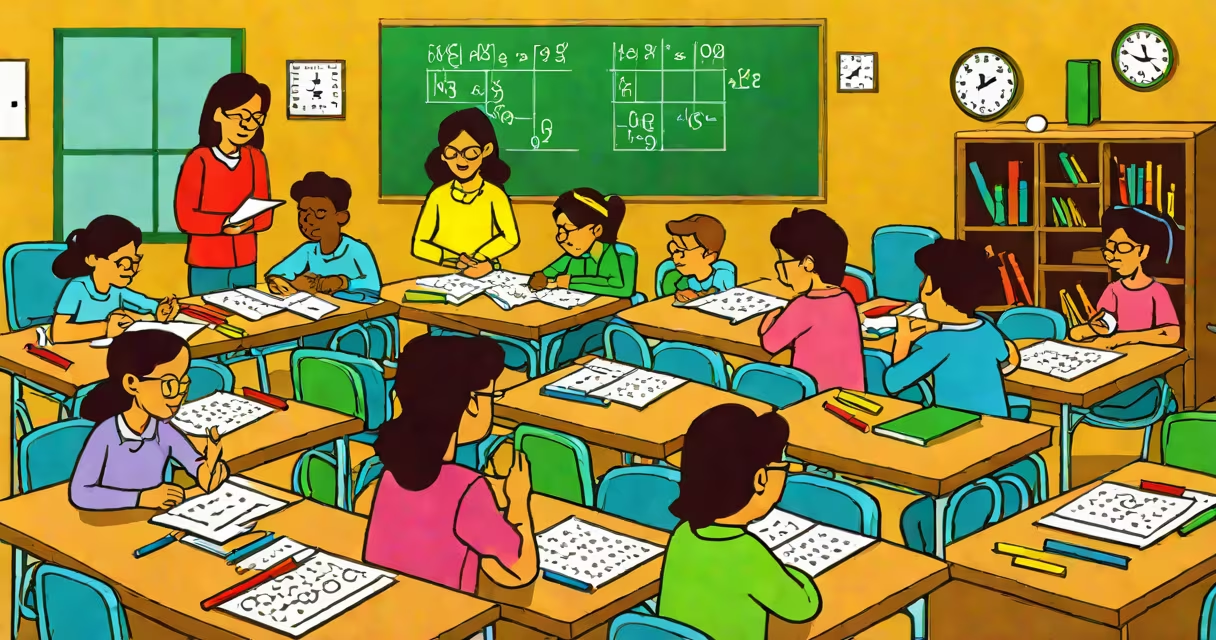
Modern math instruction prioritizes conceptual understanding, reasoning, and real-world application over memorizing formulas and procedures. Teachers now guide students through problem-solving processes, use visual models, and encourage discussion to build deep mathematical thinking.
Classrooms today rarely begin with a lecture on how to solve a specific equation. Instead, teachers present a scenario-a word problem, a pattern, a data set-and ask students to explore multiple ways to reach a solution. This method, known as inquiry-based learning, requires students to explain their reasoning, defend their steps, and compare approaches with peers.
For example, a sixth-grade class might be given a task: "You have $50 to spend on snacks for a party. Each bag costs $3. How many bags can you buy? What's left?" Rather than being told to divide 50 by 3, students use counters, draw arrays, or create tables to model the situation. The teacher asks, "Why did you choose that method?" or "Could another way work? Why or why not?" This builds number sense and flexibility.
Teaching math now relies on structured, research-backed strategies. These methods are grounded in cognitive science and curriculum standards such as the Common Core State Standards (CCSS) and the National Council of Teachers of Mathematics (NCTM) guidelines.
Three primary approaches dominate:
| Method | Focus | Example Activity |
|---|---|---|
| Inquiry-Based Learning | Problem exploration and reasoning | Students design a garden with a fixed perimeter and maximize area using grid paper. |
| Visual and Concrete Modeling | Using physical objects or diagrams to represent abstract ideas | Using fraction tiles to show why 1/2 + 1/3 = 5/6. |
| Math Talk and Discussion | Verbalizing logic and comparing strategies | Two groups present different solutions to a ratio problem; class debates which is more efficient. |
These methods are not new-they've been validated by decades of research. A 2017 study by the RAND Corporation found that students taught with inquiry-based methods outperformed peers in procedural fluency and conceptual understanding after two years. The study emphasized that effective implementation requires teacher training and classroom time, not just curriculum materials.
Many parents assume that "new math" means abandoning algorithms or skipping multiplication tables. That's incorrect. Students still learn standard procedures-but only after building context and understanding.
For instance, when teaching long division, a teacher won't start with the algorithm. Instead, students might use base-ten blocks to divide 486 by 6. They group 486 into chunks of 6, physically removing them until none remain. Only after several sessions with manipulatives do they learn the written algorithm. This ensures the process makes sense, not just follows steps.
A key difference: modern math doesn't replace calculation-it reorders it. Fluency comes after comprehension. According to NCTM's 2023 position statement, "Procedural fluency without conceptual understanding leads to fragile knowledge. Students forget steps quickly and struggle with novel problems."
This model is used in public schools across the U.S., Canada, and much of Europe. It aligns with national standards and international assessments like PISA (Programme for International Student Assessment). In the 2022 PISA results, countries with strong conceptual math instruction-such as Singapore, Finland, and Japan-ranked highest in problem-solving ability.
Even in high school, the shift continues. Algebra classes now emphasize functions as relationships between variables, not just solving equations. A student might analyze a graph of temperature changes over a week, then predict when a threshold will be crossed-not just plug numbers into a formula.
I've observed this firsthand while volunteering at a middle school. A seventh-grade teacher asked students to plan a budget for a school trip using decimals and percentages. One group used a spreadsheet, another drew pie charts, and a third created a bar graph. The class spent 45 minutes discussing which method best communicated the data. The goal wasn't just to find the right answer-it was to understand how representation shapes interpretation.
"How do they teach math now" is not synonymous with "fuzzy math," "new math fiasco," or "abandoning arithmetic." Those terms stem from past reforms, particularly the 1990s curricula that lacked coherence and teacher support. Today's approach is better structured, research-driven, and aligned with cognitive science.
Another misconception: that modern math ignores speed or accuracy. On the contrary, students practice mental math and timed drills-but only after they understand the underlying concepts. A 2021 study published in Journal of Educational Psychology showed that students who learned multiplication through arrays and skip counting scored higher on both speed and retention tests than those taught via flashcards alone.
Also, modern math doesn't eliminate homework. But assignments now often involve explaining reasoning, creating a real-life example, or reflecting on a mistake. A typical problem might read: "Explain why dividing by a fraction is the same as multiplying by its reciprocal. Use a drawing or story to show your thinking."
The central idea behind how they teach math now is that students must see *why* a method works before using it. This reduces errors, improves retention, and prepares learners for complex problems in science, engineering, and daily life.
For example, a student who understands that 0.25 × 4 = 1 because 0.25 is one-fourth of a whole will grasp fractions more deeply than one who simply recalls "25 times 4 is 100, move decimal." This foundation supports algebraic thinking later on.
Parents and educators can support this shift by asking questions like, "How did you figure that out?" or "Can you show me another way?" rather than just checking if the answer is correct. The focus is on the process, not just the product.