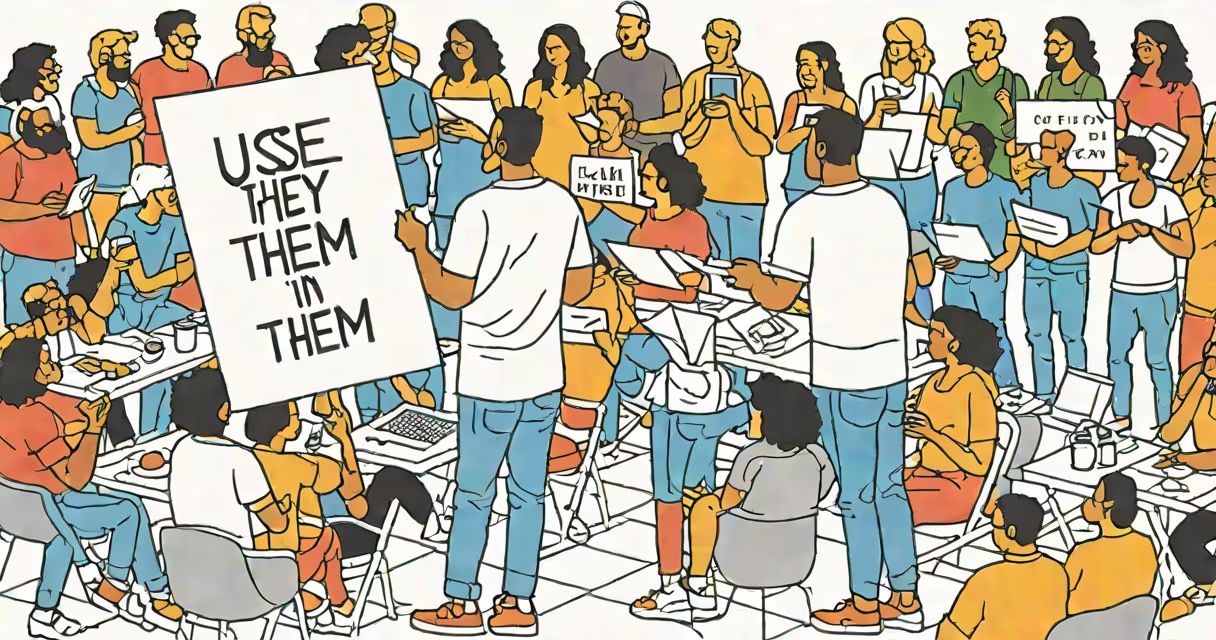
"Identify as they them" means a person uses "they" and "them" as their gender pronouns to reflect their internal sense of self, regardless of societal expectations tied to binary gender. This choice is a form of self-identification rooted in gender identity, not biological sex or social role.
People who identify as they them may be nonbinary, genderfluid, agender, or otherwise outside the male/female gender binary. The use of "they/them" pronouns is grammatically correct and widely accepted in formal and informal contexts. It is not a mistake or a shortcut-it is a standard feature of English grammar, especially when referring to singular individuals whose gender is unspecified or non-conforming.
The American Psychological Association states that gender identity is a person's internal sense of being male, female, both, neither, or somewhere along the spectrum. When someone identifies as they them, they are affirming their identity through language. This practice reduces misgendering and supports mental well-being, particularly among youth.
Using "they/them" as pronouns follows standard English syntax. For example: "Alex came late. They apologized." The subject ("Alex") is singular, but the pronoun ("they") remains plural in form-this is grammatically valid and increasingly common. The singular "they" has existed in English since the 14th century, appearing in Chaucer's writings and later in Shakespeare.
When introducing oneself, people often state their pronouns explicitly: "Hi, I'm Jordan. I use they/them." This signals respect and invites others to do the same. In workplaces, schools, and online communities, sharing pronouns is a routine way to create inclusive environments.
A real-world example: A university student named Taylor uses they/them pronouns. Their roommate says, "Taylor left their jacket behind. They must've forgotten it." The sentence correctly reflects Taylor's identity without assuming gender.
Not all people who use "they/them" are nonbinary. Some are transgender, others are gender-neutral, and some simply prefer the pronouns. The key difference lies in identity, not usage. Here's how different identities relate to pronouns:
| Identity Type | Pronouns | Explanation |
|---|---|---|
| Nonbinary | They/them | Gender identity outside the male/female binary. Common among those who feel neither exclusively male nor female. |
| Agender | They/them | Individuals who experience no gender. "They/them" is often used because it avoids assigning gender. |
| Genderfluid | Varies (e.g., they/them, she/her) | Gender identity shifts over time. A person might use different pronouns depending on mood or context. |
| Transgender (assigned male at birth) | They/them | Some transgender people choose "they/them" if it better reflects their identity, even if they were assigned male. |
Using "they/them" does not imply a person is undecided or confused about their gender. It is a deliberate, consistent choice. According to the National Center for Transgender Equality, nearly 30% of transgender adults in the U.S. use "they/them" pronouns, with higher rates among younger populations.
One frequent error is assuming "they/them" is only for groups. That's incorrect. Singular "they" is standard in both spoken and written English. The Oxford English Dictionary recognizes it as a legitimate form. Using "he or she" is outdated and excludes nonbinary people.
Another misconception is that "they/them" is a political statement. It is not. It is a linguistic tool for accurate self-expression. People who use "they/them" are not rejecting traditional gender roles-they are affirming their authentic selves.
A lesser-known fact: "They" as a singular pronoun was used by Jane Austen, George Eliot, and other literary figures. It predates modern debates on gender. The shift toward inclusivity in language is not new-it's a return to long-standing usage.
I once attended a community meeting where a speaker introduced themselves as "I am Jamie. I use they/them." A participant responded, "But you're a woman." The speaker calmly corrected, "My gender is not visible. My pronouns reflect my identity." The room fell silent. Later, several attendees shared that they'd never considered how deeply pronouns affect belonging.
Respecting pronouns reduces anxiety and improves mental health. A 2022 study published in *The Lancet* found that transgender and nonbinary youth who had their chosen pronouns respected reported 70% lower rates of suicidal ideation compared to those who did not.
When someone asks, "Do you want me to call you 'they'?" it's not a test. It's a request for accuracy. Responding with "Yes, please" affirms dignity. Saying "I don't know" is okay too-but it's better to ask and learn.
Start by asking. In conversations, introduce your own pronouns: "I go by they/them." Then invite others to share theirs. In emails, add pronouns to your signature: "Best, Sam (they/them)." In group settings, lead with inclusion: "Let's all share our pronouns so we're clear."
When you make a mistake, correct it quickly: "Sorry-I meant to say they." Apologizing doesn't require drama. It shows care.
For tech users, Apple's iOS 15 introduced a feature allowing users to set preferred pronouns in the Contacts app. You can now see "They/Them" listed alongside "He/Him" and "She/Her." This integration reflects growing acceptance in everyday tools.
"Identify as they them" is a statement of identity, not confusion. It is a respectful, grammatically sound way to live and speak authentically. Using "they/them" pronouns aligns with both linguistic tradition and human rights principles. It is not optional-it is essential for inclusion.