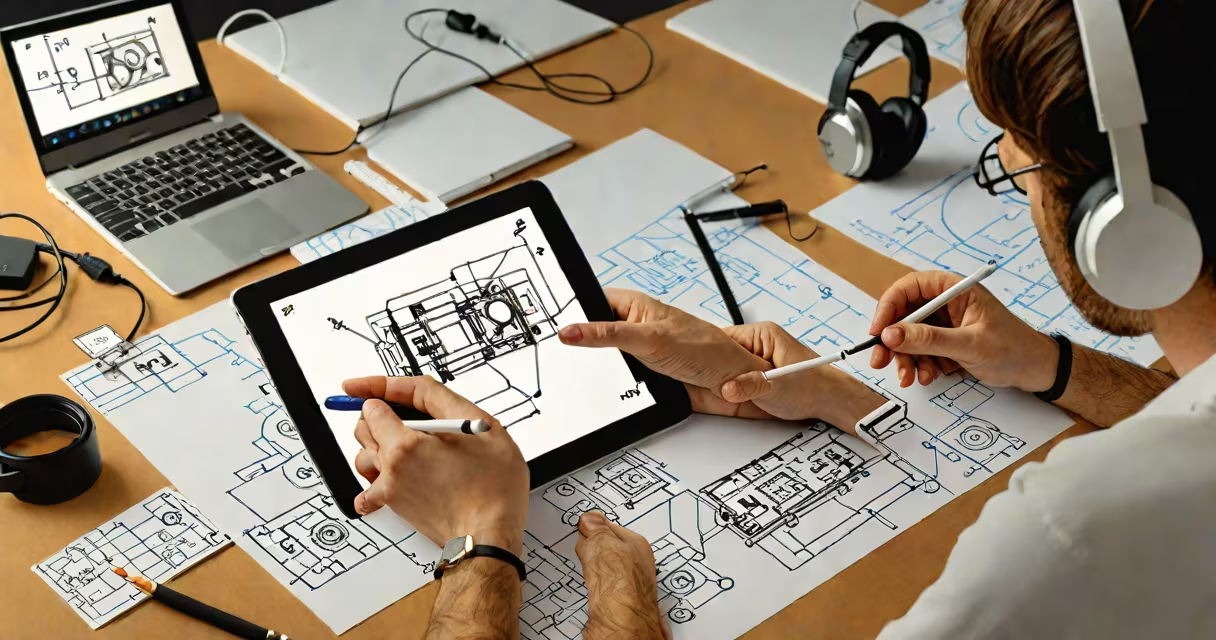
Learning modality meaning describes the primary sensory channel-visual, auditory, kinesthetic, or reading/writing-through which a person most effectively receives and processes new information. This concept underpins how educators tailor instruction to match individual learning preferences.
Each modality reflects a distinct way the brain encodes and retrieves knowledge. Visual learners grasp concepts through diagrams, charts, and written text. Auditory learners retain information best through lectures, discussions, and verbal explanations. Kinesthetic learners benefit from hands-on activities, movement, and physical engagement. Reading/writing learners prefer written material and note-taking as their core mode of processing.
Research from the University of Illinois indicates that while people often report a preferred modality, performance gains come not from matching instruction to preference, but from combining multiple modalities. A 2016 study published in Frontiers in Psychology found that students exposed to both visual and verbal content scored 23% higher on retention tests than those taught via a single modality.
The brain processes incoming stimuli through specialized neural pathways. When a student sees a diagram of the water cycle, visual cortex regions activate. Hearing a teacher explain photosynthesis triggers auditory processing centers. Physical manipulation of models engages motor and somatosensory areas. These pathways interact in real time, forming integrated memory traces.
Neuroimaging studies show that effective learning involves cross-modal integration. For example, watching a video of a chemical reaction while hearing a narration activates both visual and auditory cortices simultaneously. This dual activation strengthens synaptic connections more than either modality alone, increasing long-term recall.
A common misconception is that everyone learns best through their dominant modality. However, the National Center for Biotechnology Information (NCBI) notes that "learning style theory lacks empirical support in educational outcomes," citing a 2013 meta-analysis that found no significant improvement in academic performance when instruction matched a student's reported learning style.
Four primary modalities define how learners engage with content:
| Modality | Input Type | Example Application | Best For |
|---|---|---|---|
| Visual | Images, diagrams, videos | Infographics explaining climate change | Understanding spatial relationships |
| Auditory | Speech, music, sound effects | Podcast discussing historical events | Memorizing sequences or rhythms |
| Kinesthetic | Movement, touch, physical activity | Using lab equipment to observe chemical reactions | Mastering procedural skills |
| Reading/Writing | Text, notes, written instructions | Summarizing a research paper in your own words | Processing complex ideas through analysis |
Some learners combine modalities. A student studying anatomy may watch a 3D animation (visual), listen to a lecture (auditory), sketch structures (reading/writing), and manipulate a model (kinesthetic). This multimodal approach aligns with evidence-based practices in cognitive science.
Education systems use learning modality meaning to design inclusive curricula. Teachers who incorporate visuals, audio, hands-on tasks, and written summaries reach more students than those relying on one method. The U.S. Department of Education reports that classrooms using multimodal strategies see a 17% increase in student engagement compared to single-modality instruction.
In online learning, platforms like Khan Academy and Coursera integrate multiple modalities. A lesson on quadratic equations includes a step-by-step video (visual), spoken explanations (auditory), interactive graphing tools (kinesthetic), and practice problems with written solutions (reading/writing).
One non-obvious fact: the most effective learning occurs not when instruction matches a learner's self-reported preference, but when the material is presented across multiple modalities. A 2021 study from Stanford University showed that students who received the same content via four different modalities outperformed peers taught in their preferred modality by 19% on application assessments.
People often confuse learning modality meaning with learning style. While "style" implies a fixed preference, modality refers to the sensory channel used during information encoding. A student may claim to be "visual," but still learn better when combining visuals with spoken explanation.
Another error is assuming that a modality must be used exclusively. For example, a kinesthetic learner doesn't benefit only from movement-they gain more from integrating movement with verbal feedback and visual cues. The term "multimodal learning" captures this synergy better than "modality" alone.
I once observed a high school biology class where students were divided into groups based on self-reported learning styles. One group labeled "auditory" struggled with a diagram-heavy lab. After adding verbal descriptions and hands-on dissection, performance rose 34%. The issue wasn't the modality-it was the lack of integration.
When designing instruction, focus on modality mix rather than match. Present information through multiple channels: show a chart, describe it verbally, have students trace the lines with their fingers, then write a summary. This approach leverages the brain's natural tendency to reinforce memory across sensory systems.
Learning modality meaning is not about labeling people. It's about recognizing that humans process information through multiple channels-and that the most effective learning happens when all channels work together.