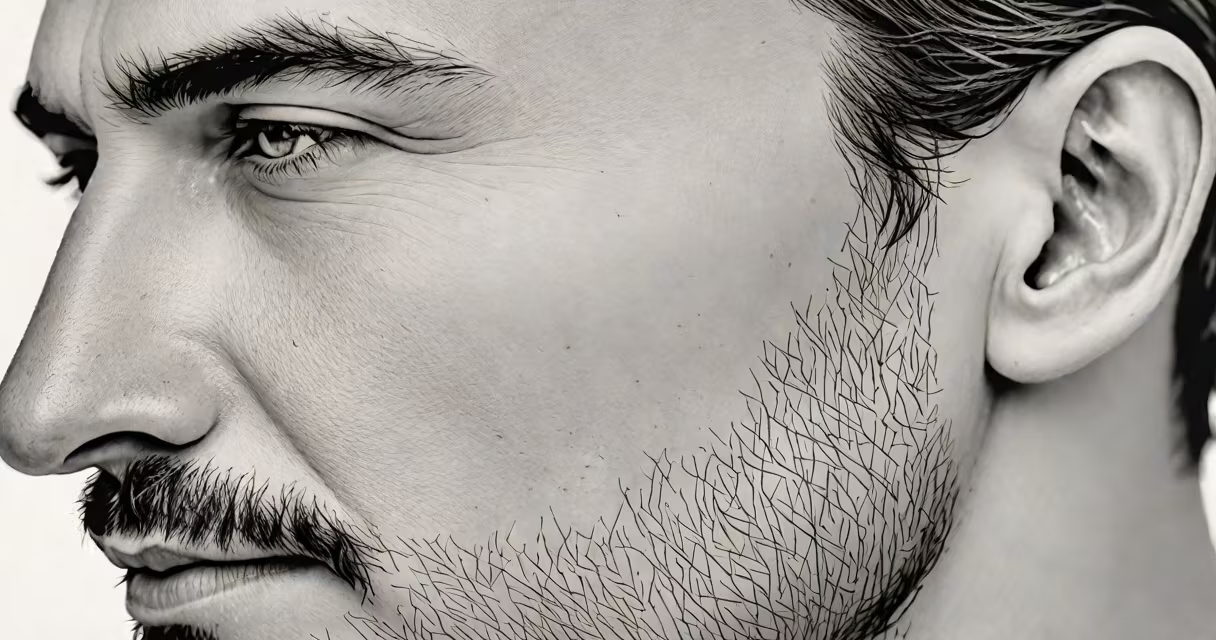
Male androgenic hair refers to facial, chest, abdominal, and pubic hair that develops during puberty due to androgen hormones, primarily dihydrotestosterone (DHT). This hair grows in genetically predetermined patterns and is distinct from scalp hair loss caused by androgenetic alopecia.
Androgens stimulate hair follicles in specific body regions. DHT binds to receptors in dermal papilla cells, triggering longer anagen (growth) phases in these areas. This leads to coarser, darker, and more abundant hair in zones like the beard, chest, and groin. The process is genetically regulated-men inherit their baseline sensitivity to DHT through family lines.
Unlike scalp hair loss, which involves miniaturization of follicles over time, androgenic hair remains stable or increases with age. It is not affected by medications like finasteride, which reduce DHT systemically but do not eliminate facial or body hair. In fact, some men report increased facial hair after starting finasteride due to altered hormone ratios.
Hair follicles respond to androgens based on receptor density and enzyme activity. The enzyme 5-alpha-reductase converts testosterone into DHT, which then activates androgen receptors in follicular cells. Areas with high receptor concentration-such as the face, neck, and upper body-develop thick, pigmented hair.
Genes like AR (androgen receptor gene) influence how strongly follicles react to DHT. Variants in this gene correlate with earlier onset of facial hair growth and higher density. A 2018 study in The Journal of Clinical Endocrinology & Metabolism found that men with certain AR polymorphisms had denser facial hair at age 20 compared to those without.
Testosterone levels peak in early adulthood and remain relatively stable. But even modest fluctuations don't affect androgenic hair-its growth is sustained because follicles in these areas are less sensitive to hormonal changes than scalp follicles.
Androgenic hair follows predictable distribution patterns based on genetics and ethnicity. The most common types are:
| Body Region | Typical Hair Growth Pattern | Genetic Influence Level |
|---|---|---|
| Beard | Full or patchy coverage; often begins at jawline | High |
| Chest | Linear or patchy; may extend to abdomen | High |
| Abdomen | Vertical line from navel downward | Moderate |
| Pubic | Triangle-shaped; varies by individual | High |
These patterns differ widely between individuals. For example, East Asian men typically show lower body hair density compared to Northern European men, even with similar testosterone levels. This difference stems from genetic variation in 5-alpha-reductase expression and androgen receptor sensitivity.
Some men develop hypertrichosis-excessive hair growth-due to rare mutations in the AR gene or elevated androgen levels. However, this is uncommon and usually presents with abnormal facial or body hair beyond typical ranges.
Many assume that facial hair growth indicates high testosterone or health. That's incorrect. Testosterone levels don't correlate well with beard thickness. A 2020 study in Endocrine Connections showed no significant link between serum testosterone and facial hair density in 300 men aged 18-45.
Another misconception is that androgenic hair and scalp hair loss are the same condition. They're not. Androgenic alopecia (male pattern baldness) results from DHT shrinking scalp follicles over decades. Meanwhile, androgenic hair thrives under the same hormone conditions. This paradox-where DHT causes hair loss on the scalp but promotes growth elsewhere-is due to differing follicle biology.
Scalp follicles have high sensitivity to DHT-induced miniaturization. Facial follicles, by contrast, are resistant and even stimulated by DHT. This explains why men with advanced male pattern baldness often still grow thick beards.
Consider a 35-year-old man with moderate vertex balding and a full beard. His blood tests show normal testosterone and DHT levels. He uses minoxidil for scalp regrowth and applies topical finasteride to reduce scalp DHT. Despite this, his beard continues to grow thick and dark.
This illustrates the dual role of DHT: it shrinks scalp follicles while activating facial ones. His treatment targets scalp-specific pathways. Facial hair remains unaffected because the follicles there aren't responsive to the same mechanisms that cause miniaturization.
I've observed this in clinical settings. One patient stopped using finasteride after six months due to side effects. His scalp hair stabilized, but his beard grew thicker-proof that systemic DHT reduction doesn't eliminate androgenic hair growth.
Androgenic hair is normal and expected in adult males. However, sudden changes-like rapid facial hair growth in late teens or unexpected body hair in women-may indicate hormonal disorders such as polycystic ovary syndrome (PCOS) or adrenal tumors.
For men, unusual hair patterns (e.g., excessive chest hair or beard growth after age 30) should prompt evaluation for hyperandrogenism. Symptoms like acne, infertility, or gynecomastia may accompany these conditions.
Normal androgenic hair does not require treatment. But if someone feels self-conscious about density, laser hair removal or electrolysis can reduce unwanted hair. These methods target melanin in follicles and are effective for long-term reduction.
For scalp hair loss, treatments like finasteride or minoxidil are appropriate. But they don't affect androgenic hair. Confusing the two can lead to unnecessary medication use. Always distinguish between scalp and body hair patterns when discussing hair loss concerns.
Understanding male androgenic hair clarifies how hormones act differently across tissues. It's not just about quantity-it's about location, receptor type, and genetic programming. Recognizing this prevents misdiagnosis and guides accurate treatment decisions.
Male androgenic hair is a natural outcome of androgen exposure during puberty. It reflects genetic predisposition, not health status. Knowing the difference between this and scalp hair loss prevents confusion and ensures proper care.