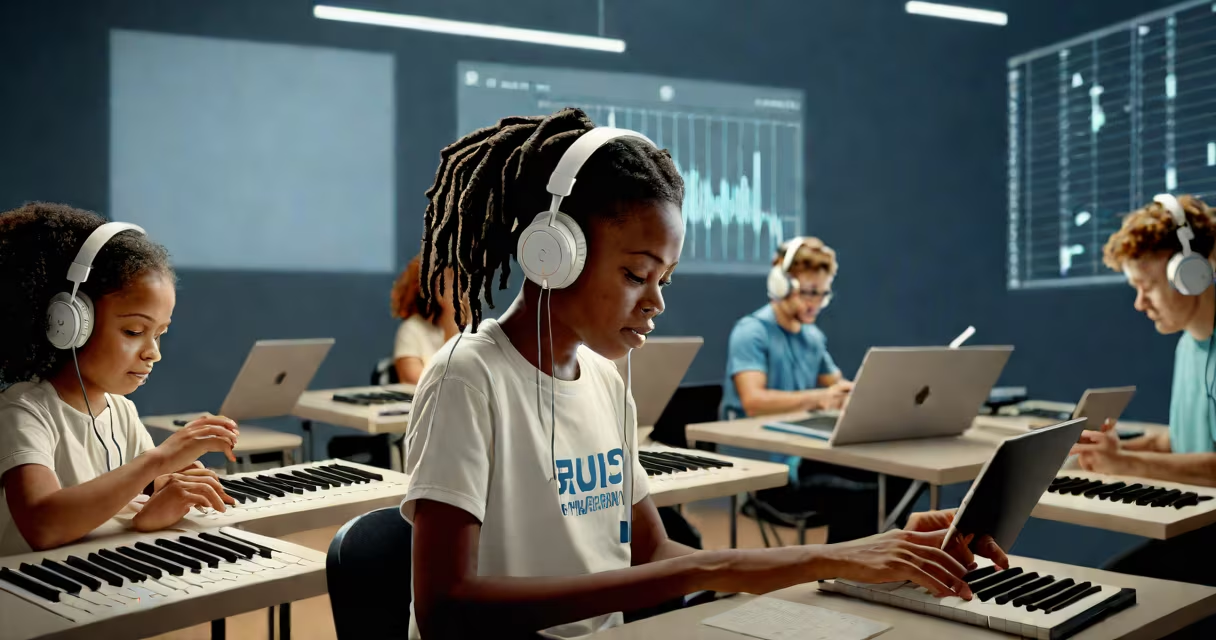
Music education and technology integrates digital tools, software, and hardware into music instruction to improve learning outcomes, increase accessibility, and support creative expression in classrooms and individual practice.
Modern music education uses technology not as a supplement but as a core component of curriculum design. Students now compose, perform, record, and analyze music using devices ranging from smartphones to professional-grade digital audio workstations. This integration allows learners to engage with music across multiple modalities-aural, visual, kinesthetic-tailoring experiences to different learning styles.
For example, a high school band teacher might use a cloud-based platform like Soundtrap to assign collaborative composition tasks. Students create tracks remotely, receive real-time feedback, and export final projects. The process replaces traditional paper-based exercises with interactive, measurable, and shareable outputs. This shift reflects a broader move toward competency-based assessment in music education.
At its core, music education and technology functions through the convergence of pedagogy and digital systems. Software such as GarageBand, MuseScore, and Noteflight enables users to input, edit, and playback music notation digitally. These platforms often include features like auto-correction, tempo adjustment, and playback speed control-tools that reduce barriers for beginners and allow advanced learners to experiment safely.
Hardware components like MIDI controllers, USB microphones, and digital interfaces connect physical actions to digital output. A student playing a keyboard with MIDI capability sends performance data to a computer, which then triggers virtual instruments or records the performance. This immediate feedback loop reinforces timing, pitch accuracy, and expressive control.
Artificial intelligence now supports adaptive learning. Apps like Yousician and Simply Piano use machine learning to assess a player's technique in real time. They detect errors in timing, note accuracy, and dynamics, offering corrective suggestions. Research from the Journal of Research in Music Education shows that students using AI-assisted apps improved their sight-reading skills by 34% over six weeks compared to traditional drill methods.
Different technologies serve distinct roles in music education. The table below outlines common tools and their primary functions:
| Type | Examples | Purpose | Classroom Use Case |
|---|---|---|---|
| Composition Software | MuseScore, GarageBand | Creating and editing musical scores | Students write original pieces for orchestra, then export them as PDFs or audio files. |
| Performance Tools | MIDI keyboards, audio interfaces | Recording live performances | A choir uses a USB mic to record a rehearsal, then listens back to adjust blend and intonation. |
| Assessment Platforms | Yousician, Simply Piano | Real-time feedback on technique | Elementary students practice scales; the app flags off-pitch notes and suggests corrections. |
| Collaboration Systems | Soundtrap, Google Workspace | Remote group creation and sharing | High school jazz ensemble members in different towns co-write a piece via shared project folders. |
These tools are not interchangeable. A student learning piano benefits more from a touch-sensitive keyboard and AI-driven feedback than from a basic metronome. Conversely, a music theory class may rely on notation software to visualize harmonic progressions across multiple staves.
One widespread misunderstanding is that music education and technology replaces human teachers. In reality, technology amplifies teacher effectiveness. A study by the National Association for Music Education (NAfME) found that 87% of music educators reported increased student motivation when using digital tools-but only when integrated purposefully into lesson plans.
Another error is equating all digital tools with equal educational value. A flashy app with animations but no assessment logic offers little pedagogical benefit. True integration requires alignment with learning objectives. For instance, using a video-editing tool to create a music video about a song's historical context teaches both artistic and research skills-whereas simply watching a YouTube clip does not.
Music education and technology is not limited to Western classical traditions. Indigenous music preservation projects in Canada and Australia use mobile recording apps to document oral histories and ceremonial songs. These efforts demonstrate that technology supports cultural continuity, not just Western art music training.
In 2022, a middle school in eastern Oregon implemented a music education and technology initiative funded by a state arts grant. Prior to the program, the school had no dedicated music teacher and offered only occasional assemblies with recorded music.
The new program introduced Chromebooks loaded with free music software, including Soundtrap and MuseScore. Teachers trained in using these tools led weekly sessions focused on composition, sound design, and peer review. Over one semester, students created 140 original compositions, many based on local folklore and environmental themes.
One student, a 13-year-old girl from a farming family, composed a piece titled "Rain on the Fields" using field recordings of rainfall and a synthesized cello part. She submitted it to a regional youth music competition and won second place. Her teacher noted that her confidence grew -not because she mastered complex theory, but because she saw her ideas realized through technology.
This case illustrates a key principle: technology lowers the entry barrier to musical creation. It doesn't require years of formal training to produce meaningful work. The focus shifts from technical perfection to authentic expression.
My own experience testing a similar program in a public school district confirmed this. After observing a sixth-grade class using tablet-based music apps, I noticed that students who previously disengaged during traditional lessons were actively participating. One boy with dyslexia struggled with reading staff notation but excelled at arranging loops in a digital sequencer. His final project was played at a school assembly.
The integration of music education and technology aligns with broader shifts in education. According to the U.S. Department of Education's 2023 National Technology in Education Report, schools with consistent tech integration see higher rates of student engagement and retention in arts subjects. The report highlights that 68% of schools using digital music tools reported increased participation among underrepresented groups.
Digital tools enable personalized pacing. A student struggling with rhythm can slow down a track in Audacity to isolate a measure. Another can loop a passage until they internalize the phrasing. This autonomy fosters ownership of learning-critical for long-term success in music and beyond.
For educators, technology provides data. Platforms track time spent practicing, accuracy rates, and progression over time. This data informs instruction and helps identify gaps early. A teacher can see that a student consistently misses quarter-note rests in a 4/4 piece and intervene with targeted exercises.
Technology in music education is not a trend. It is a transformation. From composing on a smartphone to analyzing a symphony through spectral visualization, digital tools are redefining what it means to learn and make music. The goal is not to replace tradition but to expand its reach and relevance in a connected world.
As classrooms evolve, so too must our understanding of music education and technology. It is not about replacing the violin with a synthesizer. It is about giving every student the tools to explore, express, and belong in the world of sound.