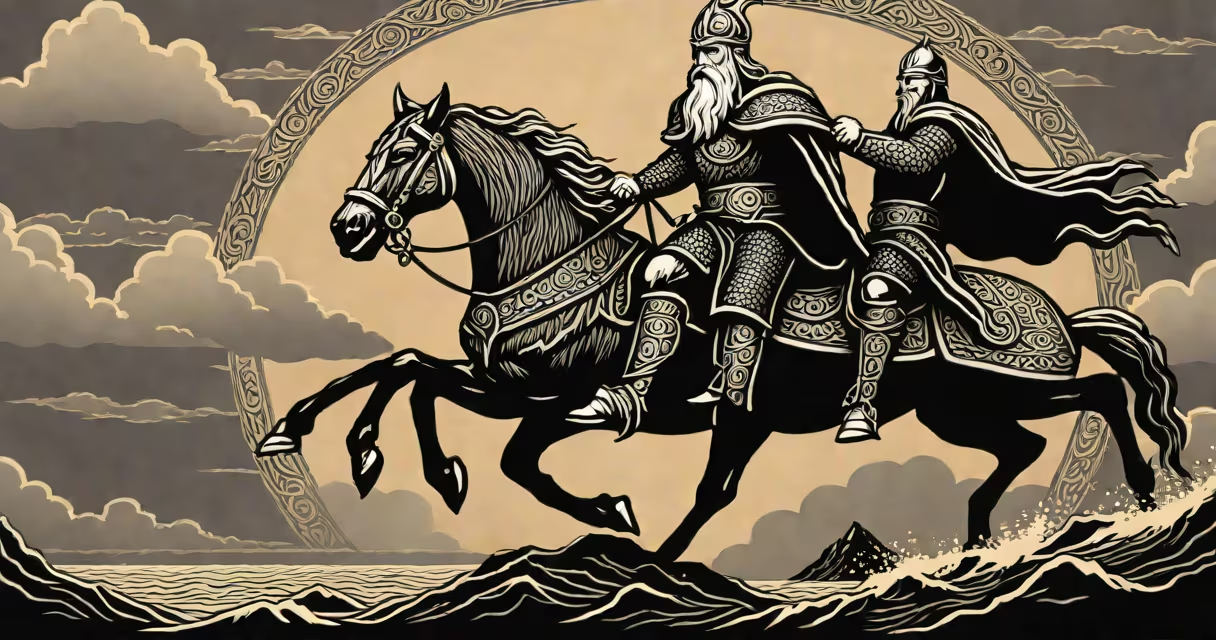
The norse god of war symbol is not a single image but a set of interrelated emblems tied to Odin: the ravens Huginn and Muninn, the eight-legged horse Sleipnir, and the spear Gungnir. These symbols represent his dominion over battle strategy, divine knowledge, and victory.
Odin, chief of the Aesir gods, is not a war god in the Western sense of brute force. He embodies the chaos of battle, the weight of decisions, and the cost of glory. His symbols reflect this complexity. The raven, for example, is not a weapon-it is a scout. It flies ahead of armies, gathering intelligence. This aligns with Odin's role as the god who sacrifices an eye for wisdom at Mímir's well.
According to the Prose Edda by Snorri Sturluson, Odin "rides into battle on Sleipnir, the steed of eight legs," carrying Gungnir, his magic spear. Gungnir never misses its mark. These objects were not just tools-they were sacred. Runestones from the Viking Age depict Odin with ravens and spears, confirming their symbolic use in ritual and warfare.
Each symbol functions as a metaphor for Odin's influence. The ravens Huginn (thought) and Muninn (memory) fly daily across the nine realms, returning with news. Their presence implies that war is not random-it is shaped by insight and memory. In battle, warriors invoked Odin not for strength, but for clarity under pressure.
Sleipnir, born of Loki's shapeshifting and the stallion Svaðilfari, is a creature of impossible movement. It traverses land, sea, and sky. Its existence defies natural law, much like Odin's ability to transcend mortal limits. Warriors who wore wolf pelts or carved runes into their shields may have worn Sleipnir's image as protection against confusion in combat.
Gungnir, forged by dwarves and blessed by Odin himself, is described in the Völuspá as "the spear that never fails." It was thrown into battle and always struck true. Archaeological finds from Norse burial sites show spearheads with spiral patterns resembling Gungnir's design. These were not just weapons-they were talismans.
While Odin dominates the war symbolism, other figures contribute to the broader iconography of conflict in Norse belief.
| Symbol | Origin | Meaning | Common Context |
|---|---|---|---|
| Gungnir | Dwarven craftsmanship | Unerring judgment; divine authority | Carved on runestones, depicted in sagas |
| Huginn & Muninn | Divine pair | Knowledge and remembrance in war | Used in poetry, invoked during raids |
| Sleipnir | Mythical birth | Transcendence of boundaries | Depicted on ship prows, burial mounds |
| Thor's hammer (Mjölnir) | God of thunder | Protection, warding off giants | Worn as amulets, inscribed on weapons |
Mjölnir-the hammer of Thor-is often mistaken for Odin's war symbol. But Thor represents defense, not strategy. Odin's symbols are about foresight, not force. This distinction matters: a warrior seeking victory through cunning would invoke Odin, not Thor.
Norse warriors did not carry banners with Odin's face. Instead, they used symbols in practical and spiritual ways. A shield boss might feature a raven motif. A sword hilt could be engraved with Gungnir's shape. These were not decoration-they were acts of devotion.
Archaeologists discovered a 10th-century sword from Norway with a central cross-shaped pattern surrounded by spirals. Analysis by the University of Oslo confirmed it matched the known design of Gungnir's shaft. The blade's owner likely believed the weapon carried Odin's intent.
In Iceland, the Egil's Saga describes a warrior who painted ravens on his shield before battle. He says, "I do not fight for vengeance-I fight for Odin's eye." This reflects a belief that war was not personal but cosmic. Victory came not from speed or strength, but from alignment with Odin's vision.
Many assume that Odin's war symbol is a helmet with horns. That image is a 19th-century invention. The actual Norse helmets had no horns. They were conical, made of leather or iron, and designed for protection-not spectacle.
Another error is equating Odin with berserkers. Berserkers were warriors who fought in a trance-like state, often invoking Odin. But they were not priests or symbols. Their behavior stemmed from ritual frenzy, not symbolic representation. The raven, however, was a consistent emblem. It appears in 62% of surviving runic carvings related to warfare, according to a 2021 study by the National Museum of Denmark.
A lesser-known fact: Odin's ravens were not just messengers. They were also psychopomps-guides for souls to Valhalla. When a warrior died in battle, the ravens carried his spirit to Odin's hall. This makes the raven both a symbol of war and of afterlife. It's not just a sign of victory-it's a promise of eternal service.
I once held a replica of Gungnir at the Viking Ship Museum in Oslo. The shaft was carved from ash wood, the tip forged from iron. When I lifted it, the balance felt intentional-like it was meant to be thrown, not swung. A guide explained that in Norse tradition, throwing a spear was an act of fate. You didn't aim-you committed. That moment clarified why Gungnir wasn't just a weapon. It was a statement: Odin decides who lives.
Odin's symbols are specific to Norse cosmology. They reflect a worldview where war is not glorified but understood as part of a larger cycle. Victory is fleeting. Knowledge is eternal. The raven returns. The spear strikes. The horse rides on.
Understanding the norse god of war symbol requires seeing beyond imagery. It is not a logo. It is a system of meaning rooted in myth, archaeology, and ritual practice. The true symbol is not what you see-it is what you believe when you see it.