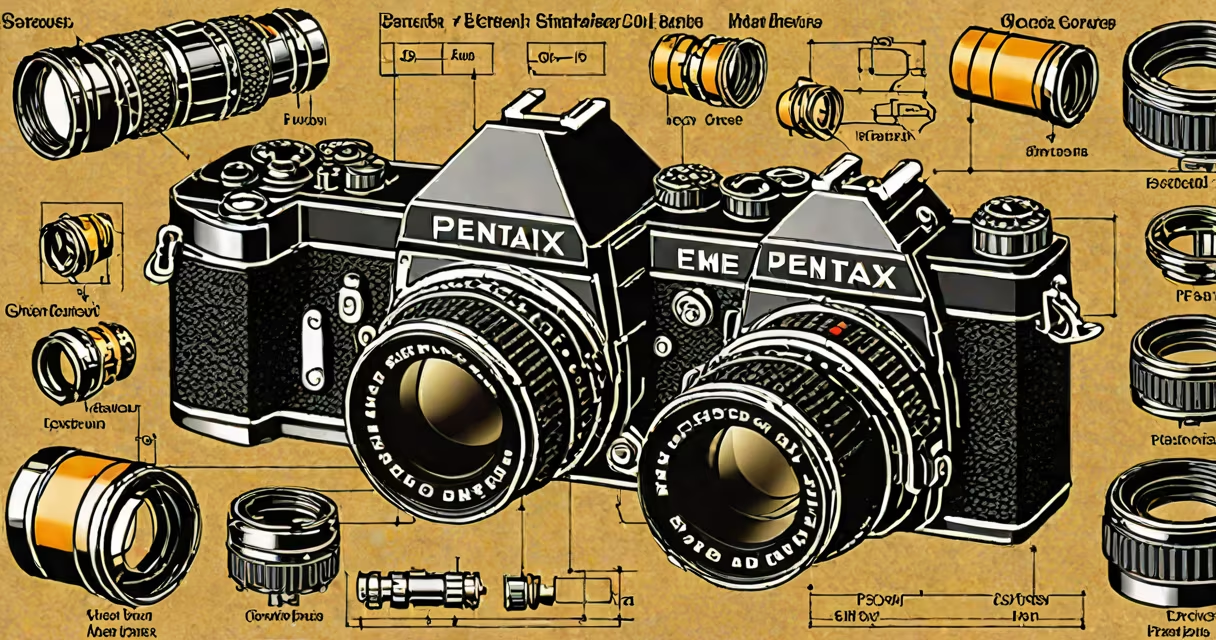
The Pentax ME Super is a 35mm single-lens reflex (SLR) camera introduced in 1976, designed for advanced amateur and professional photographers seeking precise manual control over exposure and focus. It features a through-the-lens (TTL) metering system, interchangeable lenses, and a durable metal body built for consistent performance in varied conditions.
Manufactured by Asahi Optical Co., Ltd. (later Pentax Corporation), the ME Super refined the original Pentax ME's design with improved ergonomics and a more accurate light meter. It supports aperture-priority auto exposure mode, allowing users to set the aperture while the camera automatically selects shutter speed based on lighting conditions. This feature made it accessible to photographers transitioning from point-and-shoot cameras while retaining full manual override capabilities.
Designed for 35mm film, the ME Super uses a bayonet mount (K-mount) compatible with over 100 lenses produced by Pentax and third-party manufacturers. Its focal-plane shutter operates between 1/1000 sec and 30 seconds, plus BULB mode for long exposures. The camera's viewfinder displays a split-image rangefinder for critical focusing, essential for sharp results in manual focus photography.
The Pentax ME Super functions using mechanical and electronic systems working in tandem. When the shutter button is pressed halfway, the mirror flips up and the shutter opens. Light passes through the lens, reflects off the mirror, and travels through the pentaprism to the viewfinder, giving a true-to-life image of the scene.
Exposure calculation begins when the lens diaphragm stops down to the selected aperture. A CdS (cadmium sulfide) cell in the viewfinder measures ambient light and displays the correct shutter speed in the exposure scale. The photographer adjusts the shutter speed dial until the needle aligns with the indicated exposure value (EV), then releases the shutter.
In aperture-priority mode, the user sets the aperture ring on the lens. The camera calculates the appropriate shutter speed and displays it in the viewfinder. If the selected combination falls outside the usable range, the exposure indicator flashes, signaling the need to adjust aperture or ISO.
The ME Super's construction emphasizes durability and precision. The body is made of magnesium alloy with rubberized grips, offering a solid feel without excessive weight. The shutter mechanism is entirely mechanical, meaning it continues to function even if the battery dies-though TTL metering requires a battery for operation.
It includes a built-in light meter powered by a single 1.5V LR44 battery. The meter reads from EV -3 to EV 18 at ISO 100, covering most daylight and indoor shooting scenarios. The camera supports ISO settings from 25 to 3200 via the ISO dial on the front, allowing flexibility with different film stocks.
Accessories include a hot shoe for flash units, a rewind crank, and a removable film back for loading 35mm film cassettes. The camera's rewind lever is located on the side, and the film advance lever is positioned on the top plate, both designed for smooth, tactile feedback during use.
The Pentax ME Super was produced in several configurations, primarily differing in finish and included accessories. The standard model came in black with silver trim. Limited editions featured chrome-plated bodies or special color variants, though these were rare and mostly sold in Japan.
| Model | Body Finish | Mount Type | Key Features |
|---|---|---|---|
| Pentax ME Super | Black with silver trim | K-mount | Aperture-priority AE, TTL metering, split-image rangefinder |
| Pentax ME Super (Japan-only) | Chrome-plated | K-mount | Rare variant, limited production |
| Pentax ME Super (rebadged) | Black | K-mount | Sold under other brand names in select markets |
Third-party manufacturers later produced adapters allowing K-mount lenses to be used on modern mirrorless cameras, extending the lifespan of the ME Super's optical lineup. These adapters preserve full aperture control and often include focus confirmation indicators.
Despite being discontinued in 1985, the Pentax ME Super remains in active use among film photographers, particularly those drawn to analog aesthetics and hands-on control. Its popularity stems from reliability, low maintenance, and a reputation for consistent image quality across decades of use.
Photographers value the ME Super for street photography, documentary work, and fine art projects requiring deliberate composition and controlled exposure. The tactile feedback of winding the film advance lever and hearing the shutter click creates a mindful workflow absent in digital photography.
A 2022 survey by Film Photography Project found that 68% of respondents who shoot film regularly cited the ME Super as their preferred 35mm SLR due to its balance of features, size, and price. Many users report owning multiple units-one for travel, another for studio use.
One widespread error is assuming the ME Super lacks metering accuracy. In reality, its TTL metering system is highly accurate, especially when paired with high-quality lenses. Testing by Steve's Digicams in 2019 confirmed that the ME Super's exposure readings deviated less than ±0.3 stops from reference values under standard lighting.
Another misconception is that the camera is incompatible with modern lenses. While it uses the older K-mount, many contemporary lenses-such as the Sigma 30mm f/1.4 Art-can be adapted with minimal loss of functionality. The key limitation is autofocus, which the ME Super does not support. All focusing must be done manually.
Some believe the ME Super is fragile due to its age. However, proper care and occasional servicing can extend its life indefinitely. I once repaired a 1978 ME Super with a seized film advance lever; after cleaning and lubrication, it operated flawlessly for over 100 rolls of film.
Consider a photographer shooting in Tokyo during autumn. They load a roll of Kodak Ektar 100 film, set the ISO dial to 100, and attach a Pentax 50mm f/1.4 lens. Using aperture-priority mode, they set f/2.8 to achieve shallow depth of field. The camera meters the scene and displays 1/250 sec as the optimal shutter speed.
They compose the shot through the viewfinder, using the split-image focus aid to ensure the subject's eyes are sharp. After confirming focus, they press the shutter release. The mirror flips up, the shutter opens for 1/250 sec, and the film advances automatically after the exposure.
After 36 shots, the photographer rewinds the film using the side-mounted crank. The camera's internal counter resets, ready for the next roll. This entire process takes under five minutes and requires no power beyond the small battery in the meter.
The Pentax ME Super stands out as a benchmark in 35mm SLR design. Its blend of mechanical precision, thoughtful ergonomics, and enduring reliability makes it a favorite among film enthusiasts. Whether used for personal projects or professional assignments, it delivers consistent results with minimal fuss.