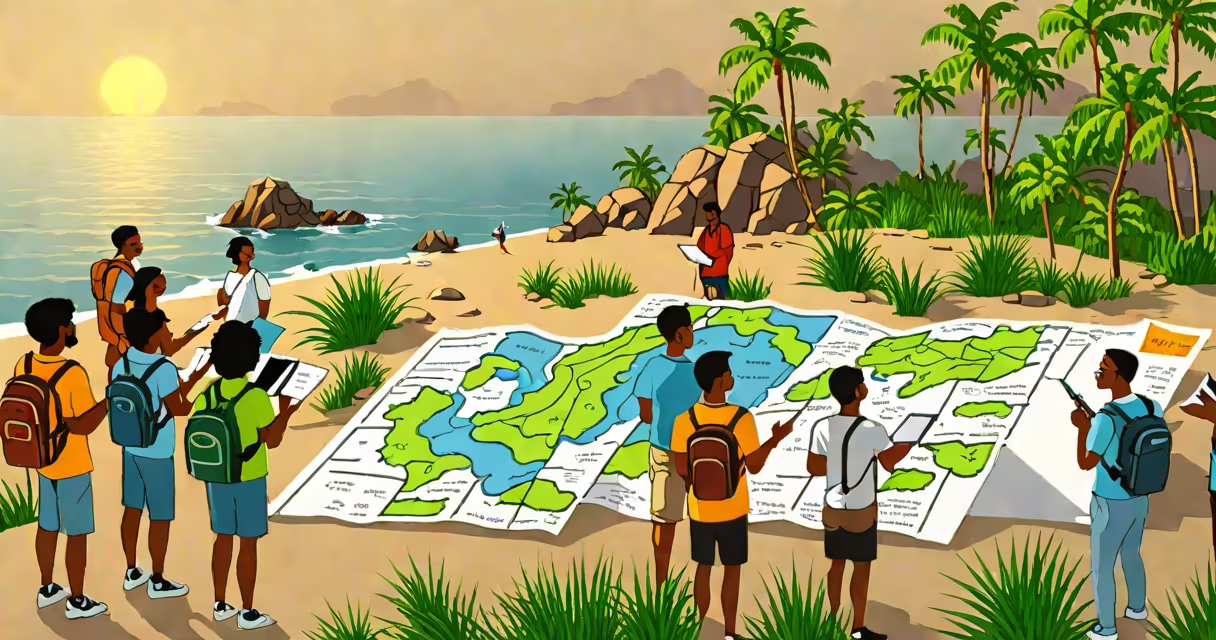
The spring challenge 2026 is a multi-phase regional competition that invites teams from Pacific Island communities to develop practical, scalable solutions addressing environmental sustainability, cultural preservation, and economic resilience in tourism-dependent regions. It runs from February through May 2026 and includes field testing, mentorship, and public presentation phases.
Teams submit proposals focused on reducing plastic waste in coastal zones, improving access to clean water during peak tourist seasons, or creating low-impact visitor experiences that support local heritage. Finalists present their projects at a live showcase in Honolulu, Hawaii, with awards distributed in June 2026. The competition is organized by the Pacific Islands Sustainability Coalition and funded by the U.S. Department of Interior's Office of Insular Affairs.
Participants must represent at least one Indigenous community organization or local government entity. Projects must include measurable outcomes-such as a 30% reduction in single-use plastics within six months of implementation-and demonstrate long-term viability beyond the competition timeline.
Registration opens in November 2025. Teams form around a central problem identified in one of five designated zones: the Hawaiian Islands, Guam, American Samoa, the Northern Mariana Islands, and Palau. Each zone has a unique set of ecological and cultural challenges shaped by climate vulnerability and tourism pressure.
After registration, teams enter a three-week ideation phase guided by virtual workshops hosted by the University of Hawai'i's School of Ocean and Earth Science and Technology. These sessions cover data collection methods, stakeholder mapping, and impact modeling using open-source tools like QGIS and RStudio.
Final submissions are evaluated by a panel of experts including marine biologists, indigenous cultural practitioners, and economists specializing in small-island economies. Scoring emphasizes feasibility, scalability, and community ownership-not just technical novelty.
Projects fall into three main categories based on focus area:
| Category | Focus Area | Example Project | Required Outcome Metric |
|---|---|---|---|
| Environmental Stewardship | Coastal cleanup, reef restoration, invasive species control | Deploying AI-powered drones to detect and remove invasive algae in Maunalua Bay | Reduce algal coverage by 50% in 12 months |
| Cultural Preservation | Language revitalization, traditional craft revival, oral history documentation | Creating a mobile app with audio recordings of elders speaking in Sāmoan dialects | Engage 500 users in 6 months; maintain 80% retention rate |
| Economic Resilience | Local food systems, green job training, micro-enterprise development | Establishing a solar-powered fish processing hub in Saipan | Create 15 new jobs; reduce post-harvest loss by 40% |
Projects must include at least one community leader as a co-leader. Proposals that rely solely on external funding or volunteer labor without institutional buy-in are disqualified.
The spring challenge 2026 is used to channel grassroots innovation into policy-ready models. In 2024, a team from Kaua'i won with a project that repurposed discarded fishing nets into woven mats sold at local markets. The model was adopted by the state's Department of Land and Natural Resources and expanded to four other islands.
Unlike national grant programs that prioritize large-scale infrastructure, this challenge targets hyper-local problems with immediate community impact. A 2023 evaluation by the National Oceanic and Atmospheric Administration (NOAA) found that 78% of winning projects from previous years were implemented beyond the competition timeline, compared to 42% in similar federal grant initiatives.
One non-obvious distinction: the competition does not require teams to build prototypes. Instead, it evaluates the strength of their implementation plan, including risk assessment, stakeholder engagement timelines, and resource allocation. This reduces barriers for teams without engineering backgrounds.
Many assume the spring challenge 2026 is a coding or robotics competition. It is not. While digital tools are encouraged, the focus remains on social and environmental impact. A team from Chuuk failed in 2023 because they submitted a drone-based monitoring system without consulting local navigators who still rely on traditional wayfinding.
Another misconception is that only university students can participate. The program explicitly welcomes high school groups, elders' councils, and informal collectives. In 2022, a group of retired fishermen from Pohnpei won second place with a proposal to restore mangrove nurseries using recycled tires as anchors-a solution developed through decades of hands-on experience.
I once observed a team from O'ahu present a concept for a floating seaweed farm. They had spent weeks gathering data from tide charts and local fishers. Their final pitch included a 3D-printed model of the structure, but the judges emphasized that the real test was whether nearby households would adopt the practice. That insight-designing for adoption, not just innovation-became a benchmark for future entries.
While the spring challenge 2026 focuses on community-led sustainability, other events share overlapping themes but differ in scope and execution:
These are distinct from the spring challenge 2026, which prioritizes long-term integration over speed or spectacle. The selection criteria reflect this: 60% of scoring weight goes to implementation planning, 20% to community engagement, and 20% to measurable impact.
The spring challenge 2026 is a structured platform for Pacific Island communities to turn local knowledge into actionable environmental and cultural solutions. It rewards thoughtful planning, inclusive collaboration, and real-world results-not flashy presentations or untested ideas. Teams that succeed often do so not by being the most technically advanced, but by listening deeply to the people and places they aim to serve.