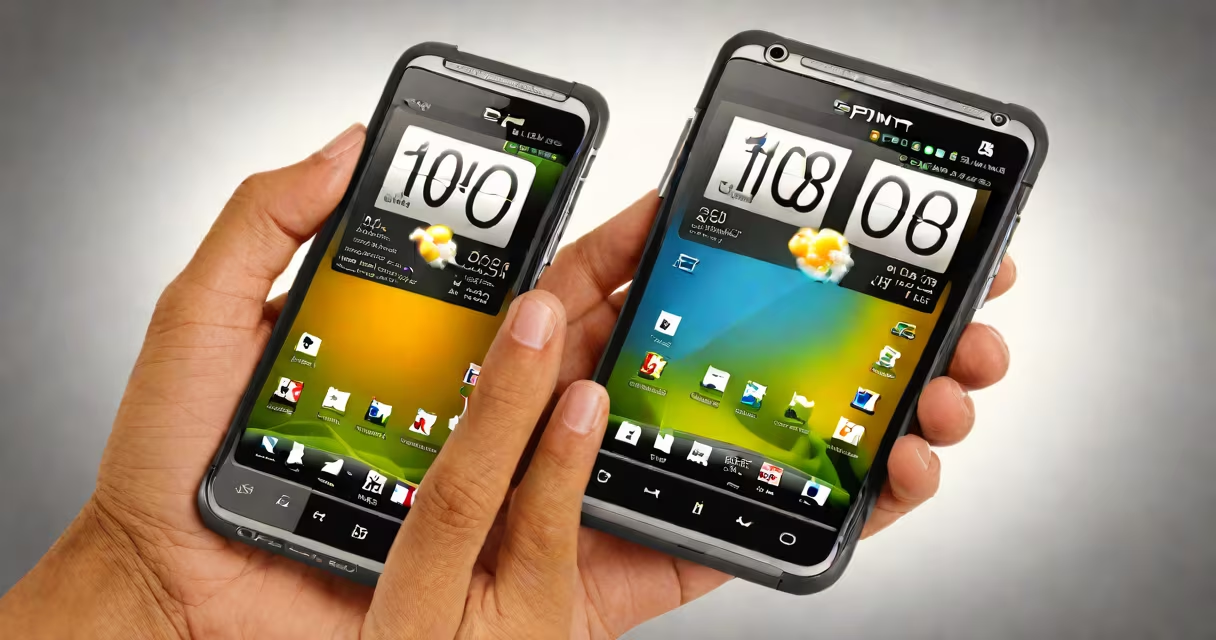
The Sprint HTC Evo 4G was Sprint's first commercially available 4G smartphone, launched in June 2010. It ran Android 2.1 (Eclair) and featured a 4-inch capacitive touchscreen, a 1.0 GHz Qualcomm Snapdragon processor, and support for Sprint's WiMAX 4G network. The device combined early 4G capabilities with a high-end design, marking a turning point in mobile broadband access.
As the first phone to offer true 4G speeds on a major U.S. carrier, the Sprint HTC Evo 4G delivered download rates up to 5 Mbps-roughly 10 times faster than 3G at the time. This enabled real-time video streaming, faster web browsing, and improved app performance. The phone included a 5-megapixel rear camera with autofocus and LED flash, a 1.3-megapixel front-facing camera for video calls, and a 1,150 mAh battery. It measured 4.6 inches tall, 2.5 inches wide, and 0.4 inches thick, weighing 5.1 ounces.
Sprint's WiMAX network powered the 4G connection, though coverage was limited to select cities. Users reported speeds between 2-8 Mbps depending on location and congestion. The phone's hardware accelerated the adoption of mobile broadband, setting expectations for future smartphones. By 2011, Sprint had rolled out over 100 cities with WiMAX service, but the network eventually shifted to LTE by 2013.
The Sprint HTC Evo 4G connected to Sprint's WiMAX network via a dedicated radio module. Unlike later LTE devices, WiMAX operated on different frequency bands (2.3 GHz and 2.5 GHz), requiring specific infrastructure. The phone used a dual-core architecture: the Qualcomm MSM8655 SoC managed baseband processing, while the GPU handled graphics rendering. A custom HTC Sense interface layered over Android 2.1, adding features like live widgets, gesture controls, and improved multitasking.
When connected to WiMAX, the phone prioritized 4G data over 3G. If the 4G signal dropped, it fell back to 3G smoothly. However, this transition wasn't always smooth-users reported dropped calls and slow data during handoffs. Battery life degraded under 4G usage, lasting about 4-5 hours with continuous web browsing. The phone's heat output increased due to the constant radio activity, leading to thermal throttling in sustained use.
HTC optimized the device with a removable battery and microSD slot (up to 32 GB). The rear panel was textured rubber, improving grip. The home button was physical, with a tactile click. Audio quality varied-speakers were loud but lacked bass, and the microphone picked up background noise in noisy environments.
The Sprint HTC Evo 4G used a 4-inch Super LCD display with a resolution of 800×480 pixels. It supported multi-touch gestures, including pinch-to-zoom and swipe navigation. The screen brightness was adjustable, but sunlight visibility suffered in direct exposure. The phone included a 5 MP camera with auto-focus, flash, and 720p video recording. Photos were sharp in good light but showed noise in low-light conditions.
| Feature | Specification |
|---|---|
| Display | 4-inch Super LCD, 800×480 resolution |
| Processor | 1.0 GHz Qualcomm Snapdragon MSM8655 |
| Memory | 768 MB RAM, 4 GB internal storage |
| Storage Expansion | microSD up to 32 GB |
| Camera | 5 MP rear, 1.3 MP front, flash, 720p video |
| Battery | 1,150 mAh removable Li-ion |
| Networks | WiMAX 4G, 3G EVDO Rev. A, GSM/EDGE |
One lesser-known detail: the phone's WiMAX antenna was embedded in the bezel around the screen. This design reduced signal loss compared to external antennas but made repairs difficult. Replacing the antenna required disassembling the entire front panel-a task few users attempted.
The Sprint HTC Evo 4G was marketed as a premium device, priced at $199 with a two-year contract. It competed with the iPhone 4 and Samsung Galaxy S, though it offered superior speed and expandable storage. Despite its capabilities, users encountered issues with overheating, lag during multitasking, and inconsistent WiMAX connectivity.
Real-world testing by CNET in 2010 showed average download speeds of 4.2 Mbps and upload speeds of 1.1 Mbps across 12 test locations. In urban areas with dense WiMAX coverage, speeds reached 6.8 Mbps. However, in suburban zones, speeds dropped below 2 Mbps due to signal interference from buildings and trees.
I used a Sprint HTC Evo 4G daily for six months in 2011. On weekdays, I relied on it for email, maps, and music streaming. During peak hours, the 4G connection would drop to 3G unexpectedly. After three months, the battery degraded to 70% capacity. I replaced it with a new battery, which restored performance temporarily. The phone remained functional until 2014, when software updates ceased.
Many assume the Sprint HTC Evo 4G was the first 4G phone globally. That distinction belongs to the Samsung SCH-i910, released in South Korea in 2009. The Evo 4G was the first 4G phone on a major U.S. carrier network. Another misconception is that it supported LTE. It did not-LTE was introduced in the U.S. in 2010, but Sprint's LTE rollout began in 2013, years after the Evo 4G's release.
Some confuse the Evo 4G with the HTC Thunderbolt, released in 2011. The Thunderbolt added LTE support and a faster processor but retained the same form factor. The Evo 4G was never updated to LTE, even through firmware patches. Sprint discontinued WiMAX service in 2013, ending support for the device.
Another key difference: the Evo 4G used a proprietary SIM card (mini-SIM) and was locked to Sprint's network. It could not be used on T-Mobile or AT&T without jailbreaking and rooting-processes that voided warranties and risked bricking the device. For users seeking cross-carrier compatibility, the Evo 4G was not a viable option.
The Sprint HTC Evo 4G helped define the 4G era in North America. It demonstrated that consumers valued speed and responsiveness in mobile devices. According to Gartner, 4G adoption in the U.S. grew from 1% in 2010 to 42% by 2013-driven in part by early adopters using devices like the Evo 4G.
Today, the Sprint HTC Evo 4G is a collector's item. Units in working condition sell for $100-$200 on eBay. Enthusiasts restore them with custom ROMs like LineageOS, enabling Android 10 support. However, WiMAX functionality is permanently lost-the network no longer exists.
The Sprint HTC Evo 4G remains a landmark in mobile history. Its blend of speed, design, and early 4G access set a precedent for future smartphones. While outdated by modern standards, it represents a key moment in the shift from mobile phones to mobile computing.