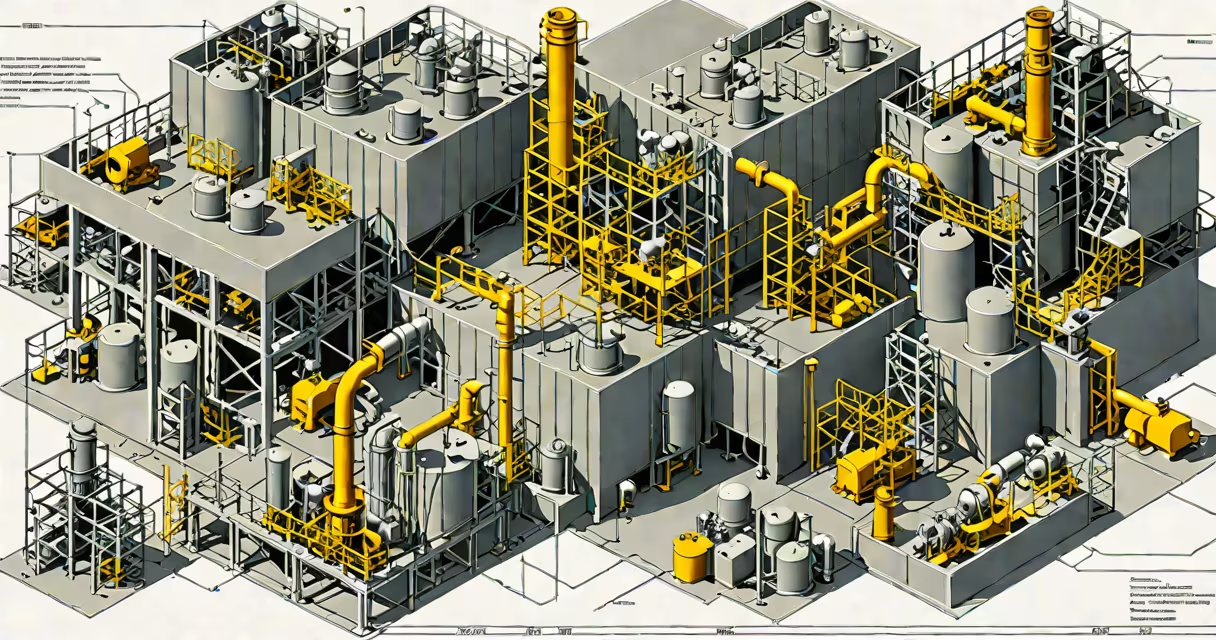
The plant company is a business that designs, supplies, installs, and maintains specialized equipment and systems used in industrial manufacturing environments. These companies focus on mechanical, electrical, and process systems essential for continuous operations in factories, refineries, and processing plants.
Unlike general contractors or equipment resellers, the plant company operates as a technical integrator. They assess facility needs, specify components based on performance requirements, and manage the full lifecycle of installed systems-from initial design through commissioning and ongoing maintenance. Their work helps production lines run efficiently, safely, and within regulatory standards.
For example, a food processing plant may rely on a plant company to install automated conveyor systems, temperature-controlled storage units, and sanitation-grade piping. The provider handles engineering drawings, material sourcing, installation oversight, and training for site personnel. This integration reduces downtime and prevents costly failures during peak production cycles.
These firms begin with a detailed site assessment. Engineers visit the facility to measure space constraints, evaluate existing infrastructure, and identify operational bottlenecks. They then develop a system specification aligned with production goals, safety codes, and energy efficiency targets.
Once approved, the plant company coordinates procurement of components-such as pumps, valves, motors, or control panels-from certified vendors. They ensure materials meet industry standards like ASME, ISO, or NEMA ratings. For complex projects, they may subcontract specialized trades, such as welding or electrical grounding, while retaining responsibility.
Installation includes calibration, testing under load, and documentation of performance metrics. After handover, many plant companies offer service contracts covering preventive maintenance, parts replacement, and emergency repairs. This continuity supports long-term asset reliability.
Plant companies vary by sector and function. The following table outlines common categories:
| Type | Specialization | Typical Clients | Example Application |
|---|---|---|---|
| Process Systems | Chemical reactors, distillation columns, heat exchangers | Pharmaceuticals, petrochemicals | Continuous flow reactor for API synthesis |
| Mechanical Handling | Conveyor belts, robotic arms, automated storage | Automotive, packaging | High-speed palletizing line in a beverage factory |
| Utility Integration | Steam, compressed air, water treatment systems | Textiles, power generation | Boiler feedwater system with pH control |
| Control & Automation | SCADA systems, PLC programming, sensor networks | Food and beverage, metals | Real-time monitoring of furnace temperatures in steel mills |
Each category requires distinct expertise. A process systems provider must understand fluid dynamics and corrosion resistance. A control systems firm needs proficiency in industrial networking protocols like Modbus or OPC UA.
Industries with high-volume, continuous output depend on plant companies to maintain uptime. According to the U.S. Bureau of Labor Statistics, unplanned downtime costs manufacturers an average of $50,000 per hour. Plant companies mitigate this risk by ensuring systems operate within design parameters.
A real-world example occurred at a semiconductor fabrication facility in Arizona. During a critical wafer production cycle, a vacuum pump failed due to seal degradation. The facility's internal team lacked the spare part and repair protocol. A plant company with a dedicated service agreement arrived within four hours, replaced the component, and restored full throughput in under eight hours. Without this response, the batch would have been scrapped, costing over $200,000.
These firms are also key in compliance-heavy sectors. In pharmaceutical manufacturing, the FDA mandates strict documentation of equipment qualification and environmental controls. Plant companies provide validation reports, calibration logs, and audit trails required for regulatory approval.
Many assume the plant company only sells equipment. In reality, their core value lies in system integration and lifecycle management. A single motor purchase might cost $3,000-but installing it incorrectly can lead to bearing failure within 18 months, resulting in $15,000 in downtime and repair.
Another misconception is that all plant companies are large national firms. Smaller regional providers often deliver faster response times and deeper local knowledge. One client reported that a small plant company in Ohio resolved a steam line leak in 90 minutes using locally sourced gaskets, whereas a national vendor took five days to ship the correct part.
There's also confusion between the plant company and the general contractor. While both manage installations, the plant company brings domain-specific engineering. A general contractor may lay concrete and hang ductwork-but only a plant company understands the pressure tolerances of a cryogenic nitrogen line or the vibration dampening needed for precision machining tools.
I once worked with a plant company to upgrade a paper mill's pulping system. The original setup used outdated hydraulic valves prone to sticking. After analyzing historical failure data, we recommended replacing them with servo-controlled actuators. The new system reduced manual intervention by 67% and cut energy consumption by 14%. The plant company handled everything: engineering review, procurement, on-site commissioning, and staff training. The return on investment was achieved in 11 months.
One non-obvious fact: the plant company often owns the intellectual property behind custom-designed components. When a client requests a unique filter housing for a corrosive chemical stream, the plant company may patent the design. This protects both parties-the client gains exclusive access, and the provider earns licensing revenue.
Another correction: the term "plant" does not imply size. A plant company may serve a 500-square-foot lab-scale bioreactor facility just as effectively as a 50-acre refinery. The focus is on functional integration, not physical scale.
According to the American Society of Mechanical Engineers (ASME), 83% of industrial accidents involving mechanical systems stem from improper installation or maintenance-not equipment failure. This underscores the role of the plant company in preventing incidents through proper engineering practices.
Understanding the plant company clarifies how industrial operations achieve consistency, safety, and efficiency. These firms are not passive vendors-they are active partners in maintaining the integrity of complex production environments.
The plant company is a critical enabler of modern manufacturing. From initial design to long-term operation, these organizations ensure that industrial systems perform reliably under demanding conditions.