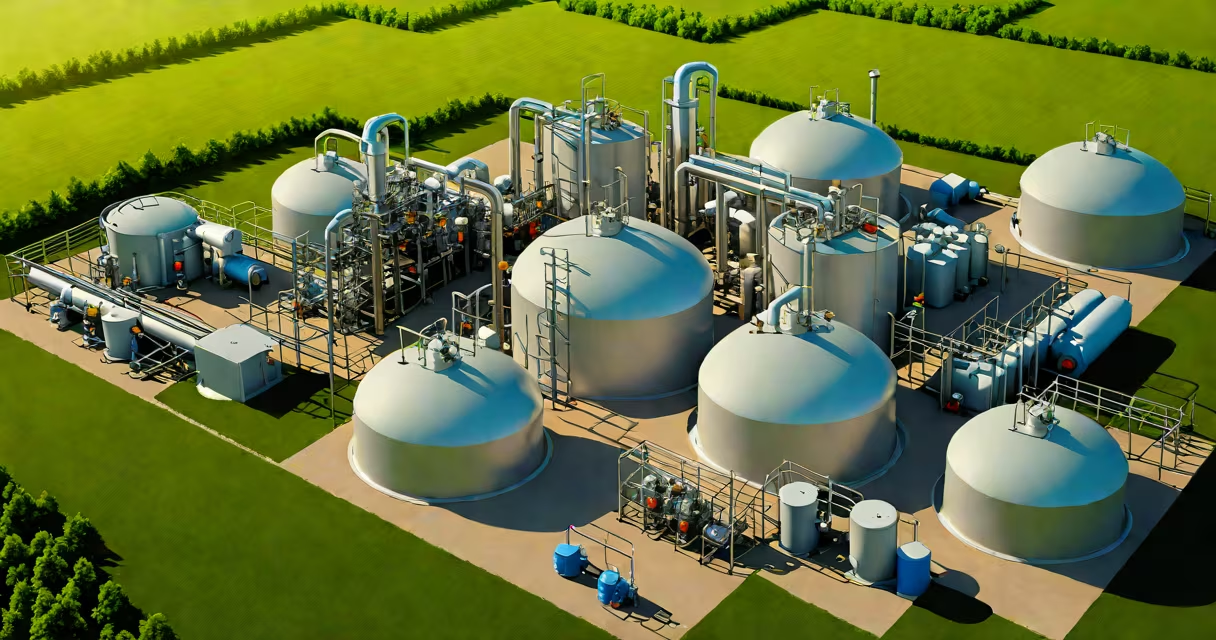
Eco gas is renewable natural gas derived from organic waste such as food scraps, manure, and sewage. It replaces fossil-based natural gas in heating, cooking, and transportation, reducing greenhouse gas emissions by up to 80% compared to conventional sources.
Produced through anaerobic digestion, eco gas captures methane from decomposing biomass and purifies it to meet pipeline standards. The process turns waste into a usable fuel, turning environmental liabilities into energy assets. Unlike fossil fuels, which release ancient carbon, eco gas recycles carbon already in the current cycle, minimizing net emissions.
According to the U.S. Environmental Protection Agency (EPA), biogas systems in the United States generated over 1.2 billion cubic feet of renewable natural gas in 2022-enough to power nearly 100,000 homes annually. This output is expected to grow as states adopt renewable portfolio standards that include gas alternatives.
Organic material enters a sealed digester tank where microbes break it down in the absence of oxygen. This biological process releases methane-rich biogas. The raw gas contains impurities like hydrogen sulfide and water vapor, which must be removed through filtration and scrubbing.
Once cleaned, the gas undergoes upgrading to achieve pipeline-quality methane concentration-typically above 95%. This upgraded gas can be injected into existing natural gas infrastructure or used directly in vehicles and industrial processes.
A single dairy farm in California processes 120,000 gallons of manure daily. Its anaerobic digester produces enough eco gas to power 1,200 homes and reduce methane emissions equivalent to removing 20,000 cars from the road each year. The system pays for itself within seven years through energy sales and avoided waste disposal costs.
Not all eco gas comes from the same feedstock. The primary categories differ by origin and environmental impact:
| Type | Source Material | Carbon Impact | Common Use |
|---|---|---|---|
| Biogas | Manure, food waste, wastewater sludge | Net-negative when captured from landfills | On-site heating, vehicle fuel |
| Renewable Natural Gas (RNG) | Landfill gas, agricultural waste, municipal solid waste | Up to 80% lower lifecycle emissions than fossil gas | Grid injection, heavy transport, home heating |
| Synthetic Gas (Power-to-Gas) | Electrolysis of water using renewable electricity | Zero-emission if powered by wind/solar | Seasonal storage, industrial feedstock |
While biogas and RNG are widely deployed, synthetic gas remains experimental at scale. Germany's "Power-to-Gas" pilot in Falkenhagen uses surplus wind energy to split water into hydrogen and oxygen. The hydrogen is then combined with captured CO₂ to form methane, stored underground until needed.
One key distinction often missed: eco gas is not inherently carbon-free. Its climate benefit depends entirely on feedstock sourcing and treatment. Using landfill gas avoids methane release-a potent greenhouse gas. But if feedstocks displace food crops or require deforestation, the net effect may worsen emissions.
Utility companies in California, Oregon, and New York now offer customers the option to switch to eco gas via their natural gas provider. In 2023, Southern California Gas Company (SoCalGas) delivered over 15 million therms of RNG to residential and commercial users, meeting 12% of regional demand.
Transportation fleets are adopting eco gas as a drop-in replacement for diesel. The San Francisco Bay Area's Muni bus system runs 150 buses on RNG, cutting annual emissions by 18,000 metric tons of CO₂-equivalent to planting 400,000 trees.
Industrial applications include cement kilns and steel furnaces, where high-temperature heat demands stable fuel sources. A cement plant in Texas replaced 30% of its natural gas with RNG, reducing emissions by 14% without altering production capacity.
Many assume eco gas is the same as "green" or "clean" energy. That's incorrect. While eco gas reduces emissions, it still burns to produce CO₂. Its advantage lies in being part of a closed-loop system-carbon released during combustion was recently absorbed from the atmosphere, unlike fossil fuels that release sequestered carbon.
Another myth: eco gas is expensive. In reality, costs have dropped sharply. The National Renewable Energy Laboratory (NREL) reports that RNG production cost fell from $12 per million BTU in 2015 to $4.50 in 2023 due to improved digesters and government incentives.
I once visited a rural biogas facility in Wisconsin that converted corn silage and cow manure into fuel for local farms. The operator showed me the control panel-real-time data on methane yield, moisture levels, and grid injection rates. What stood out wasn't the tech, but the simplicity: a few tanks, a filter, and a compressor. It ran on solar power and required less than two staff members per shift.
Both eco gas and fossil natural gas are primarily methane (CH₄), but their origins and impacts differ:
| Factor | Fossil Natural Gas | Eco Gas |
|---|---|---|
| Source | Underground reservoirs, extracted via fracking | Organic waste, landfills, wastewater treatment |
| CO₂ Emissions (per million BTU) | 56 kg | 12-18 kg (up to 80% lower) |
| Water Use | High (fracking requires 2-5 million gallons per well) | Negligible (mostly recycled) |
| Land Disruption | Significant (well pads, pipelines) | Minimal (often co-located with existing facilities) |
Despite similarities in molecular structure, eco gas offers a path to decarbonize sectors where electrification is impractical-such as long-haul trucking and industrial heating.
Eco gas is not a silver bullet, but it is a proven tool for reducing emissions in hard-to-abate sectors. As infrastructure expands and regulations evolve, its role in the energy mix will grow. The U.S. Department of Energy projects that by 2035, eco gas could supply 15% of national natural gas demand, displacing over 100 million tons of CO₂ annually.
Understanding what is eco gas means recognizing it as a bridge between legacy fossil systems and full renewable integration. It's not perfect-but it's practical, scalable, and already in use today.