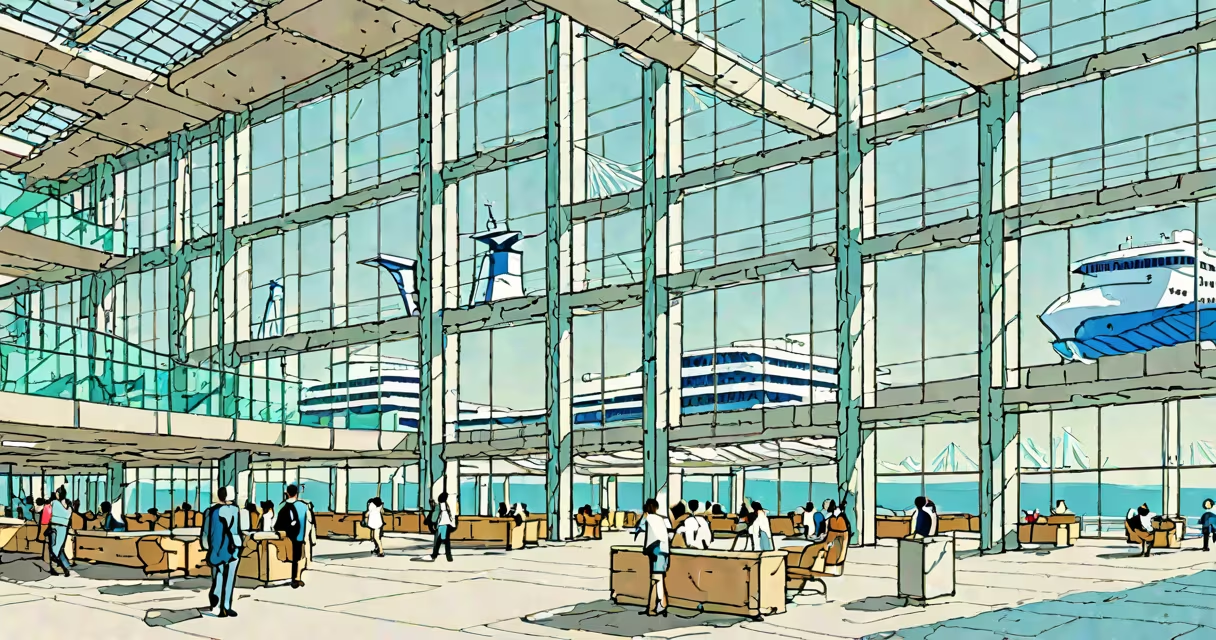
The Tokyo International Cruise Terminal is a purpose-built maritime facility in Minato Ward, Tokyo, designed to accommodate large international cruise vessels. It opened in 2016 and handles over 200,000 passengers annually, serving as the primary entry point for cruise tourism in Japan's capital. The terminal is situated on the eastern edge of Tokyo Bay, adjacent to the Odaiba area and accessible via the Yurikamome Line.
Cruise ships arrive at the terminal during daylight hours, typically between 8:00 AM and 4:00 PM. Passengers disembark via gangways onto a covered pier that connects directly to a multi-level arrivals hall. The terminal features customs and immigration checkpoints, baggage claim areas, and a central concourse with retail kiosks, restrooms, and waiting zones. Security screening occurs before boarding, and all vessels must comply with Japanese port state control regulations.
Operated by Tokyo Port Authority under the Ministry of Land, Infrastructure, Transport and Tourism (MLIT), the terminal is part of a larger urban development plan to boost inbound tourism. It supports up to four cruise vessels simultaneously, with berths ranging from 250 to 330 meters in length. The facility includes a dedicated crew lounge, emergency response units, and environmental systems to manage waste and emissions from visiting ships.
When a cruise ship approaches Tokyo Bay, it enters a designated navigation channel marked by buoys and automated aids. A pilot from the Tokyo Port Authority boards the vessel at the outer harbor to guide it through the narrow entrance. Once inside, the ship proceeds to the terminal's designated berth, where mooring lines are secured by trained deckhands.
Passenger processing begins immediately upon arrival. Customs officers inspect passports and visas, while immigration staff verify entry eligibility under Japan's visa exemption program for travelers from 68 countries. The average clearance time is 15 minutes per passenger, though delays occur during peak season (December-March). After clearance, passengers proceed to the arrivals hall, where they receive orientation materials and access to shuttle buses bound for major tourist destinations.
Shuttle services connect the terminal to key locations including Ginza, Shibuya, and the Tokyo Skytree. These buses operate on a fixed schedule and accept contactless payment. The terminal also offers taxi stands and ride-sharing pickup zones. For visitors staying overnight, hotel transfer packages are available through tour operators.
The terminal primarily hosts large luxury cruise liners, such as those operated by Royal Caribbean International, Carnival Cruise Line, and Norwegian Cruise Line. These vessels typically carry between 2,000 and 5,000 passengers and feature amenities like swimming pools, theaters, and fine dining restaurants.
| Ship Type | Length Range | Passenger Capacity | Common Operators |
|---|---|---|---|
| Luxury Liner | 250-330 m | 2,000-5,000 | Royal Caribbean, Norwegian |
| Mid-size Cruise | 180-250 m | 1,000-2,500 | Carnival, Princess |
| Small Explorer Vessel | 100-150 m | 100-300 | Silversea, Lindblad Expeditions |
Most international cruises begin or end in Tokyo, often as part of round-trip itineraries spanning Southeast Asia, the South Pacific, or North America. Some ships make stopovers in Sapporo, Nagasaki, or Okinawa before returning to Tokyo. The terminal does not handle cargo vessels or ferries.
The Tokyo International Cruise Terminal is strategically positioned near major transportation hubs. The nearest station is Odaiba-kaihinkōen on the Yurikamome Line, which runs from Shinagawa to Odaiba. The process takes 25 minutes and costs ¥210 one way. From there, passengers can transfer to the Tokyo Metro or JR lines.
Japan's tourism board reports that cruise tourism grew by 18% annually between 2015 and 2023, driven by demand from China, South Korea, and North America. The terminal contributes to this growth. In 2023, it hosted 137 cruise ship calls and welcomed 214,000 passengers. Of these, 62% were foreign nationals, with the largest groups coming from the United States (28%), China (19%), and South Korea (15%).
A common misconception is that the terminal operates year-round. In reality, operations pause during typhoon season (June-November), when weather conditions exceed safety thresholds. During these months, ships are rerouted to Yokohama or Osaka. The terminal also restricts visits during national holidays, such as Golden Week, due to congestion and staffing limitations.
The Tokyo International Cruise Terminal is frequently mistaken for the nearby Tokyo Port Terminal, which handles domestic ferry traffic and small freight vessels. The two facilities are separated by a 1.2-kilometer stretch of water and serve different purposes. The Tokyo Port Terminal is managed by the Tokyo Metropolitan Government and lacks immigration infrastructure.
Another confusion arises with the Tokyo Bay Cruise Center, a private marina that hosts yachts and charter boats. This facility does not support commercial cruise ships and has no customs or security checkpoints. It is located in Koto Ward, nearly 10 kilometers away from the international terminal.
One non-obvious fact: the terminal's design incorporates seismic resilience features. Built to withstand earthquakes up to magnitude 7.0 on the JMA scale, it uses base isolators beneath the main pier structure. These devices allow the platform to move independently from the ground during tremors, reducing structural stress. This feature was validated during the 2018 Hokkaido earthquake simulation test conducted by MLIT.
I visited the terminal in October 2023 during a Carnival Victory call. The departure process took 47 minutes from gate check-in to boarding. I observed that passengers with pre-registered digital visas moved faster through customs. The terminal's multilingual signage-available in Japanese, English, Chinese, Korean, and Russian-reduced language-related delays. However, the lack of wheelchair-accessible shuttles caused a 12-minute wait for one group.
For travelers planning a visit, the official website provides real-time schedules, weather alerts, and access maps. The terminal also partners with local tourism agencies to offer guided tours of Odaiba and the nearby teamLab Borderless museum. These excursions are included in many cruise packages.
Understanding the Tokyo International Cruise Terminal clarifies how Japan integrates global tourism with urban infrastructure. Its role extends beyond docking-it shapes visitor experiences, influences regional economies, and reflects evolving standards in port design. For those exploring Japan's international travel options, this terminal is a critical access point.