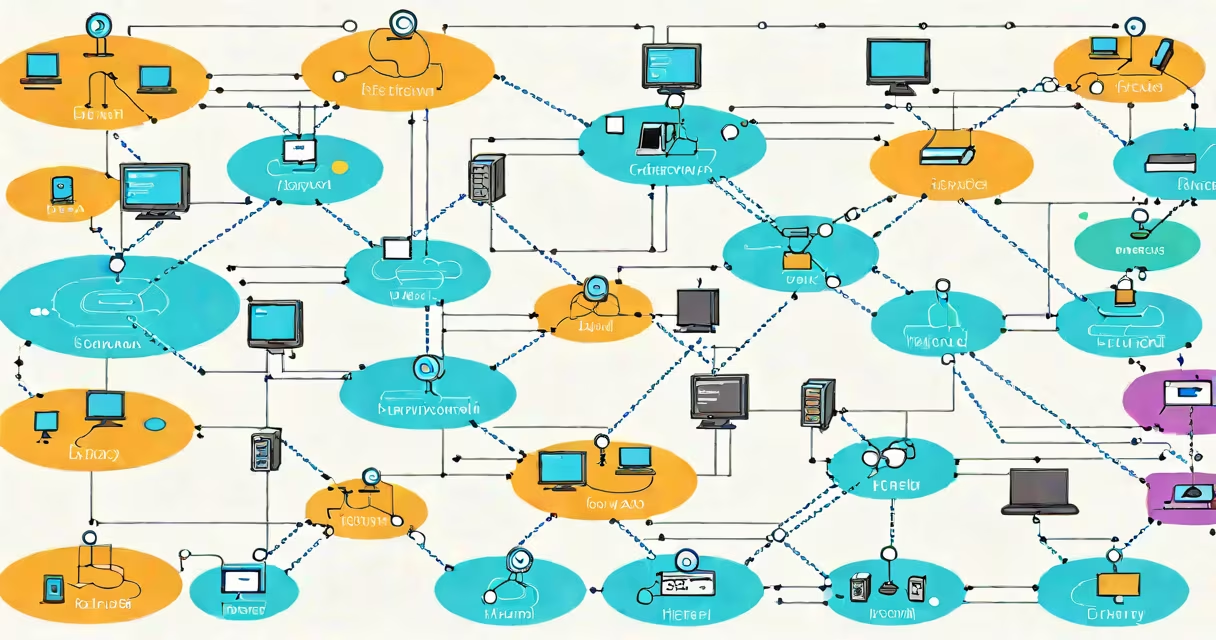
Types of topology in computer network refer to the physical or logical arrangement of devices in a network, determining how data flows between them. These layouts affect performance, scalability, fault tolerance, and cost. The most common configurations are bus, star, ring, mesh, and hybrid.
Topology governs how devices like computers, routers, and switches link together. In a physical topology, cables and hardware form visible patterns. Logical topology describes actual data flow, which may differ from physical layout-especially in complex systems.
For example, Ethernet networks often use a physical star configuration but operate logically as a bus, where all devices share a single communication channel. This separation allows flexibility in design.
Each topology uses specific protocols and standards. Ethernet relies on CSMA/CD in bus networks; token passing manages traffic in rings. These mechanisms prevent collisions and ensure orderly data transmission.
Five primary topologies define how devices interconnect. Each has distinct advantages and trade-offs in reliability, speed, and maintenance.
| Type | Structure | Pros | Cons | Use Case |
|---|---|---|---|---|
| Bus | Single shared cable connects all devices | Low cost, simple setup | Single point of failure, limited bandwidth | Small offices, legacy systems |
| Star | All devices connect to a central hub or switch | Easy troubleshooting, high fault tolerance | Requires more cabling, hub is a bottleneck | Modern LANs, home networks |
| Ring | Devices form a closed loop; data travels clockwise or counterclockwise | Consistent performance, predictable latency | Failure of one node breaks the chain | Industrial control systems, older campus networks |
| Mix | Multiple connections between nodes; redundancy built in | High availability, excellent fault tolerance | Expensive, complex to manage | Data centers, military networks |
| Hybrid | Combination of two or more topologies | Scalable, adaptable to different needs | Design complexity increases with scale | Large enterprises, cloud infrastructure |
Star topology dominates modern local area networks due to its resilience and ease of management. A single device failure doesn't disrupt others, unlike in bus or ring setups where one failure can cascade.
Mesh topology offers the highest redundancy. In full mesh, every device connects directly to every other device. A 5-node full mesh requires 10 unique links. Partial mesh reduces cabling but still provides multiple paths for data.
Hybrid topologies emerge when organizations combine star and ring designs. For example, a university might use star hubs in each building connected via a ring core. This balances performance and fault isolation.
Bus topology was standard in early Ethernet networks using coaxial cable. IEEE 802.3 specifies 10BASE5 and 10BASE2 variants, both operating at 10 Mbps. These are largely obsolete today due to poor scalability and collision issues.
Star topology powers nearly all current wired LANs. Devices connect to a managed switch, enabling full-duplex communication. A 24-port gigabit switch supports 24 devices at 1 Gbps each-ideal for office environments.
Ring networks remain in use in industrial settings. Token Ring (IEEE 802.5) operated at 4 or 16 Mbps and used a rotating token to grant transmission rights. Though rare now, ring structures appear in fiber-optic core systems like SONET.
Mix topologies serve mission-critical systems. The U.S. Department of Defense's SIPRNet uses a mix of redundant paths across multiple sites. If one route fails, traffic reroutes automatically through alternative links.
Hybrid designs scale efficiently. A multinational company might deploy star topologies within regional offices, then link those offices via a ring or mesh core. This ensures localized control while maintaining global connectivity.
Many assume that physical and logical topologies are always the same. They're not. A network can have a physical star layout but function as a logical bus-this occurs in traditional Ethernet where all devices share a single broadcast domain.
Another misconception is that mesh networks are always expensive. While full mesh requires significant cabling, partial mesh with intelligent routing reduces costs. Software-defined networking (SDN) enables changing path selection, making mesh efficient even at scale.
Some believe ring topologies are outdated. While less common in consumer settings, they persist in environments requiring deterministic timing. Industrial automation systems use ring topologies to guarantee data delivery within strict time windows-critical for robotic assembly lines.
I once observed a small business using a daisy-chained bus setup. When a printer failed, the entire network dropped. Replacing it with a star topology using a single switch restored stability. The change reduced downtime from hours to minutes.
Understanding types of topology in computer network is essential for designing reliable, efficient systems. Star and hybrid topologies dominate modern infrastructure due to their balance of cost, performance, and fault tolerance.
Always assess your environment: small teams benefit from star layouts; large-scale deployments require hybrid or mesh structures. Avoid assuming that older models like bus or ring are obsolete-they still solve niche problems effectively.