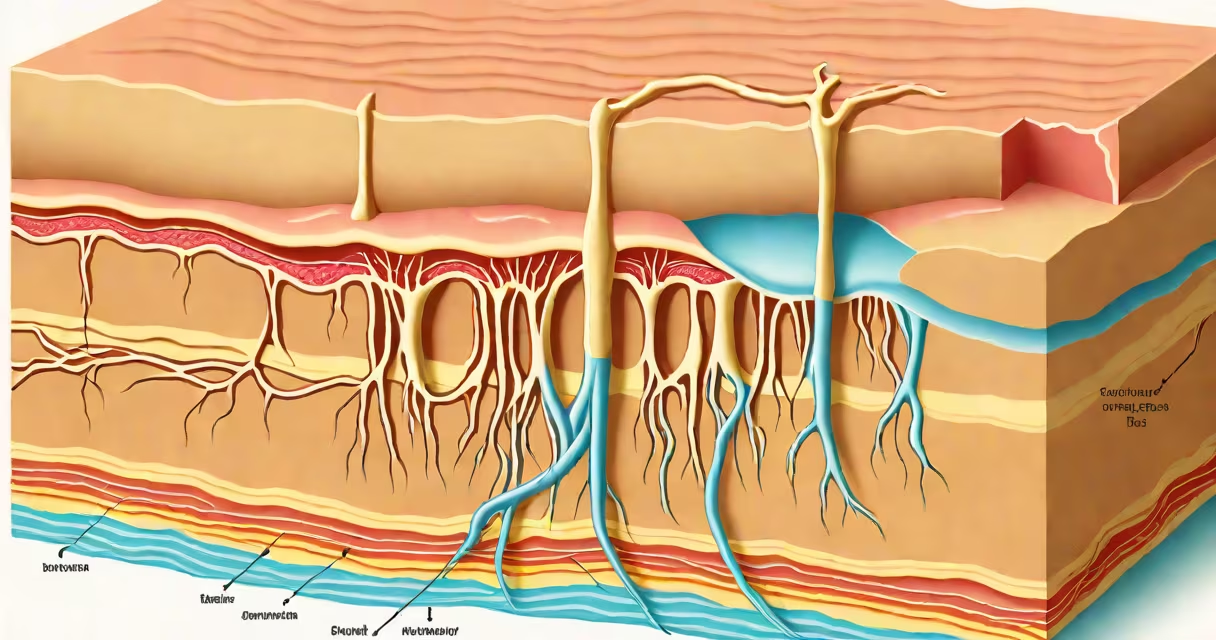
Sensory nerves carry information from the body's surface and internal organs to the central nervous system, allowing the brain to perceive touch, pain, temperature, and body position. These nerves are essential for detecting environmental changes and maintaining awareness of physical state.
They operate through specialized receptors in the skin, muscles, joints, and viscera. When stimulated-by pressure, heat, cold, or injury-these receptors generate electrical signals. The signals travel along sensory nerve fibers to the spinal cord and then to the brain, where they are interpreted as sensations.
For example, touching a hot stove triggers nociceptors (pain receptors) in the skin. Within 100 milliseconds, the signal reaches the brain's somatosensory cortex, triggering the sensation of burning and prompting a withdrawal reflex. This process happens automatically and protects the body from harm.
Sensory nerves are part of the peripheral nervous system and consist of axons that extend from sensory neurons located in dorsal root ganglia near the spinal cord. These neurons have receptor endings in the skin, muscles, or internal organs.
When a stimulus occurs-like a pinprick-the receptor converts mechanical, thermal, or chemical energy into an electrical impulse called an action potential. This impulse travels along the nerve fiber at speeds ranging from 1 meter per second (slow pain fibers) to over 100 meters per second (touch and vibration fibers).
The brain decodes the signal based on which pathway it follows. For instance, light touch activates A-beta fibers that project to the primary somatosensory cortex. Sharp pain travels via A-delta fibers to the thalamus and then to cortical areas involved in emotional response and decision-making.
Sensory nerves are classified by the type of stimulus they detect and their conduction speed. The following table outlines major categories:
| Type | Stimulus Detected | Conduction Speed | Function Example |
|---|---|---|---|
| A-beta | Light touch, vibration, pressure | 70-120 m/s | Feeling a handshake or texture of fabric |
| A-delta | Sharp, localized pain, cold | 10-30 m/s | Immediate reaction to a cut or icy surface |
| C fibers | Dull, aching pain, warmth, itch | 0.5-2 m/s | Chronic discomfort or persistent heat sensation |
| Proprioceptive (A-alpha) | Joint position, muscle stretch | up to 120 m/s | Maintaining balance while walking blindfolded |
Each type serves a distinct role. A-beta fibers allow fine motor control by informing the brain about fingertip pressure during typing. C fibers contribute to long-term pain perception, such as the dull ache after a sprained ankle.
Not all sensory nerves send signals to conscious awareness. Some relay data to autonomic centers in the brainstem to regulate heart rate, digestion, and breathing-functions we don't consciously monitor.
Many assume sensory nerves only handle "feeling" in the hands or feet. But they also monitor internal conditions: blood pressure via baroreceptors in neck arteries, lung stretch during breathing, and stomach distension after eating.
Another error is equating pain with damage. While sharp pain often indicates tissue injury, chronic pain can persist even after healing-due to sensitized sensory nerves that fire excessively. This is why neuropathic pain doesn't always reflect ongoing injury.
Also, sensory nerves do not act alone. They work with motor nerves and interneurons in reflex arcs. For example, stepping on a nail triggers both pain signaling and immediate leg withdrawal-all within 200 milliseconds-without waiting for brain processing.
Neurologists assess sensory nerve function using tests like monofilament testing for diabetic neuropathy. A 10-gram nylon filament applied to the foot detects loss of protective sensation. If the patient cannot feel it, they're at high risk for foot ulcers due to unnoticed injuries.
Electromyography (EMG) and nerve conduction studies measure how fast signals travel along sensory nerves. Slowed conduction indicates demyelination, as seen in multiple sclerosis or Guillain-Barré syndrome.
I once observed a patient with hereditary sensory neuropathy type 1 who couldn't feel temperature changes on their hands. They had burned themselves repeatedly because C-fiber function was impaired. This illustrates how sensory nerves aren't just about perception-they're critical for safety.
Sensory nerves differ from motor nerves, which carry commands *from* the brain to muscles. They also differ from autonomic nerves, which regulate involuntary functions like pupil dilation and gut motility.
While all three are part of the peripheral nervous system, only sensory nerves convey external and internal stimuli toward the CNS. Motor nerves send output signals away from the CNS. Autonomic nerves manage homeostasis through sympathetic and parasympathetic pathways.
Confusing them leads to misdiagnosis. For example, numbness in the feet may stem from sensory nerve damage (e.g., diabetes), but weakness suggests motor nerve involvement (e.g., spinal stenosis).
Contrary to outdated views, sensory nerves don't simply report events. They actively shape perception. Research shows that the brain uses prior expectations to interpret incoming signals-a phenomenon known as predictive coding.
For instance, a study published in Nature Neuroscience demonstrated that people perceive a tactile stimulus as stronger when expecting it, even if intensity remains constant. This means sensory nerves don't just relay data-they interact with higher brain regions to construct reality.
Sensory nerves can undergo plasticity. After limb amputation, residual nerves may reorganize, leading to phantom limb pain. The brain continues interpreting signals from nerves that no longer connect to limbs.
Sensory nerves enable the body to detect and respond to the environment. They translate physical inputs into neural signals that the brain interprets as touch, pain, temperature, and movement. Without them, we'd lack awareness of our bodies and surroundings.