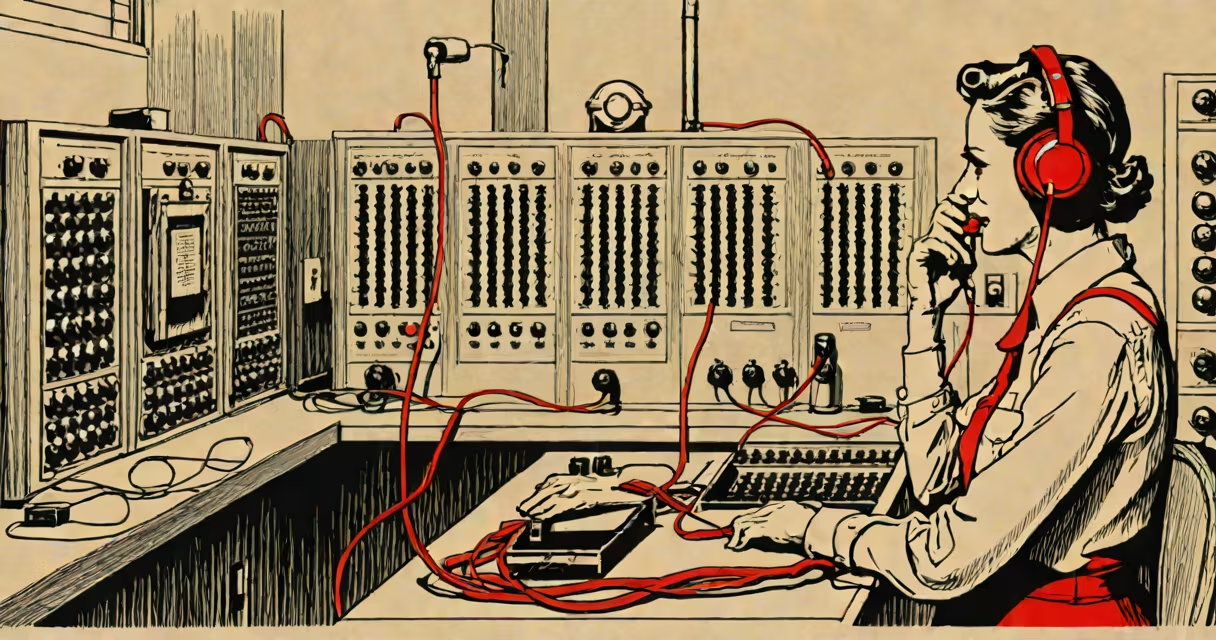
A switchboard operator connects incoming calls to their correct destinations using a physical or digital switchboard, manages emergency communications, and provides real-time assistance during system failures or high-volume traffic. This role requires quick decision-making, accurate information handling, and calm under pressure.
Switchboard operators historically managed manual switchboards with patch cords and jack sockets. Today, most work with computerized systems that route calls automatically, though human oversight remains essential for complex or urgent requests. Operators verify caller identity, direct calls to departments or individuals, and escalate emergencies to appropriate services.
The core function is routing-connecting people through voice or data networks. Operators may handle medical emergencies, police dispatches, or corporate internal communications. They maintain logs of call activity, monitor system status, and assist users with technical issues. Their work supports continuity in hospitals, airports, government offices, and large businesses.
When a call arrives, the operator sees the caller's number or extension on a display. They answer with a standard greeting, such as "Good morning, Central Desk," then ask for the extension or department. If the recipient is unavailable, the operator offers options: leave a message, transfer to voicemail, or hold the call.
In older systems, operators physically plugged cords into jacks to connect lines. Modern systems use software interfaces with buttons, touchscreens, or voice commands. For example, a hospital switchboard might route a call from a patient's room to the on-call doctor's mobile device via a secure network.
During outages, operators act as backup coordinators. If the automated system fails, they manually reroute calls using predefined protocols. A 2021 report from the National Emergency Number Association (NENA) found that 68% of 911 centers still rely on human operators to manage overflow during peak events, even with advanced routing software.
Switchboard operations vary by environment. The following table outlines common setups and responsibilities:
| System Type | Common Use | Operator Duties | Example Setting |
|---|---|---|---|
| Manual Patchboard | Historical or low-tech facilities | Physical cord insertion, visual monitoring | Small airport terminal, rural clinic |
| Digital PBX | Businesses with internal phone networks | Call forwarding, voicemail access, queue management | Corporate office, university admin center |
| VoIP with CRM Integration | Customer service, healthcare | Caller ID lookup, call logging, escalation | Hospital triage desk, tech support hub |
| Emergency Dispatch System | 911 centers, disaster response | Emergency prioritization, resource coordination | Public safety answering point (PSAP) |
Each system demands different skills. Manual boards require spatial memory and hand-eye coordination. Digital systems emphasize software navigation and attention to detail. VoIP systems integrate with databases, so operators must verify identities quickly and securely.
Switchboard operators remain critical in settings where accuracy and speed matter. Hospitals use them to connect patients with specialists, nurses, or emergency teams. Airports rely on them to coordinate ground staff, flight crews, and security.
Large corporations use switchboard operators to manage internal communications during mergers, product launches, or crises. During the 2020 pandemic, many companies shifted to remote work, increasing demand for operators who could manage hybrid call flows between home offices and central hubs.
One non-obvious fact: many switchboard roles are not entry-level. According to the U.S. Bureau of Labor Statistics (BLS), median annual pay for switchboard operators was $42,720 in 2022, with higher rates in metropolitan areas and specialized fields like aviation or healthcare. Some positions require certification in emergency communication procedures.
Many assume switchboard operators are obsolete due to automation. While automated systems handle routine calls, humans are still needed for complex routing, emotional context, and error correction. A 2023 study by the International Telecommunication Union (ITU) found that 34% of automated call centers still route 15% of calls to live agents due to ambiguity in caller intent.
Another misconception is that operators only answer phones. In reality, they often monitor multiple channels-voice, text, email-and manage priority queues. For example, during a natural disaster, a switchboard operator may prioritize calls from shelters, hospitals, and emergency vehicles based on predefined protocols.
I once observed a switchboard operator at a regional trauma center during a mass casualty incident. When the system crashed, she manually rerouted 12 emergency calls using a printed map of extensions and a backup landline. Her actions ensured that surgical teams received timely alerts. That moment confirmed: the human element is irreplaceable in crisis scenarios.
Operators are not the same as customer service representatives. While both interact with callers, operators focus on connectivity, not information delivery. A customer service rep might explain a refund policy; a switchboard operator ensures the call reaches the right person to discuss it.
Understanding what a switchboard operator does reveals a important layer of modern infrastructure. These professionals ensure that voices reach their destinations, even when systems fail. Their work remains essential in high-stakes environments where delay means risk.