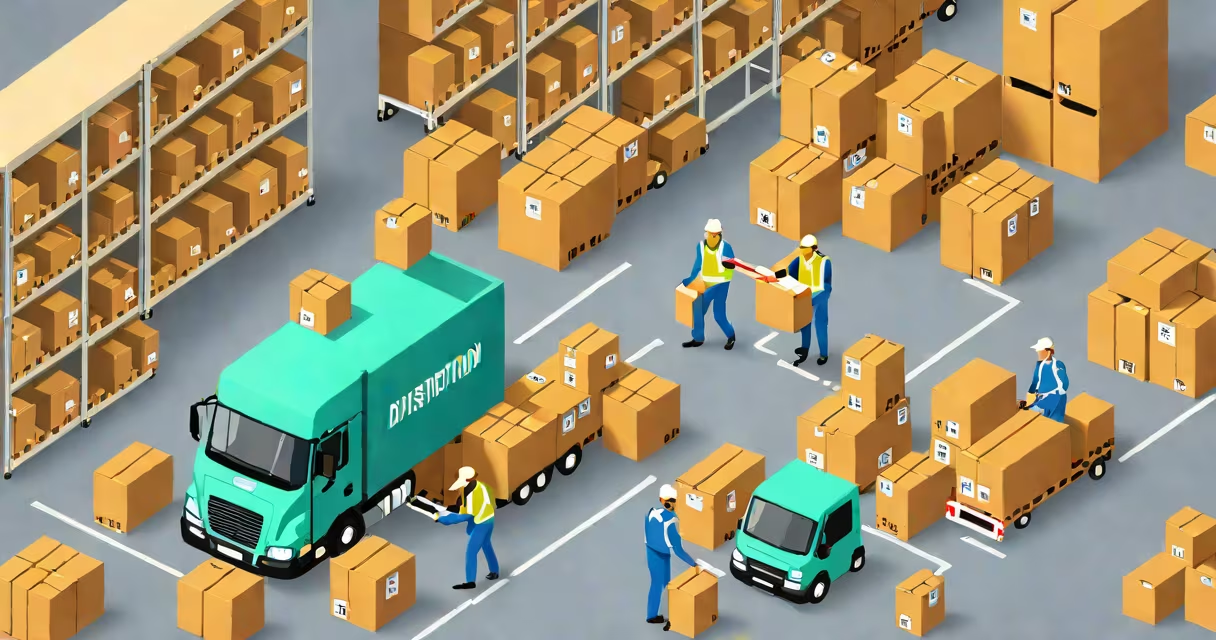
Distribution is the process of moving goods from manufacturers to end users through intermediaries like wholesalers, retailers, and logistics providers. It ensures products are available where and when customers need them.
At its core, distribution handles the physical flow of products, but it also includes planning, inventory management, and channel selection. A well-executed distribution strategy reduces delays, lowers costs, and increases customer satisfaction.
For example, when a smartphone manufacturer produces 100,000 units, distribution determines how those phones are shipped to regional hubs, stored in warehouses, and delivered to stores or online customers. Without distribution, even the most popular product cannot reach buyers.
Distribution operates through a network of facilities and transportation routes. Goods start at production sites, move to central or regional distribution centers, then travel to retail outlets or directly to consumers via delivery services.
Each step involves decisions about volume, timing, cost, and reliability. For instance, a beverage company may use regional distribution centers to serve grocery chains within a 200-mile radius. This reduces delivery time and fuel costs compared to shipping from a single national plant.
Modern distribution relies heavily on software systems like WMS (Warehouse Management Systems) and TMS (Transportation Management Systems). These tools track inventory levels, assign shipments, and improve delivery routes using real-time data.
Businesses choose distribution methods based on product type, target audience, and control preferences. The main models are direct, indirect, and hybrid.
| Type | How It Works | Best For | Example |
|---|---|---|---|
| Direct | Sales from producer to consumer via website, catalog, or storefront. | Custom goods, high-margin products, brands wanting control. | A designer sells handcrafted shoes through their own e-commerce site. |
| Indirect | Use of intermediaries like distributors, wholesalers, or retailers. | Mass-market products, wide geographic reach, lower upfront investment. | A cereal brand ships to supermarkets via a national distributor. |
| Hybrid | Combines direct and indirect methods. | Products needing broad access and brand control. | An electronics company sells online while also supplying major retailers. |
Some companies use exclusive distribution-limiting availability to select partners-to maintain premium branding. Others use intensive distribution, placing products in as many outlets as possible, common for everyday items like snacks or batteries.
Effective distribution directly impacts revenue, customer retention, and competitive advantage. A product that's out of stock due to poor logistics loses sales and damages trust.
According to the Council of Supply Chain Management Professionals (CSCMP), efficient distribution can reduce operational costs by up to 18%. For a company with $10 million in annual logistics spend, that translates to nearly $1.8 million in savings.
One non-obvious fact: distribution isn't just about movement-it's about timing. A retailer that receives inventory too early faces storage costs. Too late, and shelves go empty during peak demand. The goal is precise synchronization between production, warehousing, and sales.
I once observed a small coffee roaster in Portland struggle with distribution. They produced high-quality beans but relied solely on local farmers markets. When demand spiked during holiday season, they couldn't scale fast enough. After switching to a regional distributor with cold-storage capability, their sales grew 40% in six months. The bottleneck wasn't quality-it was delivery speed and reach.
Distribution is often confused with marketing or sales. While related, they're distinct functions. Marketing attracts attention. Sales close deals. Distribution delivers the product.
Another mistake is equating distribution with shipping. Shipping is a component-but distribution includes forecasting, inventory allocation, channel negotiation, and reverse logistics (handling returns).
Also, people assume distribution is purely physical. But digital distribution-delivering software, music, or e-books electronically-is now a major category. A video game released digitally reaches millions instantly, bypassing warehouses and trucks entirely.
Even in physical goods, digital tracking is essential. Barcodes, RFID tags, and GPS-enabled containers allow real-time monitoring. A shipment of medical supplies from a U.S. factory to a hospital in Nairobi can be tracked every hour, ensuring temperature-sensitive items stay within safe ranges.
These terms are frequently used interchangeably but have clear boundaries.
Think of it this way: a company plans its distribution network across five states. Logistics manages the fleet and warehouse operations. Fulfillment handles the 1,000 orders placed yesterday.
Understanding this hierarchy prevents misalignment in team responsibilities and budgeting.
Amazon operates one of the most complex distribution systems globally. It uses predictive analytics to place inventory in fulfillment centers near high-demand areas. In 2023, Amazon had over 175 fulfillment centers in the U.S. alone.
When a customer in Austin orders a book, the system checks nearby centers. If a center in Dallas has the item, it's picked, packed, and shipped via Amazon's own delivery network. The entire process takes under 24 hours.
This efficiency stems from integrating distribution planning with real-time data, automated sorting, and changing routing-all coordinated through internal software platforms.
Distribution is not a side function-it's central to how products reach people. Whether delivering a meal via food app or sending a car part across continents, distribution ensures availability, reliability, and scalability.
For businesses, mastering distribution means choosing the right mix of channels, investing in visibility tools, and aligning supply with demand. It's not just about moving goods-it's about meeting customer expectations consistently.