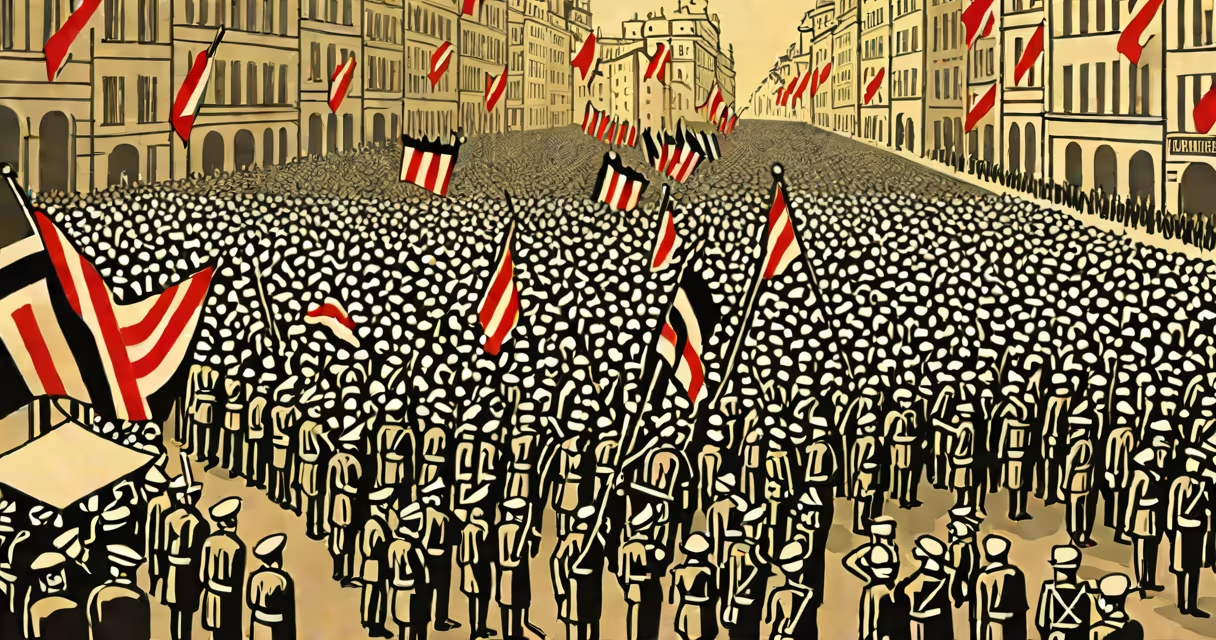
Fascism is a political ideology centered on absolute state power, extreme nationalism, and the suppression of opposition. It rejects democracy, promotes a single charismatic leader, and uses violence or propaganda to maintain control. Fascist regimes often target minority groups, censor free speech, and demand total loyalty to the nation.
The term originated in early 20th-century Italy under Benito Mussolini, who founded the National Fascist Party in 1921. The movement rose to power through street violence, intimidation, and mass rallies. By 1925, Mussolini had dismantled democratic institutions and ruled as a dictator. His regime celebrated military strength, traditional gender roles, and the idea of Italy's historical greatness.
Fascism is not simply "extreme nationalism." While nationalism is a component, fascism adds state worship, anti-intellectualism, and the belief that conflict and hierarchy are natural. It differs from other authoritarian systems by its focus on myth, ritual, and emotional mobilization. Unlike communism, which aims to abolish class differences, fascism preserves social hierarchies but redefines them around national purity and service to the state.
Fascist governments operate through centralized control. Power is concentrated in the hands of a single leader or small elite. Institutions like courts, media, and education are reshaped to serve the state's narrative. Opposition is labeled as treasonous or unpatriotic. Dissent is punished through imprisonment, exile, or violence.
One mechanism is the use of mass symbolism. Flags, uniforms, marches, and public speeches create a sense of collective identity. These rituals are designed to evoke emotion rather than reason. The goal is to replace individual thought with group loyalty. For example, Nazi Germany required citizens to salute the flag daily and attend rallies where Hitler's image was omnipresent.
Another sign is the scapegoating of minorities. Fascist regimes often blame specific groups-ethnic, religious, or political-for national problems. In Nazi Germany, Jews were portrayed as responsible for economic hardship and moral decay. This rhetoric justified forced labor, ghettoization, and eventually genocide. The Holocaust killed six million Jews and millions of others deemed undesirable.
Fascism is not synonymous with dictatorship or authoritarianism. Many dictatorships do not embrace the ideological components of fascism. A regime may suppress free speech and control elections without promoting national myth, militarism, or mass mobilization. The difference lies in intent and structure.
Some confuse fascism with conservatism. Conservative movements support tradition and stability but typically uphold constitutional limits and rule of law. Fascism rejects legal constraints and seeks to dissolve the individual in service to the nation. It does not aim to preserve existing institutions-it seeks to destroy them and rebuild society around a new, exclusive identity.
A common error is equating any aggressive nationalism with fascism. Not all nationalist movements advocate for state terror or the elimination of civil rights. True fascism requires the fusion of state power, mass mobilization, and ideological extremism. Without all three, the system lacks the defining characteristics.
While fascism emerged in Europe, its core features have appeared in various forms globally. The following table outlines key variants and their distinguishing traits:
| Type | Core Features | Historical Example |
|---|---|---|
| National Socialism (Nazi Germany) | Racial supremacy, anti-Semitism, militarized state, planned economy | Adolf Hitler's regime (1933-1945) |
| Mussolini's Fascist Italy | State worship, corporatist economy, anti-communism, imperial ambitions | 1922-1943, under Benito Mussolini |
| Modern Authoritarian Regimes | Controlled media, surveillance, suppression of dissent, cult of personality | North Korea under Kim dynasty (20th-21st century) |
North Korea is often cited as a modern example of fascist-style governance. Despite being officially socialist, it exhibits fascist traits: absolute loyalty to the leader, state-controlled religion-like devotion to the Kim family, and a rigid caste system based on political loyalty. State media portrays the country as perpetually under threat, justifying isolation and repression.
Fascism is not the same as populism. Populism appeals to "the people" against elites but does not necessarily reject democracy or promote violence. Populist leaders may hold elections and respect formal institutions while using inflammatory rhetoric. Fascism eliminates those institutions entirely.
It is also not equivalent to nationalism. National pride is healthy and widespread. But nationalism becomes fascist when it demands total submission, denies rights to outsiders, and justifies force. The difference is in scale and intensity. A country celebrating its history is not fascist. A regime that executes citizens for criticizing the flag is.
One non-obvious distinction: fascism often arises in times of crisis. Economic collapse, war, or social upheaval create conditions where people accept authoritarian solutions. The Great Depression helped fuel fascist movements in Germany, Italy, and Japan. But not all crises produce fascism. The response depends on leadership, ideology, and institutional resilience.
I once visited a museum exhibit on 20th-century totalitarianism in Berlin. One display showed a 1936 Nazi rally footage with thousands of people raising arms in unison. What stood out wasn't the spectacle-it was how many participants looked genuinely moved, even joyful. That emotional resonance is central to fascist appeal. It's not just about fear; it's about belonging.
Today, some political movements echo fascist language. They use slogans like "America First," attack immigrants as threats, and dismiss criticism as "anti-patriotic." But labeling such rhetoric as fascist requires evidence of structural control, suppression of dissent, and state-led mythmaking-not just heated speech. Words matter, but so does context.
Understanding what fascism means in simple terms helps identify warning signs. It's not a label to apply casually. When a government bans opposition parties, controls news outlets, and glorifies a leader through ritual, it moves beyond politics into ideology. Recognizing that shift is essential for preserving freedom.
Fascism is not a relic. Its patterns persist in modern autocracies and extremist movements. Knowing what it means in simple terms allows clearer judgment of current events. The tools to resist it-free press, independent courts, civic education-are still available. But they require vigilance.
Knowing what fascism means in simple terms is not academic. It's practical. It's survival.