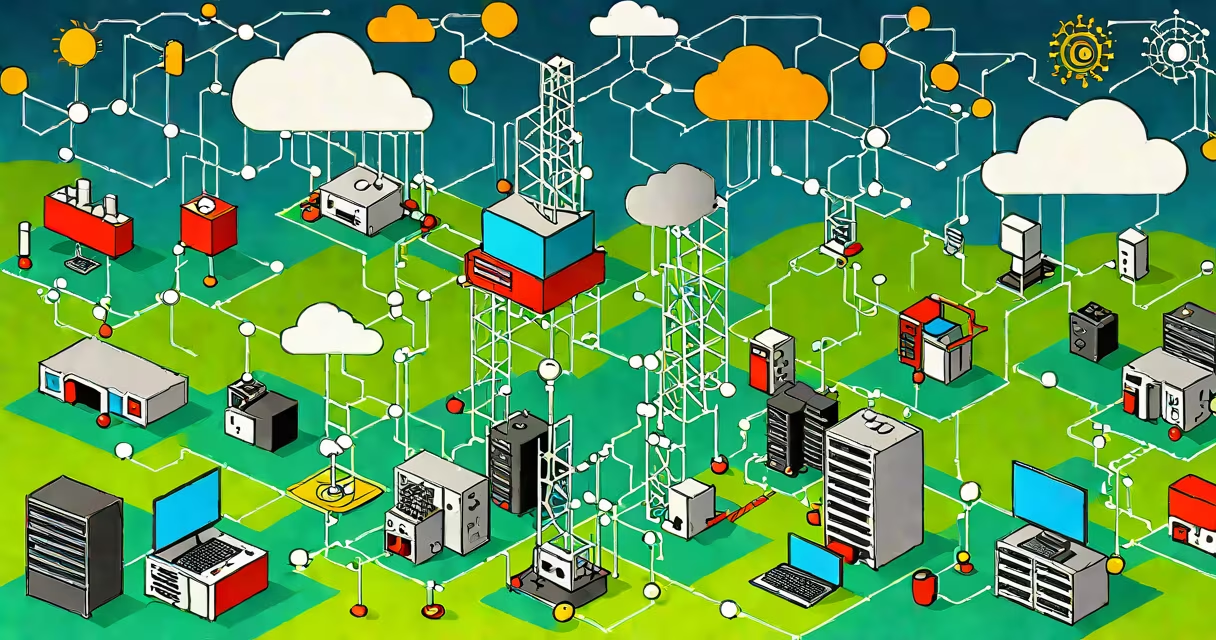
LoRaWAN stands for Long Range Wide Area Network. It is a wireless communication protocol designed for low-power, long-distance connectivity in Internet of Things (IoT) applications. The standard operates on unlicensed radio spectrum and supports bidirectional communication between battery-powered devices and central servers.
LoRaWAN was developed by the LoRa Alliance, a nonprofit organization founded in 2015 to promote and standardize the technology. The protocol uses spread-spectrum modulation based on chirp spread spectrum (CSS) to achieve high sensitivity and long-range transmission. Devices using LoRaWAN can transmit data over distances up to 15 kilometers in rural areas and 2-5 kilometers in urban environments, depending on terrain and interference.
The system relies on a star topology where end nodes communicate through gateways to a central network server. Gateways do not require direct connections to the internet-they forward packets to the network server via IP-based backhaul. This design reduces infrastructure costs and allows deployment in remote or underserved regions.
LoRaWAN operates on sub-GHz frequency bands such as 915 MHz in North America, 868 MHz in Europe, and 433 MHz in parts of Asia. These frequencies offer better penetration through walls and longer range compared to higher-frequency bands like 2.4 GHz used in Wi-Fi or Bluetooth.
Data transmission follows a class-based model. Class A devices are asynchronous and sleep most of the time, waking periodically to send data. They receive downlink messages only during scheduled windows. Class B adds scheduled receive slots, allowing the network to send commands at known times. Class C maintains continuous reception, ideal for applications requiring immediate response, though at higher power cost.
Security is built into the protocol using AES-128 encryption. Each device has a unique Device EUI, App Key, and App EUI. The network server and application server authenticate and encrypt messages to prevent eavesdropping and tampering. This ensures privacy even when operating on public spectrum.
LoRaWAN deployments fall into two primary configurations: public and private. Public networks are operated by third parties such as Semtech's LoRaWAN Network Service Provider (LNSP) or regional providers like KPN in the Netherlands. These networks allow users to connect devices without managing infrastructure. Private networks are deployed by enterprises or municipalities for internal use, offering greater control and security.
| Type | Use Case | Frequency Band | Range (Typical) | Power Consumption |
|---|---|---|---|---|
| Public | Smart meters, environmental sensors | 868 MHz (EU), 915 MHz (US) | 2-15 km | Very low (battery life: 10+ years) |
| Private | Factory automation, asset tracking | 433 MHz (Asia), 915 MHz (US) | 1-10 km | Low (5-10 year battery life) |
For example, the city of Amsterdam uses a private LoRaWAN network to monitor water levels in canals and detect leaks in underground pipes. Sensors placed every 500 meters transmit data every 15 minutes. The network runs on 868 MHz, with gateways installed on rooftops. Data flows to a local server that triggers alerts when thresholds are exceeded. Battery life exceeds seven years due to optimized duty cycles.
LoRaWAN is often confused with LoRa, which is the physical layer modulation technique, while LoRaWAN is the upper-layer protocol. LoRa refers to the underlying radio technology-long-range, low-power spread-spectrum modulation. LoRaWAN defines how devices communicate, manage keys, handle data rates, and route traffic through gateways.
A common error is assuming LoRaWAN supports real-time streaming. It does not. The protocol is optimized for infrequent, small data transmissions-typically under 51 bytes per message. Sending video or audio streams is impractical. Instead, it excels in sending sensor readings like temperature, humidity, pressure, or location updates.
Another misconception is that LoRaWAN requires expensive hardware. In reality, off-the-shelf modules like the Semtech SX1276 or Adafruit RFM95 cost less than $10. Development boards such as the Arduino MKR WAN 1300 integrate LoRaWAN support with minimal programming effort. I built a soil moisture monitor using a Raspberry Pi Pico and an RFM95 module. It sent readings every hour to a cloud dashboard via a public LoRaWAN gateway in my neighborhood. The setup ran on two AA batteries for over 18 months.
According to the International Telecommunication Union (ITU), over 25 billion connected devices were projected to be in use by 2030, with the majority being low-data-rate IoT endpoints. LoRaWAN is positioned to serve this demand due to its scalability, low cost, and energy efficiency.
Standards bodies like the European Telecommunications Standards Institute (ETSI) have ratified LoRaWAN specifications under EN 300 220 and EN 301 893. These documents define technical requirements for operation in licensed and unlicensed bands. Compliance ensures interoperability across vendors and regions.
For instance, a farm in California uses LoRaWAN-enabled weather stations to track frost risk. Each station measures temperature, wind speed, and dew point. Data is sent to a central server every 30 minutes. When frost conditions are detected, automated irrigation systems activate. The entire system runs on solar panels and lasts five years without maintenance. This level of autonomy is only feasible because LoRaWAN minimizes power consumption and maximizes coverage.