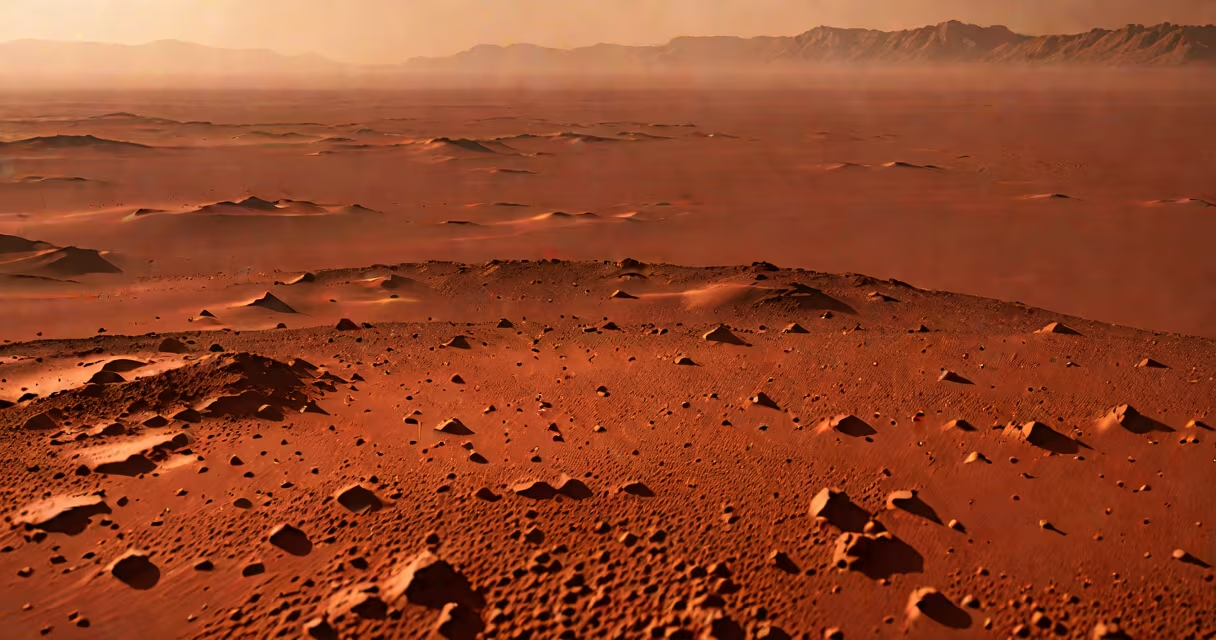
Mars appears as a reddish-orange planet in the night sky, with visible surface features including vast deserts, towering volcanoes, and deep canyons. Its color comes from iron oxide dust covering the surface. The planet's thin atmosphere scatters sunlight, giving skies a butterscotch hue during daytime.
NASA's Mars Reconnaissance Orbiter has captured images showing layered sedimentary rock formations in Valles Marineris, a canyon system stretching over 4,000 kilometers-longer than the distance from New York to Los Angeles. These layers suggest past water activity and climate shifts. High-resolution photos reveal dunes shaped by wind, with patterns resembling ripples in sand, but on a scale up to 100 meters wide.
Surface details vary dramatically. Olympus Mons, the largest volcano in the solar system, rises 21.9 kilometers above the surrounding plains-nearly three times the height of Mount Everest. In contrast, the Hellas Basin, a massive impact crater, spans 2,300 kilometers in diameter and reaches depths of nearly 9 kilometers below the average planetary elevation.
From Earth, Mars appears as a bright, orange-red dot in the sky, often outshining most stars. Its brightness fluctuates due to orbital position-closest approach occurs roughly every 26 months, when it comes within 55 million kilometers of Earth. During these oppositions, telescopes can resolve surface features such as Syrtis Major, a dark region near the equator that resembles a large, flat plateau.
Spacecraft sent to Mars provide detailed views. The Viking 1 lander, which touched down in 1976, transmitted the first close-up images of the Martian surface-cracked, rust-colored soil under a pale pink sky. Modern rovers like Perseverance have sent back high-definition panoramic shots showing layered rock strata, sand dunes, and distant mountain ranges.
Even from orbit, Mars displays seasonal changes. Polar ice caps shrink and grow with the Martian year, which lasts 687 Earth days. In winter, carbon dioxide freezes into dry ice, forming temporary ice sheets. By spring, sublimation causes plumes of gas to erupt through the ice, creating dark fans on the surface-visible in satellite images taken over time.
The following table outlines major geological features and their visual characteristics based on NASA and ESA mission data:
| Feature | Size | Appearance | Source |
|---|---|---|---|
| Olympus Mons | 600 km wide, 21.9 km tall | Smooth, gently sloping flanks; summit caldera shows collapse pits | NASA |
| Valles Marineris | 4,000 km long, up to 7 km deep | Cracked, stepped terrain with exposed bedrock layers | ESA |
| Hellas Planitia | 2,300 km diameter | Dark, dusty basin with frost patterns in winter | NASA |
| Meridiani Planum | Region near equator | Flat, rocky plain with hematite spherules ("blueberries") | NASA |
These features are not uniform. Hematite spheres found by Opportunity Rover appear as small, shiny pebbles embedded in fine-grained soil-indicating past water presence. Their formation required liquid water, suggesting Mars once had conditions capable of supporting microbial life.
Many assume Mars looks like a barren desert with endless sand dunes. While dunes exist-especially in polar regions-they cover only about 10% of the surface. Most terrain consists of basaltic rock, dust, and ancient impact craters. The surface is not uniformly red; some areas show gray or brown hues due to mineral composition differences.
Another misconception is that Mars has a thick, cloudy atmosphere. In reality, it's extremely thin-about 1% of Earth's atmospheric pressure. This results in weak weather systems. Dust storms can cover the entire planet but last weeks, not days. They appear as swirling brown clouds in satellite images, sometimes obscuring surface details entirely.
When viewed through amateur telescopes, Mars may seem featureless. But with 10-inch aperture instruments and good seeing conditions, observers can detect the polar caps and dark albedo features like Syrtis Major. The planet's rotation period is 24 hours and 37 minutes, meaning surface features shift slowly across the disk-allowing tracking over multiple nights.
In 2018, I watched a live feed from the Perseverance rover's navigation camera during a sol (Martian day). The scene showed a flat, tan-colored plain dotted with angular rocks and a faint haze in the distance. The sky was a pale yellow-orange-different from Earth's blue. When the rover moved forward, the ground shifted slightly, revealing fine-grained regolith that crunched under simulated wheels. That moment confirmed Mars isn't just a painted backdrop-it's a real, textured field shaped by wind, water, and time.
Mars is not a green planet with forests or oceans. No evidence supports liquid water on the surface today. Subsurface brines may exist, but they're too cold and salty to sustain macroscopic life. The planet lacks a global magnetic field, so solar radiation strips away atmospheric molecules-making the surface inhospitable to humans without protection.
It's also not a perfect analog for Earth. While Mars has seasons and a similar axial tilt (25.2 degrees), its elliptical orbit causes extreme temperature swings. Daytime highs reach 20°C near the equator, but nighttime lows plunge to -100°C. This variation drives dust storms and rapid thermal expansion in rocks-leading to cracking and erosion.
Some confuse Mars with Venus due to both being terrestrial planets. But Venus has a thick, toxic atmosphere with sulfuric acid clouds and surface temperatures hot enough to melt lead. Mars, by contrast, is cold, dry, and thin-atmosphere-making it more accessible for robotic exploration.
Understanding Mars' appearance informs mission planning. For example, the design of the Ingenuity helicopter-used on Mars-required lightweight materials and rotor blades optimized for low-density air. Its flight tests were successful because engineers studied how light and shadow behave on the surface.
Visual data from Mars also shapes public perception. Images of the "Face on Mars" in Cydonia were later revealed as a natural rock formation illuminated by angled sunlight-a classic example of pareidolia. Still, the illusion sparked decades of speculation, proving how useful visual interpretation can be.
What does Mars look like? A complex, changing world shaped by geology, climate, and time. Its surface reveals a history of water, volcanism, and wind-all visible through scientific imaging and robotic exploration. The answer isn't a single image-it's a story told in layers, colors, and shadows.