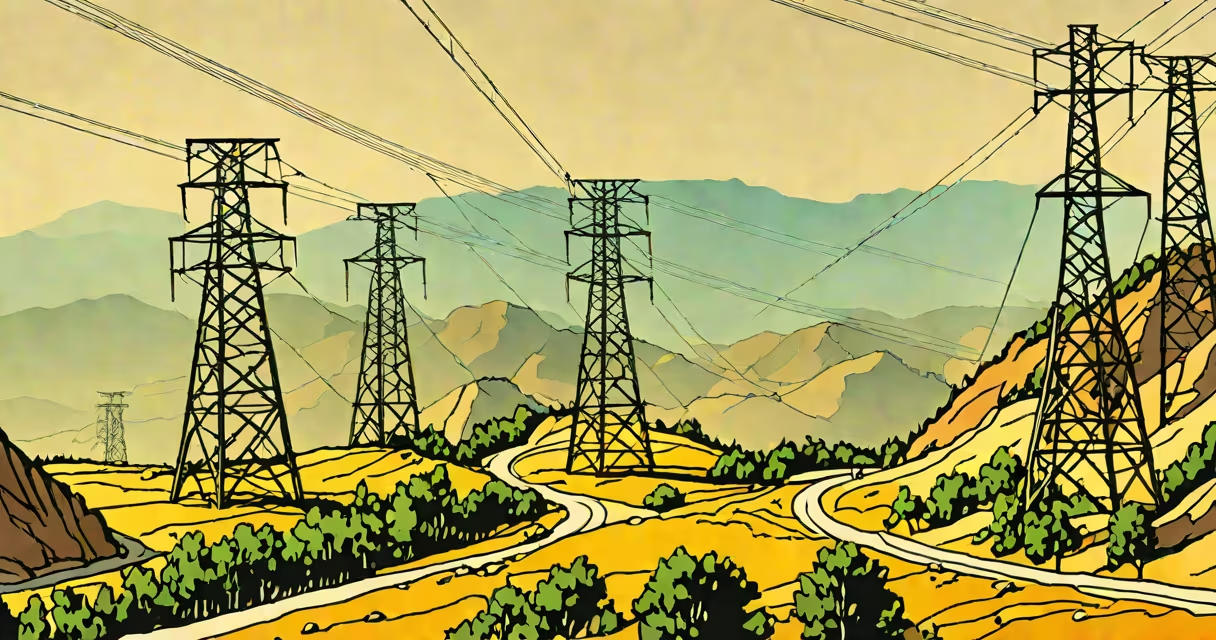
High voltage DC (HVDC) is a method of transmitting electrical power over long distances using direct current at voltages typically above ±100 kV. It enables efficient, stable transfer of large amounts of electricity between regions, especially across undersea cables or over vast land areas.
HVDC systems convert alternating current (AC) from power plants into direct current for transmission, then convert it back to AC at the receiving end. This process reduces energy losses compared to traditional AC lines, particularly over distances exceeding 500 km. The technology is essential for integrating remote renewable energy sources into national grids.
The core components of an HVDC system include converters (using thyristors or IGBTs), transformers, filters, and control systems. These components manage voltage levels, suppress harmonics, and maintain grid stability during load changes or faults. Modern systems operate at voltages up to ±800 kV, allowing transmission of hundreds of megawatts across continents.
Electricity flows in one direction in DC circuits, unlike AC, which alternates direction 50-60 times per second. This unidirectional flow eliminates reactive power losses and skin effect, where current concentrates near the surface of conductors in AC systems. As a result, HVDC lines carry more power per conductor and require fewer conductors.
At the sending end, a converter station transforms AC from a power plant into high-voltage DC. This conversion uses pulse-width modulation (PWM) with semiconductor switches like insulated-gate bipolar transistors (IGBTs). The DC travels through overhead lines or submarine cables to the receiving station, where another converter reverses the process and feeds AC into the local grid.
A key advantage is that HVDC links can connect asynchronous grids-two AC systems operating at different frequencies or phases. For example, France and Germany use an HVDC interconnector to exchange power despite differing grid standards. This capability prevents cascading failures and improves regional resilience.
There are two primary types of HVDC systems: line-commutated converters (LCC) and voltage-source converters (VSC).
| Type | Technology | Use Case | Efficiency |
|---|---|---|---|
| LCC-HVDC | Thyristor-based, requires strong AC grid | Long-distance bulk power transmission (>500 km) | ~98% |
| VSC-HVDC | IGBT-based, autonomous control | Offshore wind farms, weak grids, urban interconnects | ~99% |
LCC systems dominate older projects due to lower component costs and proven reliability. However, they require a strong AC network to commutate (switch off) the current, limiting their use in isolated or weak grids. VSC systems offer greater flexibility-they can control both active and reactive power independently and start up without external grid support.
One notable example is the NordLink cable, a 1,400 MW VSC-HVDC link between Norway and Germany. It connects hydropower-rich Norway with Germany's growing solar and wind capacity. During periods of low wind in Germany, excess hydroelectric power flows from Norway, balancing supply and demand across borders.
Many assume HVDC is only for long-distance transmission. While that's true, it's equally important for short-distance applications where grid stability matters. For instance, VSC-HVDC links stabilize microgrids in island communities, such as the 200 MW system connecting the Faroe Islands to Denmark.
Another myth is that HVDC is inherently safer. In reality, the risks are different. HVDC arcs are harder to extinguish than AC arcs because DC lacks natural zero-crossings. A fault can sustain until manually interrupted. Safety protocols require rapid circuit breakers and specialized grounding systems to prevent equipment damage and injury.
Some confuse HVDC with high-voltage AC (HVAC). HVAC remains dominant for local distribution due to mature transformer technology and ease of voltage transformation. But for distances beyond 500 km, HVDC becomes more economical. A 2023 study by the IEEE confirmed that for 1,000 km transmission, HVDC reduces line losses by 30% compared to HVAC at equivalent power levels.
Consider the Pacific Intertie, a 500-kilovolt HVDC line linking the Pacific Northwest to Southern California. Built in the 1970s, it transmits around 3,000 MW from hydroelectric plants in Oregon and Washington to energy-hungry cities in California.
Without HVDC, this power would have required multiple AC substations and higher losses. Instead, the system uses LCC converters at Sylmar, California, and Alder, Oregon. The line operates at ±500 kV, reducing resistive losses to about 1.5% per 1,000 km-far below the 3-5% typical for HVAC over similar distances.
I once visited the Sylmar converter station during a maintenance window. The sheer size of the valve halls-each housing thousands of thyristor stacks-was striking. The cooling system alone used 15,000 gallons of deionized water per minute. Even with this complexity, the system runs continuously, delivering clean power to millions.
As global energy systems shift toward renewables, HVDC plays a critical role in enabling cross-border and cross-continent power sharing. The European Union plans to install 15 GW of new HVDC capacity by 2030 to integrate offshore wind from the North Sea into southern markets.
HVDC supports grid decarbonization. A 2022 report from the National Renewable Energy Laboratory (NREL) found that HVDC-enabled transmission increases renewable energy utilization by 18% in interconnected regions by reducing curtailment-the practice of shutting down wind or solar plants when supply exceeds demand.
While AC remains standard for local distribution, high voltage DC is increasingly the core of long-range, high-capacity power delivery. Its ability to move clean energy efficiently across borders makes it indispensable in the transition to net-zero grids.
Understanding what is high voltage DC reveals not just a technical solution, but a strategic enabler of sustainable energy systems. From offshore wind farms to international interconnectors, this technology underpins modern power networks.