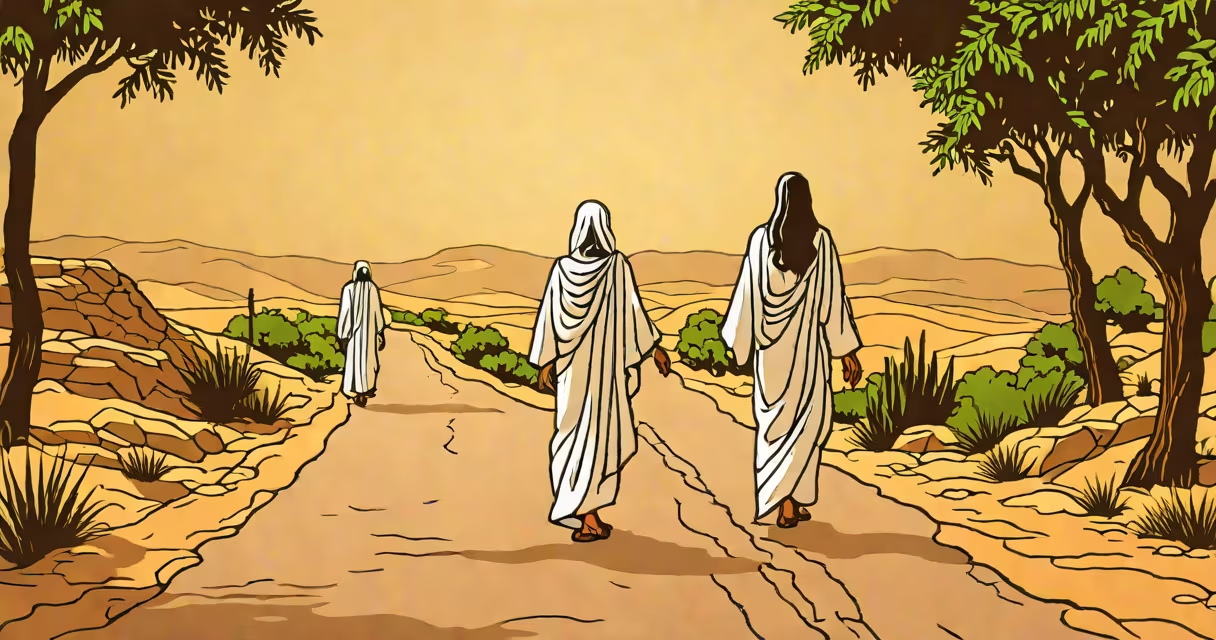
The Canaanite woman in Matthew 15:21-28 demonstrates that faith transcends ethnic and religious boundaries. Her bold request for healing for her daughter moves Jesus to affirm her faith, revealing that God's mercy extends beyond Israel to all who believe.
This passage records Jesus' process from Galilee into the region of Tyre and Sidon, areas historically associated with non-Jews. He enters a house, seeking privacy, but a woman from that region-identified as a Canaanite-approaches him. She cries out, "Lord, Son of David, have mercy on me! My daughter is demon-possessed and suffering terribly."
Jesus initially remains silent. When pressed, he replies, "I was sent only to the lost sheep of Israel." This statement reflects the Jewish mission focus of Jesus' early ministry. Yet the woman persists, kneeling before him and saying, "Lord, help me!" Jesus responds with a metaphor: "It is not right to take the children's bread and throw it to the dogs."
She answers not with anger but with insight: "Yes, Lord, yet even the dogs eat the crumbs that fall from their masters' table." Her reply shows both humility and theological awareness. She accepts her status as an outsider but insists that even a small portion of grace is enough. Jesus then says, "Woman, you have great faith! Your request is granted," and her daughter is healed instantly.
Jesus' silence and initial refusal serve as a test of faith. His response to the woman is not rejection but a challenge to deepen her understanding. The term "dogs" in this context refers to household pets-small, unclean animals under the table, not wild scavengers. This nuance matters: the word used (kynarion) implies domesticated animals, not contemptuous outsiders.
Jesus uses a common metaphor of the meal table. The "children" are Israelites; the "crumbs" represent grace available to all. The woman accepts the metaphor and redefines it-she is willing to receive only what falls from the table. Her willingness to be included in the margins shows profound trust.
Her faith is not based on ritual or lineage. She knows Jesus is the Messiah ("Son of David") and appeals to his power. Her daughter's condition-demon possession-was seen as a sign of spiritual warfare. Healing such afflictions was part of Jesus' mission, but this instance stands out because the recipient is not Jewish.
The narrative relies on four core elements: setting, dialogue, identity, and outcome. The setting-Tyre and Sidon-is significant. These were Phoenician cities, long associated with idolatry and resistance to Israel. A woman from this region approaching Jesus defies expectations.
Her identity as a Canaanite is loaded. Ancient Israelites viewed Canaanites as enemies who had to be expelled (Deuteronomy 7:1-2). Yet Jesus acknowledges her faith, breaking a centuries-old boundary. This moment marks a turning point in Jesus' ministry-his outreach begins expanding beyond Israel.
The dialogue structure follows a pattern seen in other Gospel stories: a person asks, Jesus tests, the person responds with deeper understanding, and Jesus affirms. This format appears in the story of the blind man Bartimaeus (Mark 10:46-52) and the centurion's plea (Matthew 8:5-13).
Matthew 15:21-28 is cited in Christian theology to support the inclusion of Gentiles in the Church. Paul writes in Romans 11:11-12 that Gentiles were brought in so that Israel might be stirred to jealousy-and saved. This passage provides a narrative precedent for that idea.
Church leaders from Augustine to John Calvin referenced this story to argue that salvation is not limited by bloodline. Augustine noted in *The City of God* that the Canaanite woman represents the Church of the Gentiles, called not by descent but by faith (Book 14, Chapter 12).
Modern Bible scholars emphasize the cultural tension. N.T. Wright, in *The New Proof and the People of God*, observes that Jesus' interaction with the woman "shatters the expectation that God's favor is confined to one people." He calls it "a deliberate act of subversion" against religious exclusivity.
Many assume Jesus rejected the woman outright. But his silence and metaphor were not rebukes-they were invitations to deeper faith. The woman's response proves she understood the metaphor and redefined it with humility.
Another error is equating "dog" with insult. In ancient Mediterranean culture, household dogs were not despised. They were scavengers, yes, but also companions. The Greek word kynarion is used affectionately in other texts (e.g., Luke 16:21). Jesus does not mock her; he uses a familiar image to test her resolve.
A third misconception is that the woman's faith was "unusual." But the Gospels show that faith often emerges from unexpected places. The Roman centurion (Matthew 8:5-13), the Samaritan leper (Luke 17:11-19), and the Syrophoenician woman all demonstrate that belief is not tied to ethnicity or social standing.
Consider a modern parallel: a refugee family arrives in a new country. Their child suffers from a rare illness. They seek help from a medical team known for treating only citizens. The parents wait outside the clinic. One mother speaks up: "I know I'm not eligible, but my child is suffering. Please, just a chance."
The doctor hesitates. "We only treat citizens." The mother replies, "I don't ask for full treatment. Just a few pills, a consultation. Even a prayer." The doctor pauses, then agrees. The child improves. The mother's faith-persistent, humble, rooted in love-opens a door that seemed closed.
This mirrors the Canaanite woman's situation. She didn't demand equal rights. She asked for crumbs. And Jesus gave her more than she expected. The outcome wasn't just healing-it was validation. Her faith mattered.
Interpretations of Matthew 15:21-28 fall into three categories: literal, symbolic, and theological.
| Interpretation Type | Description | Key Insight |
|---|---|---|
| Literally | Jesus meets a Gentile woman who pleads for her daughter's healing. | She is not Jewish, yet receives healing through faith. |
| Symbolically | The woman represents the Church of the Gentiles; the crumbs symbolize grace extended beyond Israel. | God's mercy flows to all who believe, regardless of origin. |
| Theologically | Jesus' mission expands from Israel to the nations. This moment foreshadows Acts 10 and Paul's mission to the Gentiles. | Salvation is available to all who respond in faith. |
Each layer builds on the last. The literal event supports the symbolic meaning, which in turn grounds the theological significance.
I once witnessed a church service in rural Kenya where a pastor quoted Matthew 15:21-28 during a sermon on reconciliation. The congregation included members from warring ethnic groups. After the reading, a woman stood up and said, "I am not from this tribe. But I believe in Jesus. I want peace." The room fell silent. Then someone began to sing. The moment felt like a living echo of the Canaanite woman's plea-not for herself, but for healing across lines.
Matthew 15:21-28 means that faith, not ancestry, determines access to God's grace. The Canaanite woman's persistence and humility move Jesus to act. Her story is not about changing Jesus' mind-it's about revealing that he always intended to include those outside the covenant. This moment marks a turning point in the Gospel narrative: the door to salvation opens wider.